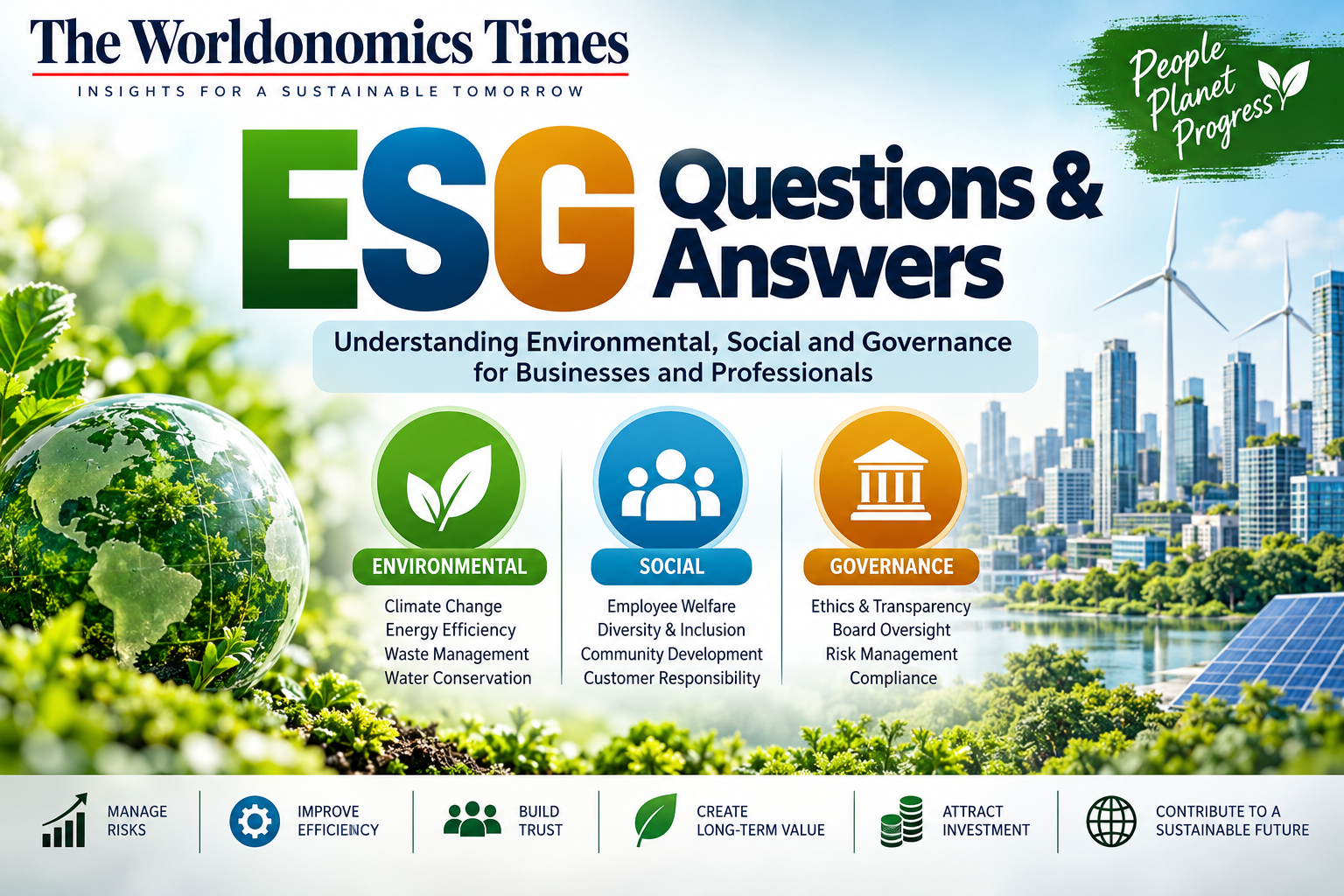
Understanding Environmental, Social and Governance for Businesses and Professionals
Q1. What is ESG?
Answer: ESG stands for Environmental, Social and Governance. It is a framework used to evaluate how an organisation manages its environmental impact, social responsibilities and corporate governance practices. ESG has become an important consideration for companies, investors, regulators, customers and other stakeholders.
Q2. What are the three pillars of ESG?
Answer: ESG has three major pillars:
- Environmental: Climate change, carbon emissions, energy consumption, waste management, water conservation, pollution and biodiversity.
- Social: Employee welfare, diversity and inclusion, human rights, health and safety, community development and customer responsibility.
- Governance: Board structure, ethics, transparency, anti-corruption measures, risk management, compliance and shareholder rights.
Q3. Why is ESG important for businesses?
Answer: ESG can help businesses manage risks, improve operational efficiency, strengthen stakeholder confidence and build long-term value. Strong ESG practices can also improve access to capital, enhance reputation and help companies respond to changing regulatory and market expectations.
Q4. Is ESG applicable only to large companies?
Answer: No. Although ESG reporting requirements are particularly relevant to larger listed companies and certain regulated entities, ESG principles are increasingly relevant to MSMEs, startups and unlisted businesses as well. Smaller businesses can use ESG practices to reduce costs, improve resource efficiency and become more attractive to customers and larger supply-chain partners.
Q5. What is the difference between ESG and CSR?
Answer: CSR, or Corporate Social Responsibility, generally focuses on an organisation’s social and community responsibilities. ESG is broader and includes environmental, social and governance factors. ESG also places significant emphasis on measurable performance, risk management, disclosures and long-term business value.
Q6. What does the Environmental component of ESG cover?
Answer: It may include greenhouse-gas emissions, energy efficiency, renewable energy adoption, water consumption, waste management, recycling, pollution control, climate-risk management and biodiversity. Companies increasingly measure their environmental footprint to identify risks and opportunities.
Q7. What does the Social component of ESG include?
Answer: The Social component covers areas such as employee health and safety, labour practices, human rights, diversity and inclusion, employee development, customer welfare, data privacy and community impact.
Q8. What does Governance mean in ESG?
Answer: Governance refers to the systems and processes through which an organisation is directed and controlled. It includes board oversight, ethical conduct, transparency, internal controls, audit practices, risk management, anti-bribery policies and regulatory compliance.
Q9. What is ESG reporting?
Answer: ESG reporting is the process of communicating an organisation’s environmental, social and governance performance to stakeholders. It may include quantitative data, policies, targets, achievements, risks and improvement initiatives.
Q10. What is BRSR?
Answer: BRSR stands for Business Responsibility and Sustainability Report. It is a reporting framework introduced in India for specified listed entities to disclose information relating to business responsibility and sustainability. BRSR has strengthened the focus on standardised sustainability-related disclosures in India’s corporate sector.
Q11. Is BRSR the same as ESG reporting?
Answer: Not exactly. BRSR is a specific Indian reporting framework, while ESG reporting is a broader concept covering environmental, social and governance disclosures. BRSR can therefore be considered an important component of the wider ESG reporting landscape in India.
Q12. What are Scope 1, Scope 2 and Scope 3 emissions?
Answer:
- Scope 1: Direct emissions from sources owned or controlled by the organisation.
- Scope 2: Indirect emissions associated with purchased electricity, steam, heating or cooling.
- Scope 3: Other indirect emissions occurring across the organisation’s value chain, such as purchased goods, transportation, business travel and use of sold products.
Q13. Why are Scope 3 emissions important?
Answer: Scope 3 emissions can represent a significant portion of a company’s overall carbon footprint. They help organisations understand environmental impacts throughout their supply chain and customer ecosystem rather than focusing only on emissions generated within their own operations.
Q14. How can MSMEs start implementing ESG?
Answer: MSMEs can begin with practical measures such as reducing electricity and water consumption, managing waste, improving workplace safety, maintaining ethical business practices, ensuring statutory compliance and establishing transparent accounting and governance systems. ESG implementation does not always require a large investment.
Q15. Can ESG reduce business costs?
Answer: Yes. Energy efficiency, waste reduction, water conservation, process optimisation and responsible procurement can reduce operating costs. ESG initiatives can therefore create both sustainability benefits and economic value when implemented effectively.
Q16. How does ESG affect investors?
Answer: Investors increasingly consider ESG-related risks and opportunities when evaluating companies. ESG information can help investors understand issues such as climate exposure, governance quality, workforce practices and potential long-term risks.
Q17. What is greenwashing?
Answer: Greenwashing occurs when an organisation gives a misleading or exaggerated impression about its environmental or sustainability performance. Companies should therefore support ESG claims with reliable data, transparent methodologies and appropriate disclosures.
Q18. What is ESG due diligence?
Answer: ESG due diligence involves assessing environmental, social and governance risks before making a business or investment decision. It may cover regulatory compliance, environmental liabilities, labour practices, governance systems, supply-chain risks and reputational issues.
Q19. How can finance professionals contribute to ESG?
Answer: Finance professionals can play a major role in ESG by integrating sustainability-related information into budgeting, risk management, internal controls, performance measurement and reporting. They can also help verify data, assess financial implications and connect ESG performance with business strategy.
Q20. What role does the Board of Directors play in ESG?
Answer: The Board provides oversight and ensures that ESG considerations are integrated into corporate strategy, risk management and governance. It should establish appropriate policies, monitor performance and ensure that material ESG risks are properly addressed.
Q21. Is ESG only about environmental protection?
Answer: No. Environmental issues are only one part of ESG. ESG equally considers people and governance. A company with strong environmental performance but poor labour practices, weak internal controls or governance failures may still face significant ESG risks.
Q22. How does ESG affect supply chains?
Answer: Large companies increasingly assess suppliers on environmental performance, labour practices, ethical conduct and compliance. MSMEs that adopt responsible business practices may therefore improve their ability to participate in domestic and global supply chains.
Q23. What are ESG risks?
Answer: ESG risks are potential financial, operational, regulatory or reputational risks arising from environmental, social or governance issues. Examples include climate-related disruptions, workplace accidents, regulatory violations, corruption, supply-chain failures and data-privacy problems.
Q24. What are ESG opportunities?
Answer: ESG can create opportunities through renewable energy, energy efficiency, sustainable products, responsible supply chains, green finance, innovation and improved employee productivity. Companies that identify these opportunities early can potentially develop new revenue streams and competitive advantages.
Q25. How can a company measure its ESG performance?
Answer: Companies can establish measurable KPIs such as energy consumption, emissions, water usage, waste recycled, workplace accidents, employee turnover, diversity indicators, training hours, compliance incidents and board-related governance indicators. The KPIs should be relevant to the company’s industry and material risks.
Q26. What is materiality in ESG?
Answer: Materiality refers to identifying ESG issues that are significant enough to influence an organisation’s performance, stakeholders or decision-making. Companies should focus their ESG efforts on issues that are most relevant to their business and stakeholders.
Q27. What is double materiality?
Answer: Double materiality considers two perspectives: how sustainability issues can affect the company and how the company’s activities can affect people and the environment. It therefore provides a broader view of sustainability impacts and financial risks.
Q28. Can ESG improve a company’s reputation?
Answer: Yes, credible ESG practices can strengthen trust among customers, employees, investors, regulators and business partners. However, reputation benefits depend on genuine performance and transparent reporting rather than simply making sustainability claims.
Q29. What are common ESG challenges faced by companies?
Answer: Common challenges include lack of reliable data, unclear responsibilities, limited expertise, inconsistent measurement methodologies, supply-chain information gaps, cost considerations and difficulty integrating ESG into core business strategy.
Q30. What should companies do first when starting their ESG journey?
Answer: Companies should begin by identifying their material ESG issues, assessing their current performance, establishing responsibilities, collecting reliable data and setting realistic targets. ESG should be treated as a business and risk-management issue, not merely as a reporting exercise.
Key Takeaway
ESG is increasingly becoming an important part of modern business strategy. Organisations that integrate environmental responsibility, social well-being and strong governance into their decision-making can strengthen resilience, manage risks and create sustainable long-term value.
For professionals, finance teams and business leaders, understanding ESG is no longer limited to sustainability departments—it is becoming an important part of finance, compliance, risk management, investment and corporate strategy.