Introduction
India’s Micro, Small and Medium Enterprises (MSMEs) are vital contributors to employment generation, manufacturing, exports and inclusive economic growth. However, access to reliable markets and institutional buyers remains a major challenge for many small businesses. To address this, the Government of India has introduced policy measures and support programmes that help MSMEs participate in public procurement, improve marketing capabilities and expand their business opportunities.
Two important initiatives in this area are the Public Procurement Policy for Micro and Small Enterprises (MSEs) and the Procurement and Marketing Support (PMS) Scheme of the Ministry of MSME. Together, they aim to create a more supportive business environment for smaller enterprises.
1. Understanding the Public Procurement Policy
The Public Procurement Policy for Micro and Small Enterprises was notified by the Ministry of MSME under Section 11 of the Micro, Small and Medium Enterprises Development Act, 2006. It came into effect on 1 April 2012 and became mandatory for relevant central government procuring entities from 1 April 2015.
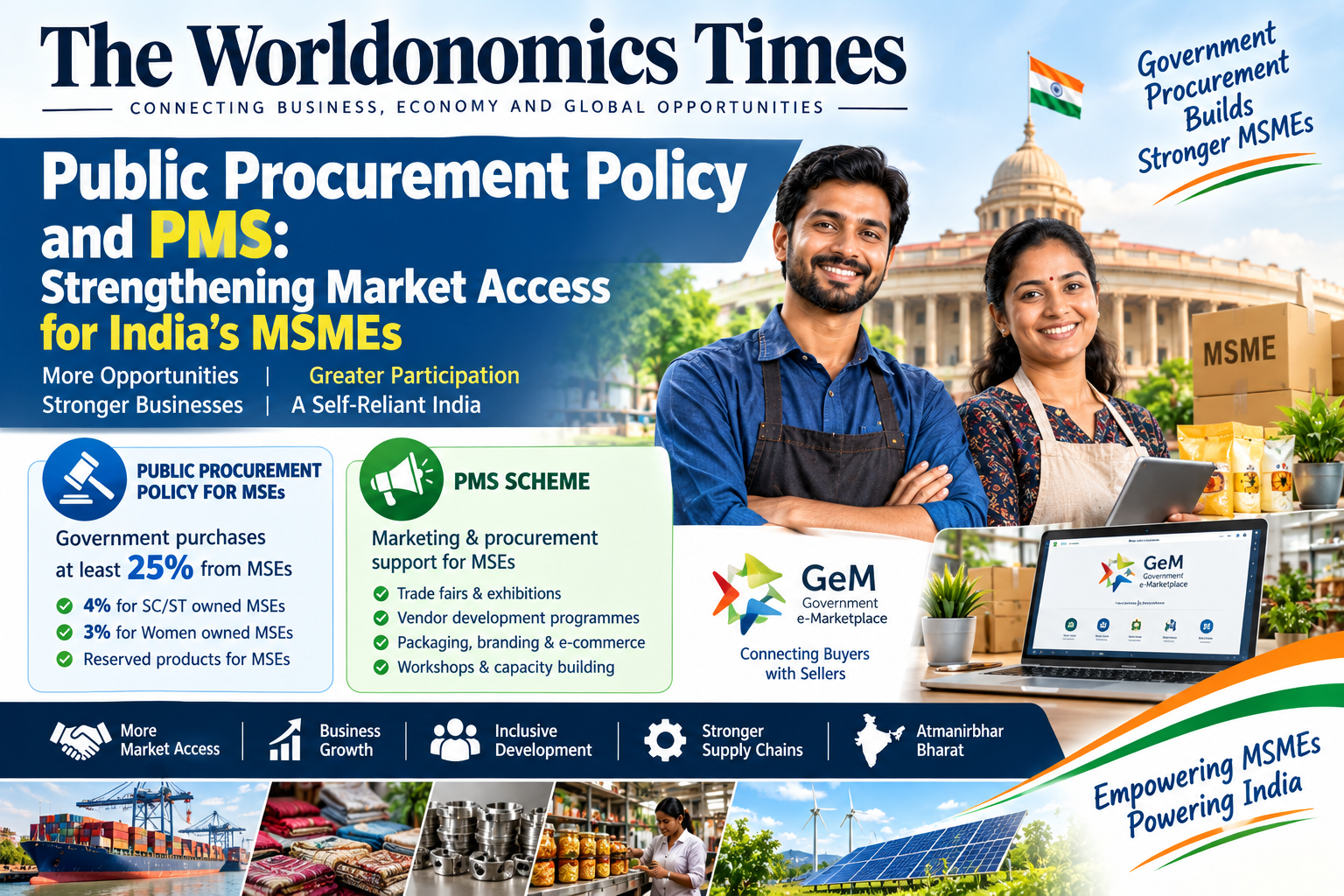
The policy requires Central Government Ministries, Departments and Central Public Sector Enterprises (CPSEs) to procure at least 25% of their annual procurement from Micro and Small Enterprises.
The policy also provides targeted opportunities within this procurement commitment:
- 4% of annual procurement is earmarked for MSEs owned by Scheduled Caste and Scheduled Tribe entrepreneurs.
- 3% is earmarked for MSEs owned by women entrepreneurs.
- Certain identified products are reserved for exclusive procurement from MSEs.
These provisions are intended to encourage wider participation, support entrepreneurship among disadvantaged groups and create a more inclusive procurement ecosystem.
2. Benefits for Micro and Small Enterprises
The policy offers several important advantages to eligible MSEs participating in government tenders.
Tender document fee exemption: Eligible MSEs receive exemption from payment of tender document fees.
Earnest Money Deposit exemption: Eligible MSEs are exempt from paying Earnest Money Deposit (EMD), helping reduce the initial financial burden of participating in tenders.
Price preference: Under the applicable purchase preference mechanism, eligible MSEs quoting within the prescribed L1+15% price band may be allowed to match the L1 price and receive a portion of the order, subject to the policy conditions.
Opportunities in reserved products: Identified products reserved for exclusive procurement from MSEs provide an additional market opportunity.
These provisions can help smaller enterprises compete for institutional orders without facing the same entry barriers as larger businesses. However, enterprises must satisfy the applicable eligibility, technical and quality requirements.
3. What Is the Procurement and Marketing Support (PMS) Scheme?
The Procurement and Marketing Support Scheme is another important initiative of the Ministry of MSME. Its objective is to improve the marketability of products and services offered by MSEs and help them explore new domestic and international markets.
Many small enterprises have quality products but lack the financial resources, marketing expertise, packaging knowledge and business networks needed to reach larger customers. PMS addresses these challenges through market access initiatives and capacity-building activities.
The scheme supports participation in trade fairs, exhibitions and MSME expos, while also promoting awareness of modern marketing practices and digital business opportunities.
4. Major Components of the PMS Scheme
The PMS Scheme focuses on three broad areas:
A. Market Access Initiatives
- Participation of individual MSEs in domestic and international trade fairs and exhibitions.
- Organisation of trade fairs, exhibitions and MSME expos.
- Vendor Development Programmes to connect MSEs with large buyers, government departments and public sector organisations.
B. Capacity Building
- Adoption of modern packaging techniques.
- Adoption of barcodes.
- Adoption of e-commerce platforms.
- Workshops and seminars on marketing, trade, packaging, export procedures and the Government e-Marketplace (GeM).
C. Development of Retail Outlets
The scheme also supports infrastructure development of retail outlets for promoting products with Geographical Indication (GI) recognition.
Manufacturing and service-sector MSEs with valid Udyam Registration can explore the scheme’s applicable benefits, subject to its guidelines and eligibility conditions.
5. Role of GeM in MSME Growth
The Government e-Marketplace (GeM) has become an important digital platform for government procurement. It provides an online marketplace through which eligible businesses can offer products and services to government buyers.
For MSMEs, GeM creates an opportunity to reach government departments and public sector organisations beyond their immediate geographical markets. It can improve product visibility, simplify procurement interactions and encourage transparent competition.
MSMEs should maintain accurate business profiles, upload clear product information, provide competitive quotations and ensure timely delivery. Proper documentation and quality standards are essential for building credibility with institutional buyers.
6. How MSMEs Can Benefit
To make effective use of these initiatives, enterprises should take a planned approach:
- Obtain and maintain valid Udyam Registration.
- Identify government departments and CPSEs that procure their products or services.
- Register on GeM wherever relevant.
- Monitor tender notifications and understand eligibility requirements.
- Participate in vendor development programmes and trade exhibitions.
- Improve packaging, branding, product quality and digital marketing.
- Maintain financial, technical and compliance documents in an organised manner.
Businesses should consult the official Ministry of MSME and Development Commissioner (MSME) portals for current guidelines, application procedures and event notifications.
7. Challenges and the Way Forward
Despite these initiatives, many MSEs continue to face challenges such as delayed payments, limited awareness, difficulty meeting technical specifications, inadequate production capacity and intense competition.
Greater awareness campaigns, simpler tender procedures, timely payments, stronger vendor development programmes and wider digital adoption can improve the effectiveness of these policies.
Large buyers can also contribute by engaging with smaller suppliers, providing clearer procurement information and encouraging capable MSEs to become part of their supply chains.
Conclusion: Building a Stronger MSME Ecosystem
The Public Procurement Policy and Procurement and Marketing Support Scheme represent important steps towards strengthening India’s small-business ecosystem. While the procurement policy creates institutional demand and purchase opportunities, the PMS Scheme helps enterprises improve their marketing capabilities and reach new customers.
For MSMEs, these initiatives are more than government support programmes; they are pathways towards sustainable business expansion, innovation and competitiveness. With greater awareness, digital readiness and effective implementation, India’s MSMEs can become stronger participants in national supply chains and contribute significantly to the vision of a self-reliant and globally competitive India.