
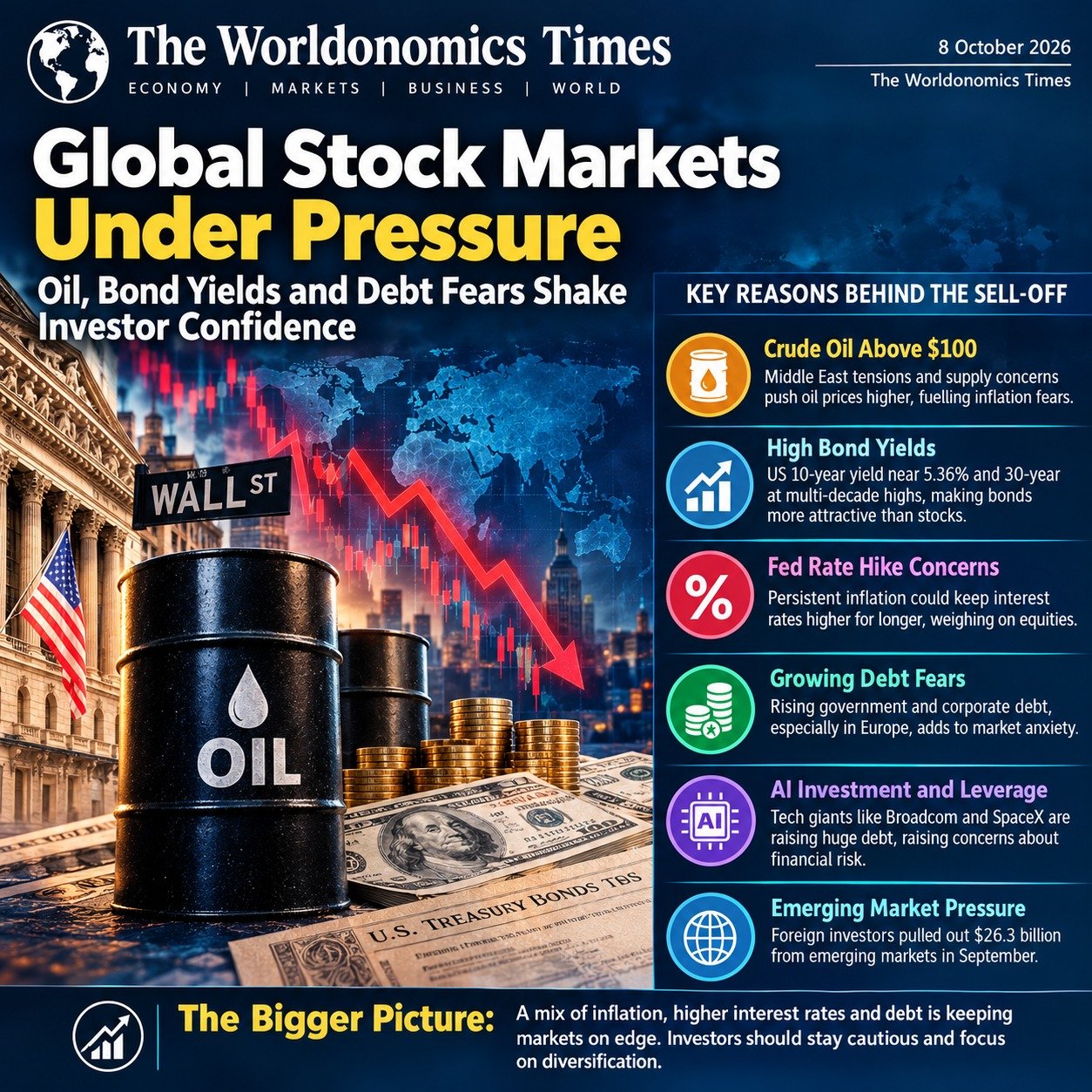
Global Stock Markets Under Pressure: Oil, Bond Yields and Debt Fears Shake Investor Confidence
Global financial markets are facing renewed pressure today as investors turn cautious amid a combination of rising crude oil prices, elevated government bond yields, inflation concerns and growing worries over global debt. After major US indices recently touched record highs, markets have begun to retreat as investors reassess the outlook for interest rates and economic growth.
The weakness is being reflected across Wall Street, Asia and European markets, with investors increasingly moving towards defensive assets and reducing exposure to riskier investments.
Wall Street Retreats From Record Highs
US stocks ended lower in the latest session after the S&P 500 and Nasdaq had reached record closing levels. The Dow Jones Industrial Average fell around 0.9%, the S&P 500 declined about 0.6%, while the Nasdaq Composite lost roughly 0.9%. The small-cap Russell 2000 performed even worse, falling about 1.3%.
The decline was significant because it came immediately after a strong rally. Investors who had benefited from the recent gains appear to have started booking profits, particularly as new risks emerged in the bond and commodity markets.
Oil Crosses the $100 Mark
One of the biggest concerns for global investors is crude oil. Brent crude moved above the psychologically important $100 per barrel level and briefly reached around $102. The increase is linked to continuing geopolitical tensions and concerns about disruption to oil supplies and shipping routes in the Middle East. The possibility of prolonged disruption has forced investors to reconsider the inflation outlook. Higher oil prices can have a broad economic impact. Energy becomes more expensive for consumers and businesses, transportation costs increase and companies may face pressure on profit margins. More importantly, expensive oil can make it harder for central banks to control inflation.
Bond Yields Become the New Market Problem
The second major factor behind the market weakness is the sharp rise in government bond yields.
The US 30-year Treasury yield touched a level not seen in approximately 24 years, while the 10-year Treasury yield moved close to its highest level since 2002. Rising yields indicate that investors are demanding greater returns to hold long-term government debt.
This creates a problem for equities.
When government bonds offer higher yields, investors have a more attractive alternative to stocks. At the same time, higher interest rates increase borrowing costs for companies and consumers.
The result can be lower corporate investment, weaker housing activity and pressure on stock valuations.