New Delhi | 23 October 2026
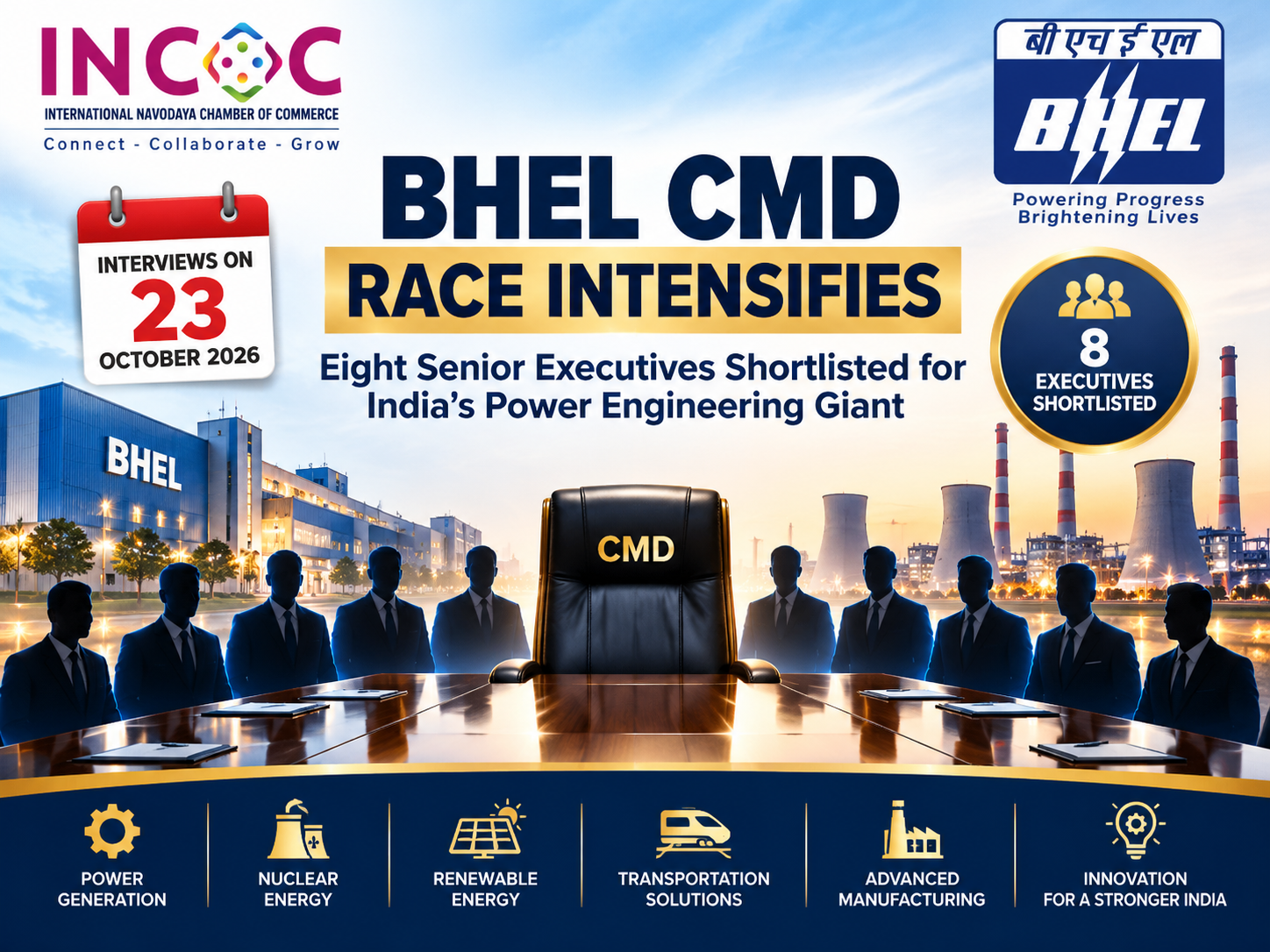
The race for the top leadership position at Bharat Heavy Electricals Limited (BHEL) has entered a decisive stage, with eight senior executives shortlisted for interviews for the post of Chairman and Managing Director (CMD). The interviews are scheduled for 23 October 2026, setting the stage for an important leadership transition at one of India’s largest public-sector engineering enterprises.
The selection process assumes importance as the current BHEL CMD, K. Sadashiv Murthy, is scheduled to retire on 28 February 2027 on attaining the age of superannuation. The next CMD will inherit the responsibility of steering BHEL through a period of major opportunities in power generation, nuclear energy, transportation, manufacturing and infrastructure.
Eight Executives in the Race
The shortlist represents a balanced contest between four senior BHEL executives and four candidates from other public-sector enterprises.
The four internal candidates are Nishit Babyloni, Executive Director, Transportation Business & Systems Group and Project Director for the Vande Bharat project; Ramesh Kumar N, Executive Director, Solar Business Division, who is also holding additional charge as CMD of HMT Limited; Vinod Jacob Sam, Executive Director, Power Sector–Southern Region; and Yatindra Mohan, Executive Director and Head of Nuclear Business at BHEL.
The external candidates include Daryaw Londhe, Executive Director (Technical) at Rural Electrification Corporation; Shivendra Nath, CMD of Engineering Projects (India) Limited; Chetan Prakash Jain, CMD of Central Electronics Limited; and Anish Sengupta, Executive Director at Steel Authority of India Limited.
The diverse shortlist brings together experience in power, transportation, solar, nuclear, engineering, infrastructure, renewable energy and public-sector management.
A Crucial Leadership Choice
The appointment of BHEL’s next CMD comes at an important moment for the company and India’s energy ecosystem.
BHEL remains a major participant in India’s power-generation equipment and heavy-engineering landscape. The company is also expanding its capabilities across emerging areas, including nuclear power, renewable energy, transportation and advanced manufacturing.
The incoming CMD will therefore face the challenge of maintaining momentum across traditional businesses while preparing the company for the next generation of industrial opportunities.
The leadership choice will also determine how effectively BHEL can convert its large order pipeline into timely project execution, manufacturing output and sustainable financial performance.
Internal Leadership vs External Experience
One of the most interesting aspects of the current selection process is the four-versus-four composition of the shortlist.
The internal candidates bring extensive knowledge of BHEL’s technology, workforce, manufacturing facilities and business processes. Their familiarity with the company’s organisational structure could help ensure continuity and accelerate decision-making.
The external candidates, meanwhile, bring experience from other major public-sector organisations. Their exposure to different business models, institutional cultures and operational challenges could introduce new perspectives into BHEL’s leadership.
The final selection will therefore be closely watched by India’s PSU and infrastructure community.
BHEL at an Important Business Inflection Point
The leadership transition comes as BHEL’s business outlook has been improving.
Recent market reports indicate that BHEL reported Q2 FY2026-27 standalone revenue of about ₹9,300 crore and profit after tax of ₹810 crore, while its outstanding order book stood at approximately ₹2.58 lakh crore as of 30 September 2026. The company has also approved capital expenditure of around ₹500 crore for additional thermal and nuclear manufacturing facilities at its Haridwar plant.
These developments highlight the scale of the opportunity awaiting the next CMD.
A large order book provides visibility, but execution will remain critical. The new leadership will need to focus on project timelines, manufacturing efficiency, supply-chain management, technology adoption and profitability.
Nuclear and Energy Transition
India’s expanding nuclear-energy programme could become another important growth opportunity for BHEL.
The company’s existing capabilities in heavy electrical equipment and engineering provide a foundation for participating in India’s expanding energy infrastructure.
At the same time, renewable energy and grid development are reshaping the power sector. BHEL’s ability to combine its traditional thermal expertise with nuclear, solar, transportation and advanced engineering businesses could determine its competitiveness over the next decade.
The next CMD will consequently need to manage both continuity and transformation.
The Importance of Project Execution
For BHEL, the challenge is not simply winning orders. Converting orders into completed projects efficiently will be central to improving financial performance.
Large engineering projects involve multiple stakeholders, long execution cycles, technology requirements and complex supply chains.
The next CMD will therefore need to maintain close coordination between engineering, manufacturing, procurement, finance, human resources and project execution teams.
Leadership at this scale requires both technical understanding and strong organisational management.
A New Chapter After K. Sadashiv Murthy
K. Sadashiv Murthy’s retirement will mark the end of the current leadership phase at BHEL. The successor will inherit an organisation with substantial institutional capabilities and a significant project pipeline.
The new CMD will also have to build on the company’s recent performance while addressing the challenges of competition, technology disruption and changing energy requirements.
The fact that four BHEL executives have been shortlisted indicates the depth of internal leadership available within the organisation. At the same time, the inclusion of four external candidates demonstrates that the selection process is open to broader public-sector experience.
What the New CMD Must Deliver
The next BHEL CMD will face several strategic priorities:
- Accelerating execution of the company’s large order book.
- Strengthening profitability and operational efficiency.
- Expanding nuclear and renewable-energy capabilities.
- Developing advanced manufacturing and engineering technologies.
- Strengthening transportation and emerging businesses.
- Enhancing productivity and workforce capabilities.
- Increasing competitiveness in domestic and international markets.
The ability to balance these priorities will define the next phase of BHEL’s development.
The Worldonomics Times Perspective
The BHEL CMD selection is more than a routine PSU appointment. It is a leadership decision for a company positioned at the intersection of India’s energy security, industrial manufacturing and infrastructure ambitions.
With eight experienced executives competing for the top position, the 23 October interview process represents an important milestone.
The eventual selection will determine who leads BHEL into its next phase—one that will require strong execution, financial discipline, technological innovation and strategic leadership.
For India’s public-sector ecosystem, the BHEL succession will be closely watched as a test of how experienced PSU leadership can support the country’s rapidly evolving energy and infrastructure