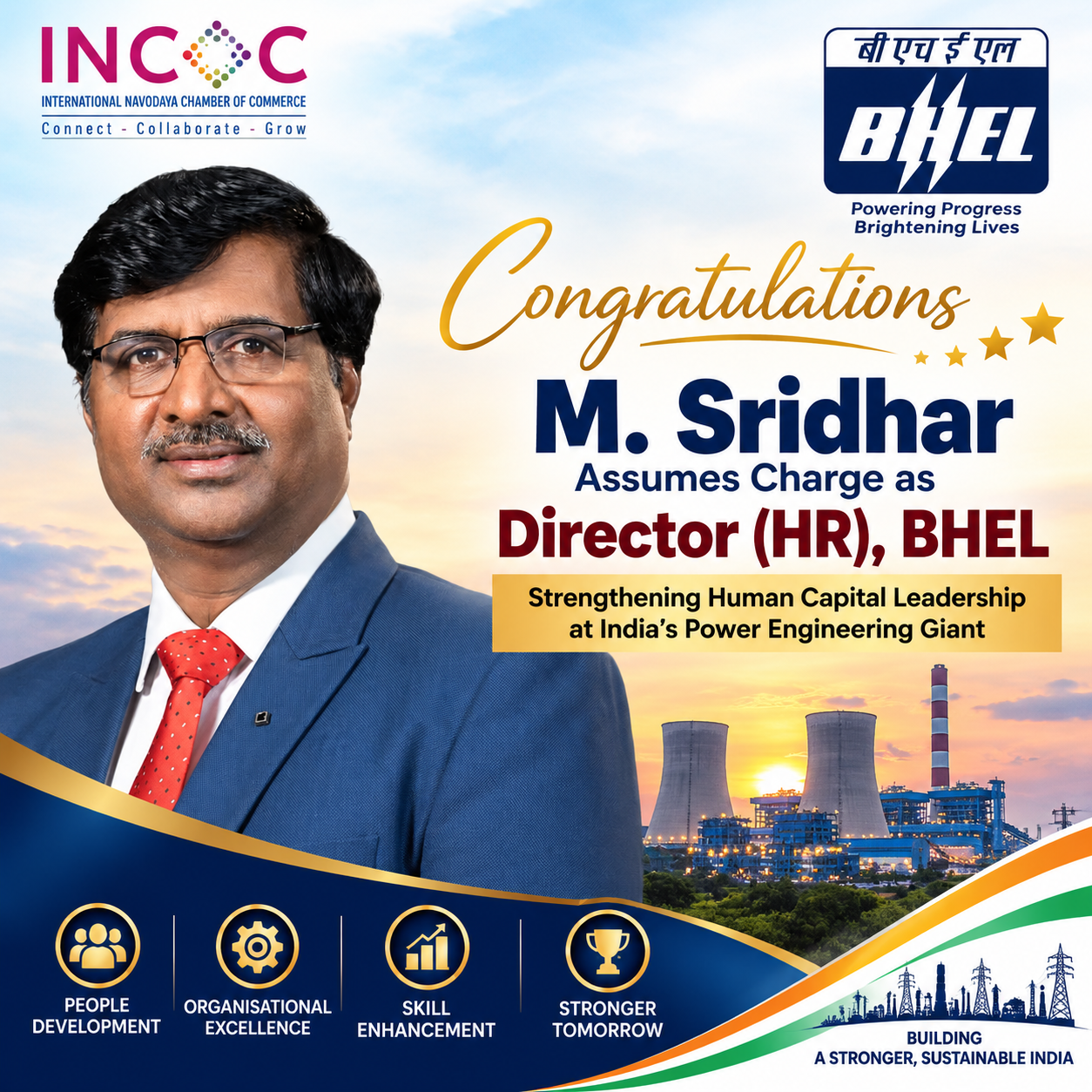
New Delhi | 22 October 2026
In a significant leadership development at one of India’s most important public sector engineering companies, M. Sridhar has assumed charge as Director (Human Resources) on the Board of Bharat Heavy Electricals Limited (BHEL). The appointment marks an important strengthening of BHEL’s senior leadership at a time when the company is navigating technological transformation, major power-sector opportunities, workforce development and changing requirements in India’s infrastructure and energy landscape.
Sridhar has been associated with BHEL for more than three decades and previously served as Executive Director (Human Resources) at the company’s corporate office in New Delhi. BHEL’s official records have listed him in senior human-resource leadership roles, reflecting his extensive experience within the organisation.
From Executive Director to Board-Level Leadership
The appointment represents a natural progression in Sridhar’s long career with BHEL. According to company disclosures, he joined BHEL on 12 February 1990 and has more than three decades of service. His academic qualifications include BE, M.Tech and a postgraduate diploma, providing a combination of technical and management-oriented expertise.
The Public Enterprises Selection Board had earlier recommended Manepalli Sridhar for the post of Director (Human Resources), BHEL, following interviews involving 11 candidates. At the time of the recommendation in July 2026, he was serving as Executive Director (Human Resources) at BHEL.
His assumption of charge now completes an important leadership transition in BHEL’s HR function.
Why the HR Role Matters at BHEL
Human resources at a large engineering enterprise such as BHEL extends far beyond recruitment and employee administration. The organisation operates across power generation, industrial systems, manufacturing, engineering, research and development, and large infrastructure projects.
BHEL employs a highly specialised workforce comprising engineers, technicians, project professionals, managers and other skilled personnel. The HR function therefore has a direct connection with productivity, skills development, industrial relations, leadership succession and organisational transformation.
Sridhar’s experience within BHEL gives him an understanding of the organisation’s workforce, manufacturing ecosystem and institutional culture. His elevation to the Board comes at a time when India’s energy sector is undergoing significant changes, including expansion of renewable energy, continued demand for thermal power, grid modernisation, localisation of manufacturing and increasing emphasis on advanced technologies.
Managing the Workforce of a Changing BHEL
One of the biggest responsibilities before the new Director (HR) will be preparing BHEL’s workforce for the next generation of engineering and manufacturing.
India’s infrastructure ambitions are creating opportunities for companies capable of executing large and technologically complex projects. At the same time, traditional engineering businesses are increasingly being combined with digital technologies, automation, artificial intelligence, advanced manufacturing and data-driven project management.
For BHEL, this creates a dual requirement: retaining its deep engineering expertise while developing new capabilities.
Human-capital strategy can therefore become a key competitive advantage. Training, reskilling, leadership development and succession planning will be essential as BHEL expands into emerging areas and responds to changing customer requirements.
A Leadership Transition at a Critical Time
Sridhar’s appointment also comes during a broader leadership transition at BHEL. The company is preparing for several senior-level changes over the coming months, with important positions scheduled for succession. Industry reports have highlighted upcoming retirements involving the CMD and functional directors, making leadership continuity an important issue for the company.
Against this backdrop, having an experienced internal professional take charge of the HR portfolio could provide institutional continuity.
For a large PSU, continuity is particularly important because organisational transformation cannot be achieved through technology and capital investment alone. It requires people with the skills and leadership capabilities to implement new strategies.
Supporting India’s Energy and Infrastructure Ambitions
BHEL remains strategically important to India’s energy and industrial ecosystem. Its activities are closely linked with power generation, heavy engineering, manufacturing and infrastructure development.
As India seeks to expand domestic manufacturing capabilities and reduce dependence on imported technologies and equipment, engineering PSUs such as BHEL have an important role to play.
The company’s human resources strategy will consequently influence not only internal employee development but also its ability to execute large national projects.
Sridhar’s experience across BHEL’s HR function could help align employee capabilities with the company’s evolving business priorities.
The Road Ahead
As Director (Human Resources), M. Sridhar is expected to play a significant role in strengthening organisational capability, employee engagement, skill development and leadership succession at BHEL.
The challenge will be to combine BHEL’s decades of institutional knowledge with the skills required for a rapidly changing industrial environment.
For India’s public sector enterprises, the next phase of growth will increasingly depend on people, technology and productivity working together. BHEL’s leadership transition therefore carries significance beyond an individual appointment.
M. Sridhar’s elevation from Executive Director (HR) to the Board represents a continuation of that institutional journey and places a seasoned BHEL professional at the centre of the company’s human-capital strategy.
At a time when India is investing heavily in energy security, infrastructure and domestic manufacturing, strong human-resource leadership will be essential to turning engineering capability into sustainable execution.
The Worldonomics Times Perspective:
M. Sridhar’s appointment highlights an increasingly important reality for India’s PSUs: the next phase of public-sector competitiveness will depend not only on capital and technology, but also on the ability to develop, retain and lead skilled human capital.