New Delhi | The Worldonomics Times | 24 October 2026
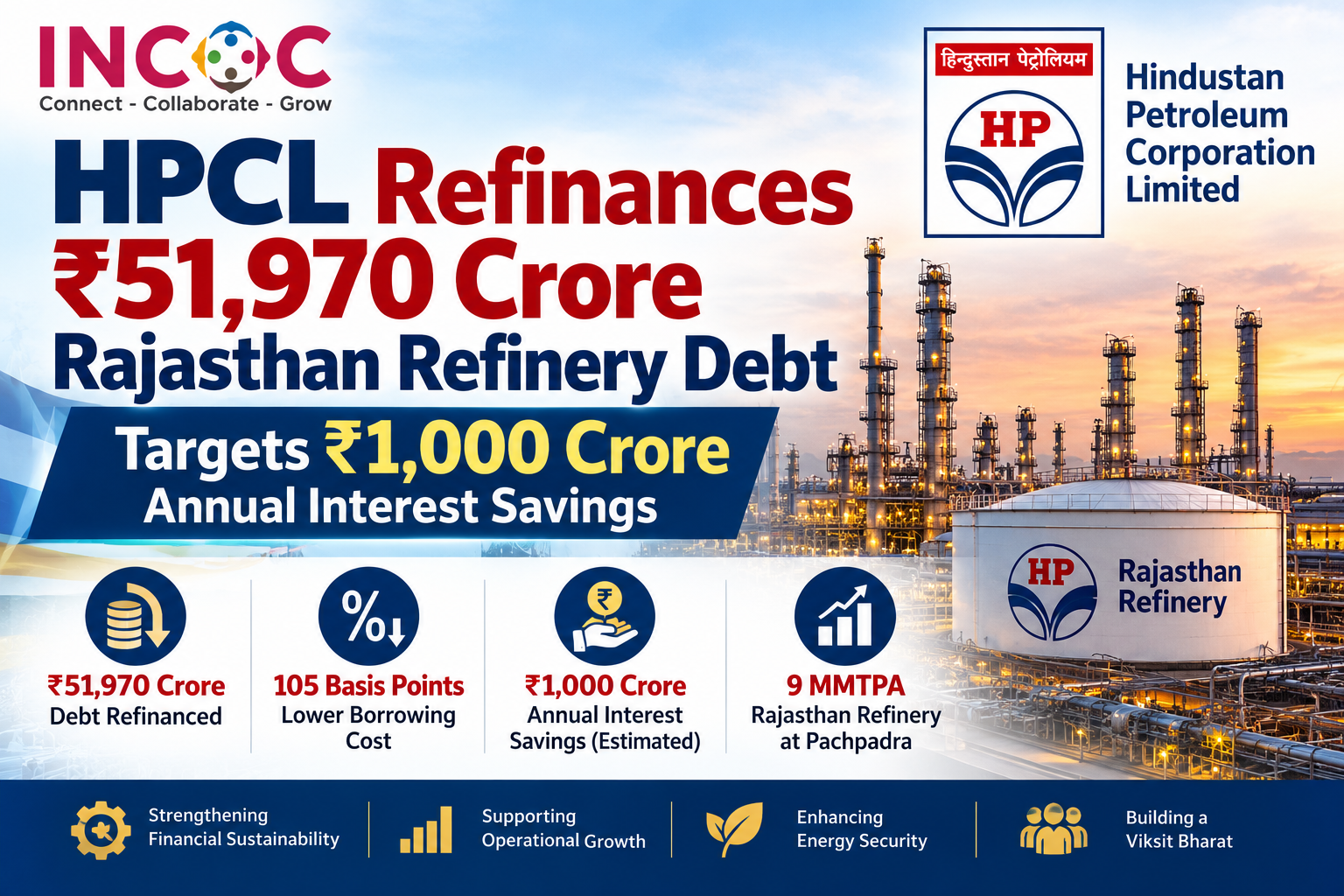
Hindustan Petroleum Corporation Limited (HPCL) has undertaken a major financial restructuring of the debt associated with its Rajasthan refinery project, refinancing and repricing debt worth approximately ₹51,970 crore at a lower cost. The move is expected to significantly reduce the interest burden of HPCL Rajasthan Refinery Limited (HRRL) and could contribute to annual interest savings of around ₹1,000 crore when the broader financial restructuring measures are taken into account.
The development is strategically important for HPCL as the company’s 9-million-tonne-per-year refinery at Pachpadra, Rajasthan, moves from the commissioning phase towards higher utilisation and commercial operations. The refinancing comes at a crucial stage when the company is focused on improving the financial economics of the large-scale refinery-cum-petrochemical project.
105 Basis Points Reduction in Borrowing Cost
According to HPCL management, the refinancing has reduced the borrowing cost by approximately 105 basis points. The revised financing became effective from October 3, 2026.
The immediate annual benefit from the lower borrowing cost is estimated at approximately ₹470 crore to ₹550 crore, while additional measures—including equity infusion and conversion of subordinated loans into equity—could take the overall annual interest-cost reduction to around ₹1,000 crore compared with the previous year.
For a capital-intensive refinery project, such a reduction in financing costs can have a meaningful impact on cash flows and long-term project economics.
The refinancing demonstrates how financial restructuring can become an important tool for improving the viability of large infrastructure and energy projects.
Major Financing Consortium
HRRL has refinanced part of its existing project loans through ₹8,000 crore of rupee term loans from a consortium comprising the National Bank for Financing Infrastructure and Development (NaBFID), India Infrastructure Finance Company Limited (IIFCL), ICICI Bank, UCO Bank and Punjab & Sind Bank.
The financing structure also includes a ₹2,000 crore working-capital demand loan from Bank of Baroda and additional fund-based and non-fund-based credit facilities of approximately ₹400 crore from ICICI Bank.
The term loans will partly refinance existing project debt, while the working-capital facilities are intended to support HRRL’s operational requirements and manage cash-flow mismatches associated with the refinery and related facilities.
Rajasthan Refinery: A ₹79,459 Crore Project
The financial restructuring assumes greater significance because the estimated cost of the Rajasthan refinery project has increased substantially over its development period.
The project cost now stands at approximately ₹79,459 crore. HPCL holds a 74% stake in HRRL, while the Government of Rajasthan owns the remaining 26%.
The refinery has a designed crude-processing capacity of 9 million tonnes per annum (MMTPA) and is integrated with a petrochemical complex.
For HPCL, the project represents a major expansion of its refining and petrochemical footprint and is expected to become an important contributor to the company’s future business performance.
Equity Infusion Strengthens Capital Structure
Debt refinancing is only one component of the financial restructuring.
During the September quarter, the Government of Rajasthan infused ₹1,500 crore of equity into the project. HPCL also converted approximately ₹4,300 crore of subordinated loans into equity.
The conversion of subordinated loans into equity is expected to reduce the interest burden by approximately ₹350 crore annually. Further equity calls are expected over the next one or two quarters.
The Rajasthan government has also committed to providing approximately ₹1,100 crore annually through interest-free loans, with the first tranche already received by the project.
Together, these measures are designed to create a more sustainable financial structure as the refinery moves into its operational phase.
Refinery Moving Towards Higher Capacity Utilisation
The financial restructuring comes as HRRL works towards increasing refinery utilisation.
The facility currently operates at approximately 60% utilisation, with HPCL targeting a run rate of around 8 million to 9 million tonnes annually around December, subject to the completion of remaining commissioning activities.
This transition is critical.
A refinery carrying substantial debt needs sufficient throughput and operating efficiency to generate the cash flows necessary to service its financial obligations. Higher capacity utilisation can therefore improve fixed-cost absorption and strengthen the project’s economics.
HPCL management has indicated confidence that the Rajasthan refinery can move towards near-full capacity by December.
Improving Product Shipments
The refinery is already seeing a sharp increase in product shipments.
According to HPCL management, product shipments have risen from virtually zero during the earlier commissioning period to substantial volumes as more processing units become operational. October shipments are expected to exceed 400,000 tonnes, potentially generating revenue of more than ₹4,000 crore during the month.
The increasing product movement is an important indicator of the transition from project commissioning to commercial operations.
For HPCL, the challenge now is to maintain stable operations, increase throughput and optimise the refinery’s product mix.
Refining Margins Could Support Profitability
Another important factor will be refining margins.
The Rajasthan refinery recorded a gross refining margin of approximately US$12 per barrel during the September quarter, while HPCL expects margins to improve as the facility moves towards processing higher-sulphur crude and reaches higher operating efficiency.
However, refinery profitability remains sensitive to crude prices, product prices, refining margins, currency movements and global market conditions.
Therefore, while lower financing costs provide an important financial advantage, sustained profitability will ultimately depend on efficient plant operations and market conditions.
Why the Refinancing Matters for PSU Finance
The HPCL-Rajasthan refinery restructuring provides an important case study in PSU financial management.
Large infrastructure projects often face challenges involving cost escalation, debt servicing, commissioning delays and working-capital requirements.
Once a project becomes operational, its financing structure may need to be redesigned to reflect its new cash-flow profile.
The refinancing of ₹51,970 crore demonstrates how a PSU can use lower-cost financing, equity restructuring and government support to reduce financial pressure while an asset moves towards commercial maturity.
For finance professionals, the development highlights the importance of capital structure optimisation, interest-cost management, debt refinancing, working-capital planning and project finance.
Strategic Importance for HPCL
The Rajasthan refinery is more than an individual project for HPCL.
It represents the company’s effort to expand its refining capacity and establish a stronger presence in integrated refining and petrochemicals.
Successful ramp-up could provide HPCL with additional refining capacity, product volumes and downstream opportunities.
At the same time, the company must ensure that the significant capital deployed in the project translates into sustainable returns.
The refinancing is therefore an important step in reducing the financial cost associated with that investment.
The Road Ahead
The next major milestone will be the successful stabilisation and ramp-up of the refinery.
If HRRL reaches its targeted operating levels, the combination of higher throughput, improved refining margins and lower financing costs could materially strengthen the project’s financial performance.
For HPCL, effective cost management will remain important as the company balances the Rajasthan refinery’s capital requirements with its broader refining, marketing and energy investments.
The company will also need to manage volatility in crude prices and domestic fuel markets while ensuring that the refinery operates efficiently.
The Worldonomics Times Perspective
HPCL’s refinancing of approximately ₹51,970 crore of Rajasthan refinery debt is a significant development in India’s PSU and infrastructure-finance landscape.
The 105-basis-point reduction in borrowing costs, combined with equity infusion, loan-to-equity conversion and interest-free state support, is expected to substantially reduce the project’s financial burden.
The immediate refinancing benefit is estimated at hundreds of crores annually, while HPCL expects the broader restructuring measures to potentially reduce annual interest costs by around ₹1,000 crore.
The real test, however, will be operational.
As the Rajasthan refinery approaches higher utilisation, HPCL will need to convert its massive investment into stronger cash flows, sustainable profitability and long-term shareholder value.
For India’s PSU ecosystem, the development offers an important lesson: large infrastructure investments require not only engineering excellence and operational execution, but also disciplined financial restructuring and strong capital management.
The Rajasthan refinery’s journey from a capital-intensive project to a profitable operating asset will therefore remain an important story to watch across India’s energy and PSU sectors.