PSU Clears 2.49 Million Sq. Ft. of Space, Disposes 1,272 MT of Scrap and Generates ₹3.12 Crore
New Delhi, October 26, 2026: NLC India Limited (NLCIL) has reported significant progress under Special Campaign 6, exceeding several operational, cleanliness, space-management and scrap-disposal targets as part of the Government of India’s nationwide drive for cleaner, more efficient and sustainable public-sector workplaces.
The campaign, being implemented under the direction of the Department of Administrative Reforms and Public Grievances (DARPG) and the Ministry of Coal, runs from October 2 to October 31, 2026. This year’s campaign places particular emphasis on the effective collection, segregation and environmentally responsible disposal of institutional e-waste, while also focusing on scrap management, record reduction, office-space optimisation and improved workplace efficiency.
According to the latest Ministry of Coal update, NLCIL had exceeded several targets as of October 23, 2026, demonstrating the company’s emphasis on operational discipline and sustainable resource management.
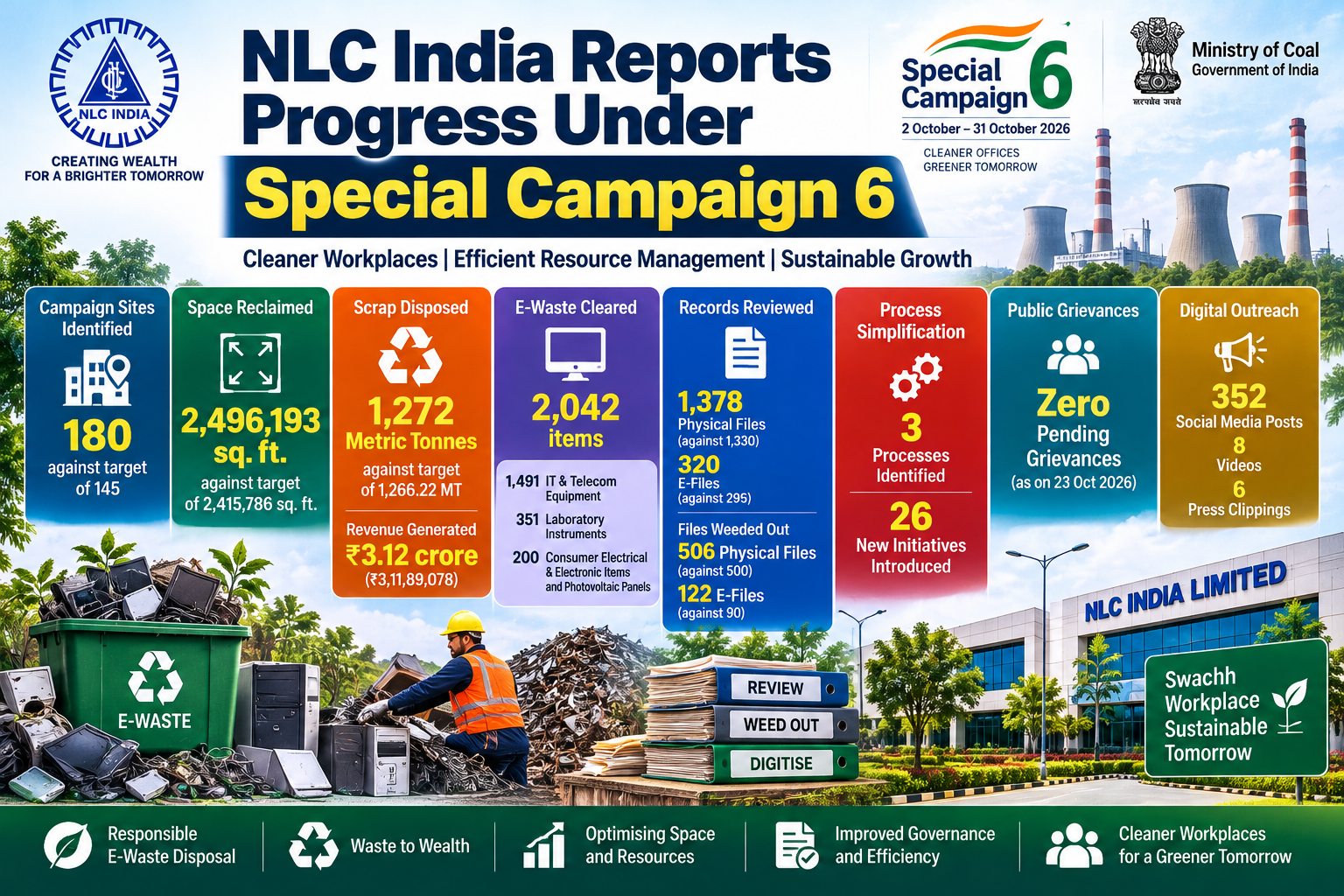
180 Campaign Sites Identified
NLCIL identified 180 campaign sites for cleanliness activities against an initial target of 145 sites, representing a significant expansion in the campaign’s operational coverage.
The company also reclaimed 2,496,193 square feet of space, surpassing its target of 2,415,786 square feet. The exercise is aimed not only at improving workplace cleanliness but also at making more efficient use of institutional and operational space.
Space optimisation has emerged as an important component of Special Campaign 6 across government organisations, with the Ministry of Coal emphasising the need to convert underutilised areas into productive and better-maintained spaces.
Scrap Disposal Generates ₹3.12 Crore
One of the most notable achievements has been NLCIL’s scrap-disposal programme.
The company disposed of 1,272 metric tonnes of scrap, exceeding the target of 1,266.22 MT. The disposal generated revenue of approximately ₹3.12 crore, specifically ₹3,11,89,078.
The result highlights the potential of systematic scrap management to convert idle or obsolete material into economic value while simultaneously freeing up operational space.
The initiative aligns with the government’s broader “Waste to Wealth” approach, which seeks to promote responsible disposal, recycling, reuse and productive utilisation of resources within public-sector organisations.
Focus on E-Waste Management
A major focus of Special Campaign 6 is institutional e-waste. The campaign’s national theme emphasises the effective collection, segregation and disposal of e-waste, in line with the E-Waste Management Rules, 2022.
NLCIL conducted a dedicated e-waste drive during the campaign and cleared 2,042 items across three categories.
These included:
- 1,491 items of Information Technology and Telecommunication Equipment;
- 351 laboratory instruments; and
- 200 consumer electrical and electronic items and photovoltaic panels.
The systematic removal of obsolete electronic equipment is aimed at strengthening responsible asset management and ensuring that electronic waste is handled through appropriate environmentally responsible channels.
The initiative also reflects the increasing importance of circular-economy practices within India’s public-sector enterprises, particularly as organisations increasingly replace legacy information-technology and electronic equipment.
Record Management and Administrative Efficiency
Special Campaign 6 at NLCIL extends beyond physical cleanliness and waste disposal to administrative efficiency.
As of October 23, the company had reviewed 1,378 physical files against a target of 1,330 and 320 e-files against a target of 295.
It subsequently weeded out 506 physical files and 122 electronic files, exceeding the respective targets of 500 and 90.
NLCIL also identified three processes for simplification and introduced 26 new initiatives under the campaign.
These measures are significant from a governance perspective because systematic record review can reduce administrative clutter, improve retrieval efficiency and support greater adoption of digital processes.
Zero Pending Public Grievances
Another important achievement has been the clearance of pending public grievances.
NLCIL reported zero pending grievances as of October 23, highlighting the citizen-centric dimension of the campaign.
Special Campaign 6 is therefore being implemented not merely as a cleanliness exercise but as a broader governance initiative covering workplace efficiency, records management, public service delivery and institutional accountability.
Digital Outreach Strengthens Campaign Visibility
NLCIL has also used digital communication to expand awareness around the campaign.
The company recorded 352 social-media posts, eight videos and six press clippings related to the campaign. Such communication initiatives help showcase best practices and encourage greater employee and stakeholder participation in sustainability and workplace-improvement programmes.
From Cleanliness to Operational Excellence
For NLC India, Special Campaign 6 represents an extension of its wider sustainability and resource-management agenda.
The company’s previous initiatives have included responsible e-waste disposal through authorised recyclers, waste-to-wealth projects and innovative reuse of scrap materials. NLCIL has also undertaken initiatives aimed at converting waste materials into productive assets and developing green spaces from reclaimed areas.
These efforts demonstrate how cleanliness and asset-management campaigns can contribute to broader environmental and operational objectives.
Significance for the PSU Sector
The progress achieved by NLCIL offers a wider example for India’s public-sector ecosystem. Large PSUs operate extensive industrial facilities, offices, townships and project sites where obsolete equipment, scrap, records and underutilised spaces can accumulate over time.
Systematic campaigns can therefore deliver multiple benefits simultaneously—better utilisation of space, monetisation of scrap, improved documentation, responsible e-waste disposal, cleaner workplaces and stronger administrative efficiency.
The financial benefit from scrap disposal also demonstrates that sustainability initiatives can generate tangible economic value while reducing environmental and operational burdens.
Outlook
With the implementation phase continuing until October 31, 2026, NLC India has an opportunity to build further on the achievements recorded as of October 23.
The company’s performance under Special Campaign 6 demonstrates how a government cleanliness initiative can evolve into a comprehensive programme encompassing environmental responsibility, resource efficiency, digital governance, space optimisation and citizen-centric administration.
For NLCIL and other public-sector enterprises, the larger objective is to institutionalise these practices beyond the campaign period and integrate them into regular operational systems.
As India continues to emphasise sustainable development and efficient utilisation of public assets, initiatives such as Special Campaign 6 can play an important role in transforming the concept of workplace cleanliness into a broader culture of efficiency, accountability and “Waste to Wealth.”
The Worldonomics Times | PSU & Governance Desk