Strong NII Growth, Higher Recoveries and Expanding MSME, Retail and Agriculture Lending Drive Performance
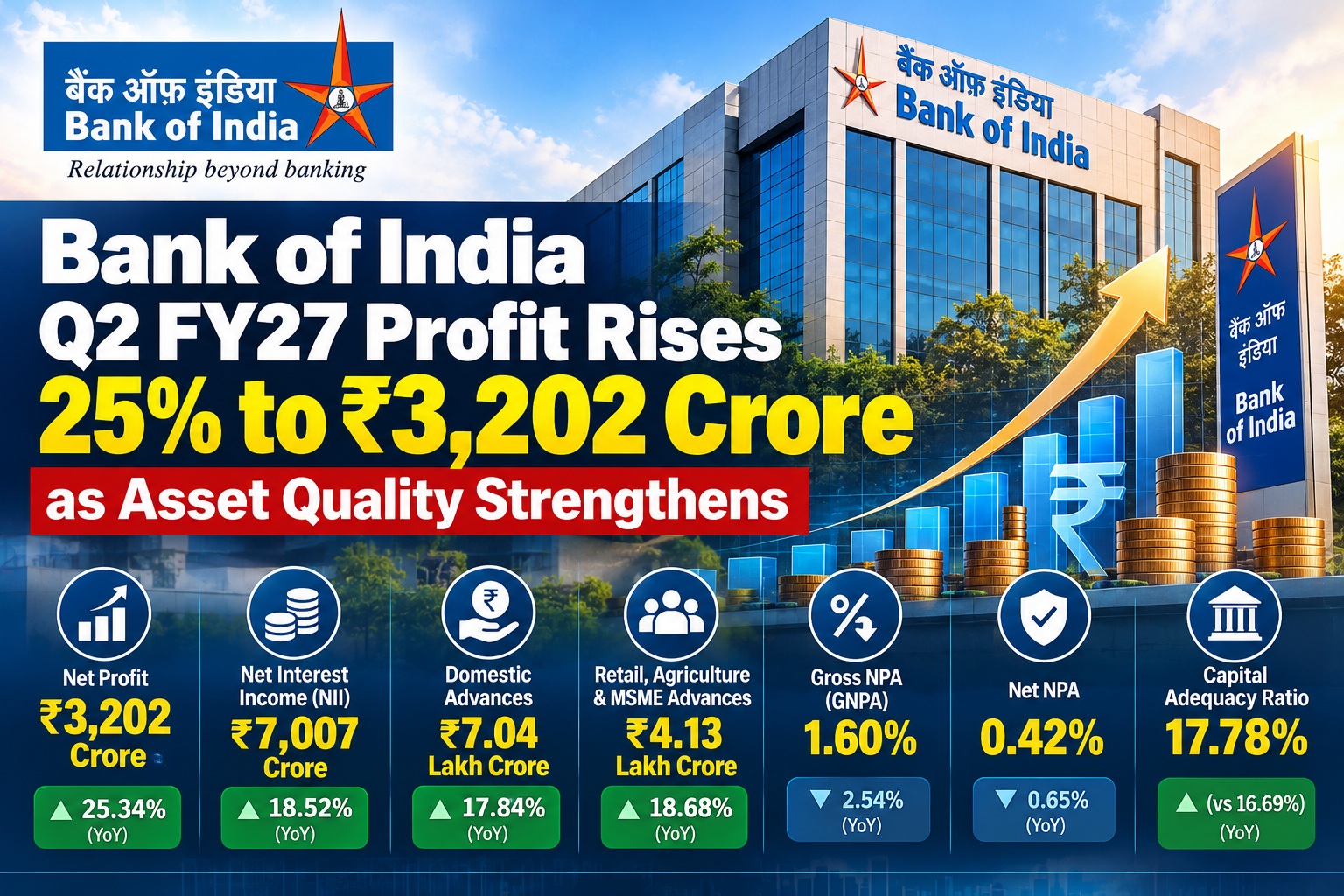
Mumbai/New Delhi: State-owned Bank of India (BOI) has reported a strong financial performance for the second quarter of FY2026-27, with standalone net profit rising 25.34% year-on-year to ₹3,202.38 crore, compared with ₹2,554.57 crore in Q2 FY26.
The bank’s consolidated net profit increased 28.4% to ₹3,308.82 crore, highlighting broad-based improvement in its operations. For the first half of FY27, standalone net profit increased 30.44% to ₹6,270 crore, compared with ₹4,807 crore during the corresponding period of the previous financial year.
The September-quarter performance was supported by strong growth in net interest income, higher recoveries from written-off accounts, increased foreign-exchange income and continued expansion in the bank’s lending portfolio.
Net Interest Income Emerges as a Key Growth Driver
One of the strongest features of Bank of India’s Q2 performance was the growth in Net Interest Income (NII).
Global NII increased 18.52% year-on-year to ₹7,007 crore, compared with ₹5,912 crore in Q2 FY26. Sequentially, NII also increased 2.55% from ₹6,833 crore in Q1 FY27.
Global interest income rose 15.34% to ₹21,229 crore. Interest earned on advances increased approximately 19.5% to ₹15,471 crore, reflecting the strong expansion of the bank’s loan book.
At the same time, interest expenses increased 13.84% to ₹14,222 crore.
The global Net Interest Margin (NIM) improved to 2.47%, compared with 2.41% in Q2 FY26. However, it was lower than the 2.52% recorded in the previous quarter.
Bank of India Managing Director and CEO Rajneesh Karnatak indicated that the domestic NIM remained above 2.70%, while the bank’s international operations, spread across 15 countries, bring down the consolidated margin. The bank expects its global NIM to remain around 2.55% during the second half of FY27.
Recoveries from Written-Off Accounts Surge
Non-interest income provided another significant boost to the quarterly results.
Bank of India’s global non-interest income increased approximately 25% to ₹2,770 crore from ₹2,220 crore in the year-ago quarter.
A particularly notable improvement came from recoveries from written-off accounts. Such recoveries surged approximately 190% to ₹978 crore, compared with ₹337 crore in Q2 FY26.
Profit from foreign-exchange transactions also increased sharply by around 157% to ₹411 crore, compared with ₹160 crore a year earlier.
These gains helped offset a decline in treasury income. Profit from the sale and revaluation of investments declined nearly 36% to ₹201 crore.
The changing composition of non-interest income is important because it demonstrates the growing contribution from recoveries and banking-related activities rather than relying exclusively on treasury gains.
Asset Quality Shows Major Improvement
Perhaps the most significant structural improvement in Bank of India’s latest results is the continued strengthening of asset quality.
The bank’s global Gross Non-Performing Asset (GNPA) ratio declined to 1.60% as of September 30, 2026, compared with 2.54% a year earlier and 1.81% at the end of June 2026.
The global Net NPA ratio declined to 0.42%, compared with 0.65% in September 2025 and 0.51% in June 2026.
The bank’s Provision Coverage Ratio (PCR) also improved to 94.45%, compared with 93.39% a year earlier.
In absolute terms, global gross NPAs declined to approximately ₹13,648 crore from ₹18,014 crore a year earlier.
Global net NPAs fell to approximately ₹3,557 crore from ₹4,530 crore.
This improvement indicates that Bank of India’s balance sheet has become significantly stronger compared with the position a year ago.
Recoveries Remain Central to Balance-Sheet Repair
The improvement in asset quality has been supported by recoveries and resolution of stressed accounts.
During the quarter, cash recoveries amounted to approximately ₹1,635 crore, while write-offs stood at ₹236 crore.
Fresh slippages were approximately ₹1,160 crore, compared with ₹1,778 crore in the previous quarter.
The bank’s ability to recover money from previously written-off accounts is particularly noteworthy because such recoveries directly support profitability while simultaneously helping clean up the balance sheet.
However, the bank will need to maintain strict credit monitoring as its loan book continues to expand rapidly.
Domestic Advances Grow Nearly 18%
Bank of India’s lending business recorded strong growth across multiple segments.
Domestic advances increased 17.84% year-on-year to ₹7.04 lakh crore as of September 30, 2026.
The bank’s Retail, Agriculture and MSME (RAM) portfolio grew 18.68% to ₹4.13 lakh crore, representing approximately 58.63% of domestic gross advances.
The segment-wise performance was:
| Segment | September 2026 | YoY Growth |
|---|---|---|
| Retail advances | ₹1.74 lakh crore | 19.27% |
| MSME advances | ₹1.18 lakh crore | 20.27% |
| Agriculture advances | ₹1.21 lakh crore | 16.34% |
| Corporate & other advances | ₹2.91 lakh crore | 16.67% |
The strong growth in MSME lending is particularly important given the role of small and medium businesses in employment generation, manufacturing, services and India’s broader economic expansion.
Within retail lending, home loans increased 17% to approximately ₹85,080 crore, while vehicle loans grew 19% to ₹26,349 crore.
Global Business Approaches ₹19 Lakh Crore
Bank of India’s overall business scale has also expanded substantially.
Global advances increased 20.58% to ₹8.55 lakh crore, while global deposits grew 21.59% to ₹10.38 lakh crore.
As a result, the bank’s global business mix increased 21.13% to approximately ₹18.93 lakh crore.
Domestic deposits stood at approximately ₹9 lakh crore, while overseas deposits were around ₹1.37 lakh crore.
The bank’s international presence across 15 countries contributes to its diversified business model, although international operations also have a lower NIM compared with the domestic business.
CASA Ratio Remains an Area to Watch
Despite strong overall deposit growth, the bank faces a challenge in improving the composition of its deposits.
The domestic Current Account Savings Account (CASA) ratio stood at 34.16%, compared with 39.39% a year earlier.
A higher CASA ratio is generally favourable for banks because current and savings deposits typically have a lower cost compared with term deposits.
Therefore, while Bank of India has achieved substantial growth in deposits, rebuilding the share of low-cost deposits will remain important for protecting margins.
This is particularly relevant in a competitive banking environment where deposit mobilisation can directly influence the cost of funds.
Capital Position Remains Strong
Bank of India’s capital position strengthened during the year.
The bank’s Capital Adequacy Ratio stood at 17.78% at the end of September 2026, compared with 16.69% a year earlier.
The Common Equity Tier-I (CET1) ratio increased to 15.49%, compared with 13.89% in September 2025.
A strong capital position provides the bank with additional capacity to support future credit growth while maintaining regulatory buffers.
It also provides greater resilience against unexpected deterioration in asset quality or changes in the economic environment.
Operating Profit Rises Strongly
Bank of India’s operating performance also improved significantly.
Global operating profit increased approximately 33% to ₹5,089 crore during Q2 FY27, while profit before tax increased around 27% to ₹4,291 crore.
The improvement in operating profit is important because it indicates that the quarter’s performance was supported by stronger underlying banking operations.
However, provisions increased during the quarter. Provisions rose approximately 49% year-on-year to ₹1,887 crore.
The bank will therefore need to maintain a balance between aggressive business growth and prudent provisioning.
A Changing Loan-Book Strategy
The latest numbers indicate a gradual evolution in Bank of India’s lending strategy.
Retail, agriculture and MSME advances now account for nearly three-fifths of domestic gross advances.
This diversification can potentially reduce concentration risks associated with a corporate-heavy loan portfolio while providing opportunities for recurring interest income.
The rapid growth in MSME advances is particularly significant. MSMEs remain an important part of India’s formal credit ecosystem, and public sector banks continue to play a major role in financing these enterprises.
For Bank of India, the opportunity will be to combine faster credit growth with disciplined underwriting and technology-led monitoring.
The Larger PSU Banking Story
Bank of India’s Q2 performance also needs to be viewed against the broader transformation taking place across India’s public sector banking sector.
Over the past several years, PSU banks have focused on:
- Reducing stressed assets
- Strengthening capital positions
- Improving recovery mechanisms
- Expanding retail lending
- Increasing MSME credit
- Digitising banking operations
- Improving profitability
- Strengthening risk-management systems
Bank of India’s latest numbers reflect several of these trends simultaneously.
The combination of lower NPAs, stronger capital, higher NII and expanding credit indicates a substantially healthier balance sheet.
Key Numbers at a Glance
| Indicator | Q2/H1 FY27 Performance |
|---|---|
| Q2 standalone net profit | ₹3,202.38 crore |
| Q2 consolidated net profit | ₹3,308.82 crore |
| Q2 profit growth | 25.34% standalone |
| H1 FY27 net profit | ₹6,270 crore |
| H1 profit growth | 30.44% |
| Q2 NII | ₹7,007 crore |
| NII growth | 18.52% |
| Global advances | ₹8.55 lakh crore |
| Domestic advances | ₹7.04 lakh crore |
| Global deposits | ₹10.38 lakh crore |
| Global business | ₹18.93 lakh crore |
| GNPA | 1.60% |
| Net NPA | 0.42% |
| Capital adequacy ratio | 17.78% |
The figures demonstrate the scale of Bank of India’s operations and the improvement in several important financial indicators.
Outlook for FY27
Bank of India’s first-half performance provides a strong foundation for the remainder of FY27.
The bank enters the second half with strong credit growth, improving asset quality, a healthy capital position and significant improvement in recoveries.
At the same time, management will need to focus on maintaining margins, increasing low-cost deposits, controlling credit costs and ensuring that rapid loan expansion does not lead to a deterioration in asset quality.
The bank’s expectation of a global NIM around 2.55% for the second half of FY27 will be an important indicator to monitor.
The performance of the retail and MSME portfolios will also remain significant as these segments expand at a faster pace than some traditional lending categories.
Conclusion
Bank of India’s Q2 FY27 results present a picture of a stronger and more diversified public sector bank.
Standalone net profit rose 25.34% to ₹3,202 crore, while first-half profit increased more than 30%. NII grew 18.52%, global advances increased more than 20%, and asset quality improved significantly, with GNPA declining to 1.60% and net NPA to 0.42%.
The sharp increase in recoveries from written-off accounts has also contributed meaningfully to earnings.
The key challenge ahead will be maintaining this momentum without compromising margins or asset quality.
For India’s banking sector, Bank of India’s latest results provide another indication that the transformation of public sector banks is progressing from balance-sheet repair toward a phase of sustainable credit expansion, stronger profitability and broader financial inclusion.
For The Worldonomics Times, the Bank of India story is therefore more than a quarterly earnings update—it is an important indicator of how India’s PSU banking institutions are positioning themselves for the next phase of economic growth.