From Career Counselling to Career Creation: A Strong Contribution to the Growth of the CMA Profession
New Delhi | The Worldonomics Times
The growth of any professional institution depends not only on its academic framework but also on its ability to reach young students, explain career opportunities and inspire the next generation to choose the profession.
In this context, the contribution of CMA Madhuri Kashyap, Regional Council Member of the Northern India Regional Council (NIRC) of The Institute of Cost Accountants of India (ICMAI) and Chairperson of its Student Welfare Committee, has emerged as a notable example of active institutional engagement and student outreach.
During 2025–26, CMA Madhuri Kashyap played an extensive role in career counselling and student awareness initiatives, with a particular focus on introducing students to the CMA profession, explaining its career opportunities and encouraging them to consider Cost and Management Accountancy as a long-term professional career.
53 Career Counselling Programmes Led by CMA Madhuri Kashyap
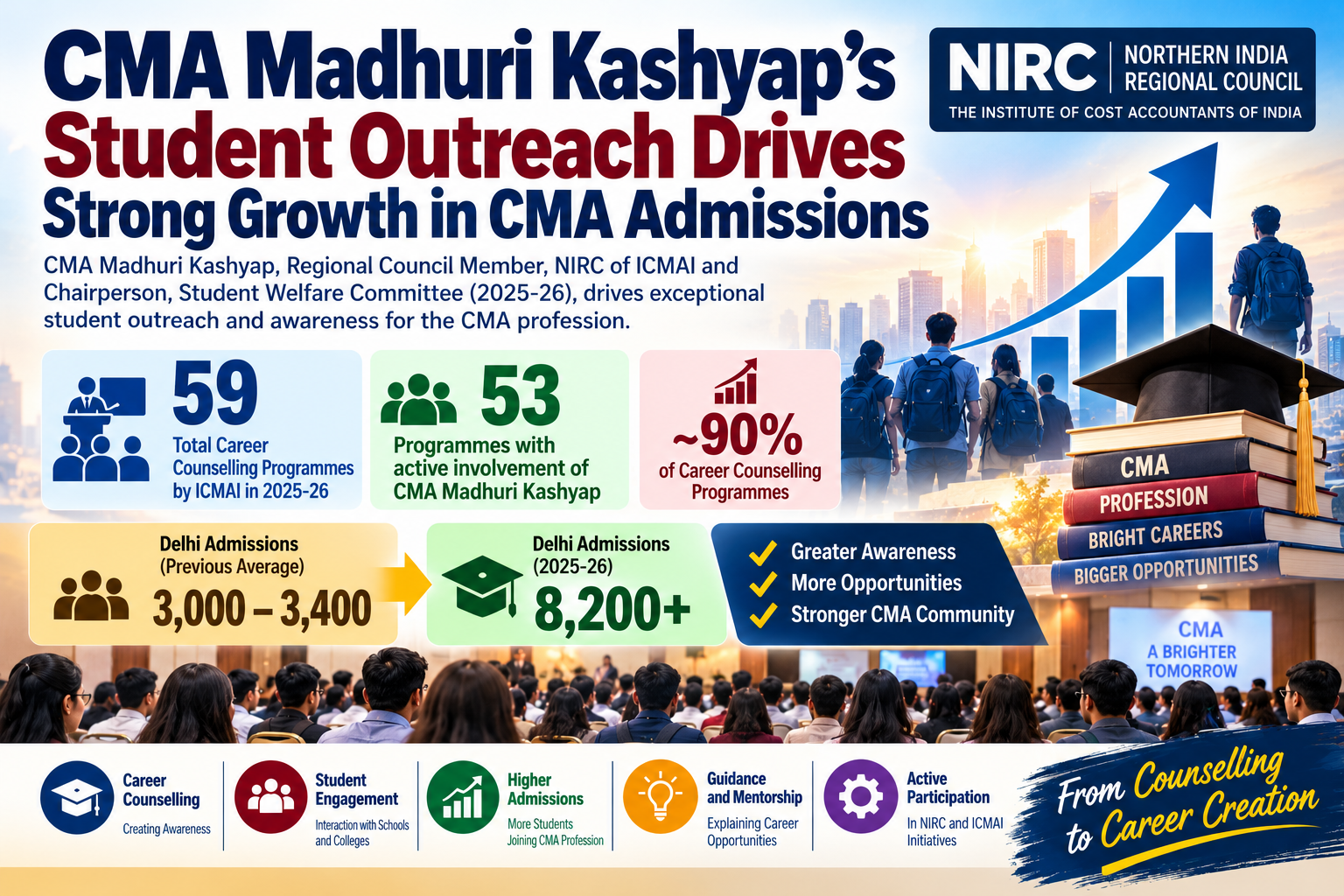
According to the figures shared for the 2025–26 period, ICMAI conducted 59 career counselling programmes, of which 53 programmes were undertaken with the active involvement and leadership of CMA Madhuri Kashyap.
This represents an exceptionally high level of participation in the Institute’s career-awareness initiatives.
The programmes provided opportunities to interact directly with students from schools, colleges and educational institutions and explain the CMA course, its structure, professional opportunities and career pathways.
ICMAI itself identifies career counselling as an important mechanism for creating awareness about the CMA qualification and its career prospects among school and college students. Its annual reporting has highlighted the role of Regional Councils and Chapters in taking the CMA message to educational institutions across the country.
The scale of participation by CMA Madhuri Kashyap demonstrates a sustained commitment to this objective.
From Counselling to Conversion: Admission Momentum
Career counselling becomes meaningful when awareness ultimately translates into students taking the next step towards professional education.
Delhi has traditionally witnessed strong interest in the CMA programme. According to the figures shared for the Delhi region, admissions in previous periods generally averaged around 3,000–3,400 students.
The latest admission cycle, however, witnessed a significant jump, with admissions crossing 8,200 students.
The increase represents a substantial expansion compared with the historical average and highlights the growing interest among students in professional courses that offer opportunities across finance, costing, management accounting, taxation, corporate finance, strategic management and industry.
While admissions are influenced by several institutional and market factors, sustained career counselling and direct interaction with prospective students can play an important role in helping students understand the relevance and opportunities associated with the CMA qualification.
Student Welfare as a Professional Development Mission
As Chairperson of the Student Welfare Committee of NIRC, CMA Madhuri Kashyap has focused not merely on admissions but on the broader student journey.
Student welfare encompasses awareness, guidance, interaction, access to opportunities and creating a stronger connection between students and the professional community.
Her approach reflects the view that students entering the CMA profession need more than information about examinations. They need to understand where the qualification can take them.
From corporate careers and PSU opportunities to professional practice, consultancy, entrepreneurship and emerging roles in technology-driven finance, the modern CMA profession offers a wide range of career possibilities.
Active Participation in NIRC Activities
CMA Madhuri Kashyap has also maintained an active presence in various programmes and initiatives of NIRC.
The official NIRC website currently lists her as a Regional Council Member, alongside other members of the Council. NIRC’s activities include professional seminars, student programmes, placement initiatives, industry interactions and other activities designed to strengthen the CMA community.
Her participation has extended across different institutional activities, reflecting an approach centred on active engagement rather than participation limited to formal responsibilities.
The NIRC Annual Report for 2024–25, for example, records her participation as an NIRC Council Member in the CMA-PSU Connect programme held on 25 April 2025. The programme brought together CMA professionals to discuss the evolving professional landscape and opportunities in the PSU sector.
Building the Next Generation of CMAs
One of the most important challenges before professional institutions is ensuring that young students understand the relevance of professional qualifications in a changing economy.
The finance function is rapidly evolving. Artificial intelligence, automation, analytics, ESG, digital transformation, strategic cost management and data-driven decision-making are creating new opportunities for finance professionals.
Against this backdrop, effective career counselling has become increasingly important.
Students need to know not only what the CMA course is, but also why CMA matters in the future of business.
This is where professionals and institutional leaders can make a difference. Personal interaction with students can help remove misconceptions, explain career pathways and provide the confidence required to make an informed career decision.
A Model of Institutional Engagement
The numbers associated with the 2025–26 career counselling initiatives provide an interesting picture.
| Indicator | 2025–26 |
|---|---|
| Career counselling programmes cited | 59 |
| Programmes involving CMA Madhuri Kashyap | 53 |
| Share of cited programmes | Approx. 90% |
| Earlier average Delhi admissions | 3,000–3,400 |
| Latest Delhi admissions | 8,200+ |
The figures illustrate the scale of her engagement with student outreach.
Importantly, the achievement should be viewed as part of the collective efforts of ICMAI, NIRC, its members, faculty, chapters, student volunteers and institutional teams. Career counselling and admissions are institutional outcomes, and individual leadership can strengthen that larger ecosystem.
Beyond Numbers
The significance of the initiative goes beyond admission statistics.
Every new student entering the CMA profession represents a potential future Cost Accountant, finance leader, entrepreneur, consultant, educator or strategic business professional.
For an institution like ICMAI, therefore, career counselling is also an investment in the future of the profession.
CMA Madhuri Kashyap’s extensive involvement during 2025–26 demonstrates how regional-level leadership can contribute directly to this mission by taking the profession closer to students and educational institutions.
Her work also reinforces the importance of student-centric leadership within professional institutions.
The Road Ahead
As the CMA profession continues to evolve, student engagement will remain a critical priority.
The next generation of CMAs will enter a business environment shaped by technology, global supply chains, sustainability, AI, digital finance and increasing demand for strategic financial professionals.
Creating awareness about these opportunities at the student level can help the profession attract talented young minds and strengthen its future talent pipeline.
The strong admission numbers reported for Delhi provide encouraging evidence of growing interest in the CMA pathway. Continued career counselling, mentorship, industry exposure and student welfare initiatives can further strengthen this momentum.
The Worldonomics Times Take
CMA Madhuri Kashyap’s contribution during 2025–26 reflects an important principle: professional growth begins with awareness.
With 53 career counselling programmes out of the 59 cited programmes, her extensive involvement demonstrates a strong commitment to bringing the CMA profession closer to students.
The reported rise in Delhi admissions from a historical average of around 3,000–3,400 to more than 8,200 is a significant development and reflects the growing opportunity for the CMA profession.
The larger lesson is clear: when professional leadership actively engages with students, explains opportunities and provides a vision for the future, career counselling can become career creation.