New Delhi: India’s traditional artisans and craftspeople represent an important part of the country’s cultural heritage as well as its micro-enterprise economy. From carpenters and potters to goldsmiths, tailors, cobblers and basket makers, millions of skilled workers depend on traditional occupations for their livelihoods.
However, many such artisans operate in the informal economy and face challenges such as limited access to modern tools, formal credit, technology, training, branding and larger markets. To address these challenges, the Government of India launched the PM Vishwakarma Scheme on 17 September 2023.
Implemented by the Ministry of Micro, Small & Medium Enterprises along with the Ministry of Skill Development & Entrepreneurship and the Department of Financial Services, the scheme aims to provide end-to-end support to traditional artisans and craftspeople.
A Scheme Designed for Traditional Skills
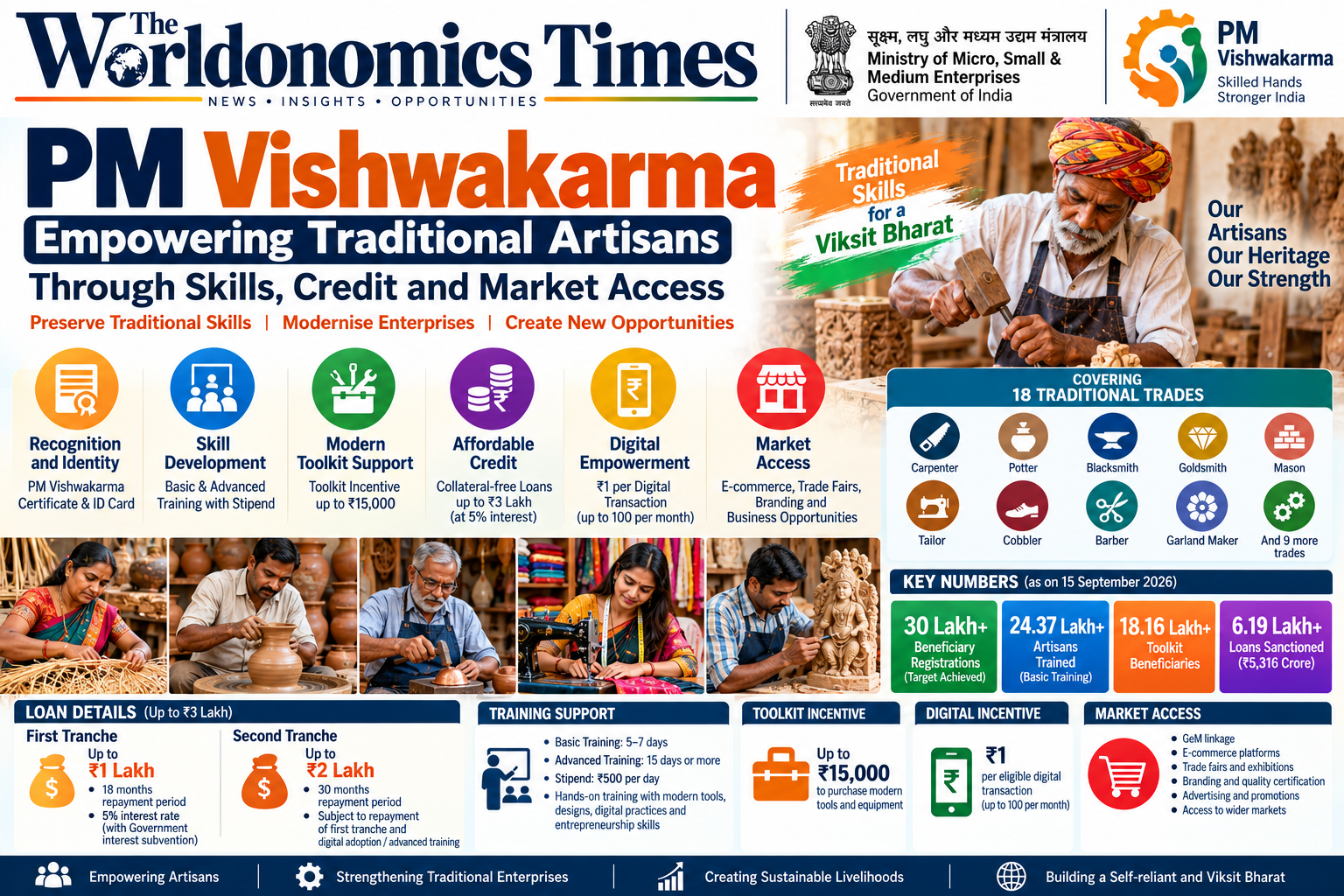
PM Vishwakarma focuses on artisans who work with their hands and traditional tools. The scheme covers 18 traditional trades, including carpenters, boat makers, armourers, blacksmiths, tool and hammer makers, locksmiths, goldsmiths, potters, sculptors and stone workers, footwear artisans, masons, basket and mat makers, traditional toy makers, barbers, garland makers, washermen, tailors and fishing-net makers.
The objective is not simply to provide financial assistance. The scheme combines recognition, skill development, modern tools, affordable credit, digital incentives and marketing support so that traditional workers can develop their activities into stronger and more sustainable enterprises.
Recognition as a Vishwakarma
The first step is formal recognition.
Eligible beneficiaries who complete the registration and verification process receive a PM Vishwakarma Certificate and ID Card. This recognition can help bring traditionally informal workers into the formal support ecosystem.
The scheme also connects beneficiaries with the Udyam Assist Platform, helping informal micro enterprises become part of the formal MSME ecosystem and access applicable government support.
This formalisation is significant because many traditional artisans operate as individual workers or family-based businesses without formal registration or structured access to institutional support.
Skill Development for a Changing Market
Traditional skills provide the foundation, but modern markets increasingly demand new designs, improved quality, productivity and digital capabilities.
PM Vishwakarma provides Basic Training of 5–7 days and offers Advanced Training of 15 days or more for interested beneficiaries. Trainees receive a stipend of ₹500 per day. The training introduces participants to modern tools, improved practices, digital transactions, marketing and entrepreneurial knowledge.
This combination of traditional knowledge and modern business skills can help artisans improve both productivity and commercial opportunities.
Modern Toolkit Support
Technology and tools can make a major difference to a micro-enterprise.
Under PM Vishwakarma, eligible beneficiaries can receive a toolkit incentive of up to ₹15,000. The objective is to enable artisans to acquire better and more modern tools that can improve productivity, product quality and their ability to meet changing customer requirements.
For an artisan working with limited capital, upgrading tools can be an important first step towards expanding production.
Affordable Credit for Enterprise Development
Access to formal finance is another important component of the scheme.
PM Vishwakarma provides collateral-free Enterprise Development Loans of up to ₹3 lakh in two tranches. The first tranche is up to ₹1 lakh with an 18-month repayment period, while the second tranche can provide up to ₹2 lakh with a 30-month repayment period, subject to the applicable conditions.
The beneficiary interest rate is fixed at 5%, with Government interest subvention of up to 8%. Eligibility for the second tranche is linked to repayment of the first tranche and either adoption of digital transactions or completion of Advanced Training.
The credit component can help artisans purchase raw materials, upgrade equipment, increase production and strengthen their working capital.
Digital Payments and Digital Empowerment
Digitalisation is becoming increasingly important even for very small businesses.
PM Vishwakarma provides an incentive of ₹1 per eligible digital transaction, for up to 100 transactions per month. The objective is to encourage beneficiaries to adopt digital payment practices and become more comfortable with formal digital commerce.
For traditional businesses, digital adoption can also create better transaction records and help establish a foundation for future participation in formal financial and commercial systems.
From Local Markets to Wider Markets
Finance and skills alone cannot transform an enterprise unless the entrepreneur can find customers.
The scheme therefore includes marketing support, including quality certification, branding and promotion, e-commerce linkages, trade fairs, exhibitions, advertising and other market-development activities.
Recent government updates also highlight efforts to connect beneficiaries with platforms such as GeM and e-commerce channels, as well as trade fairs and exhibitions.
This is particularly important for artisans producing handicrafts, traditional products, clothing, jewellery, furniture and other products that can potentially reach customers well beyond their local markets.
Eligibility and Registration
The scheme is intended for artisans and craftspeople aged 18 years or above, working with their hands and tools in one of the 18 notified traditional trades on a self-employed basis in the unorganised sector.
There are also restrictions concerning previous government-backed self-employment loans, family participation and government employment. Generally, benefits are restricted to one member of a family, while government employees and their family members are excluded.
Registration is facilitated through Common Service Centres (CSCs), followed by a multi-level verification and approval process.
A Significant Milestone in 2026
The scheme has reached an important milestone. According to a September 2026 government update, the 30-lakh beneficiary registration target had been achieved as PM Vishwakarma approached three years of implementation.
As of 15 September 2026, more than 24.37 lakh artisans had received basic skill training, while over 18.16 lakh had received toolkits. More than 6.19 lakh loans worth approximately ₹5,316 crore had also been sanctioned.
The Road Ahead
PM Vishwakarma represents an important shift from treating traditional artisans only as beneficiaries of welfare programmes to recognising them as entrepreneurs and contributors to the MSME economy.
Its integrated approach—recognition, skills, modern tools, affordable credit, digital adoption and market access—can help traditional enterprises become more productive and commercially sustainable.
The larger opportunity lies in connecting India’s traditional craftsmanship with modern branding, e-commerce, digital payments, quality certification, government procurement and export markets.
For India’s artisans, the future of traditional enterprise may therefore depend not on abandoning traditional skills, but on combining those skills with modern technology, finance, entrepreneurship and access to markets.
PM Vishwakarma’s core message is clear: preserve traditional skills, modernise the enterprise and create new pathways for growth.