Understanding China’s ESG and Sustainability Reporting Framework
China is rapidly developing a structured sustainability-reporting system. Its approach combines stock-exchange disclosure requirements, China Securities Regulatory Commission (CSRC) rules, Ministry of Finance sustainability standards, environmental regulations and state-owned enterprise requirements.
A major development occurred in 2024 when the Shanghai, Shenzhen and Beijing stock exchanges issued sustainability-reporting guidelines for listed companies. In 2025, the CSRC’s revised information-disclosure rules formally required listed companies to publish sustainability reports in accordance with stock-exchange regulations.
At the same time, China’s Ministry of Finance and other government departments are developing a national unified sustainability disclosure standards system, with the objective of having the basic system substantially established by 2030.
Q1. Is ESG reporting mandatory in China?
Yes, for specified listed companies, sustainability reporting is mandatory under China’s securities and stock-exchange regulatory framework.
However, ESG reporting is not yet universally mandatory for every Chinese company. The national sustainability standards are being implemented progressively, moving from listed companies and large enterprises toward broader corporate coverage.
Q2. Does China have one single ESG law?
No.
China’s ESG framework consists of multiple regulatory instruments involving:
- CSRC
- Ministry of Finance
- Ministry of Ecology and Environment
- NDRC
- PBOC
- SASAC
- Shanghai Stock Exchange
- Shenzhen Stock Exchange
- Beijing Stock Exchange
The framework is gradually being integrated into a more unified sustainability-disclosure system.
Q3. Which regulator is most important for listed-company ESG reporting?
The China Securities Regulatory Commission (CSRC) is a key regulator for listed-company information disclosure.
The Shanghai, Shenzhen and Beijing stock exchanges implement detailed sustainability-reporting requirements under their self-regulatory frameworks.
Q4. What changed in China’s ESG reporting framework in 2025?
On March 28, 2025, the CSRC issued revised Administrative Measures for Listed Company Information Disclosure, together with revised annual and semi-annual reporting guidelines.
The rules took effect on July 1, 2025.
Importantly, the revised information-disclosure framework requires listed companies to publish sustainability reports in accordance with applicable stock-exchange regulations.
Q5. What does this mean for ESG reporting?
It represents an important shift from ESG reporting being primarily a voluntary or stock-exchange-led practice toward a requirement incorporated into China’s broader regulatory information-disclosure system.
Q6. Which listed companies must publish sustainability reports?
Under the stock-exchange sustainability-reporting rules, mandatory reporting initially covers specified companies, including major index constituents and companies with dual domestic and overseas listings.
For example, the Shanghai Stock Exchange rules cover companies included in the SSE 180 Index, STAR 50 Index and companies listed domestically and overseas.
Q7. Are all Chinese listed companies required to publish ESG reports?
No.
The requirements are currently differentiated.
Specified listed companies must publish sustainability reports, while other listed companies are encouraged to voluntarily disclose sustainability information in accordance with the relevant guidelines.
Q8. When did China’s stock-exchange sustainability guidelines become effective?
The Shanghai Stock Exchange’s sustainability-reporting guideline took effect on May 1, 2024.
Comparable sustainability-reporting guidelines were also issued by the Shenzhen and Beijing stock exchanges.
Q9. When was the first mandatory sustainability-reporting cycle?
Companies covered by the mandatory stock-exchange requirements were required to prepare and publish their 2025 sustainability reports by April 30, 2026, under the transition arrangements.
This made 2026 a significant year for China’s mandatory ESG reporting landscape.
Q10. What is China’s Corporate Sustainability Disclosure Standards – Basic Standard?
The Corporate Sustainability Disclosure Standards – Basic Standard (Trial) is the foundation of China’s national sustainability-disclosure standards system.
It was jointly issued by the Ministry of Finance and other government departments in November 2024.
Q11. Is the Basic Standard currently mandatory for every Chinese company?
No.
The Ministry of Finance explicitly states that, until the implementation scope and requirements are specified, enterprises may apply the Basic Standard voluntarily.
China intends to move progressively from voluntary disclosure toward mandatory disclosure.
Q12. What is China’s long-term ESG reporting objective?
China’s objective is to establish a national unified sustainability disclosure standards system.
The Ministry of Finance has stated that basic and climate-related standards and application guidance are expected to be developed by 2027, with the national unified system substantially established by 2030.
Q13. What are the major elements of China’s sustainability disclosure framework?
The Basic Standard identifies four core disclosure elements:
- Governance
- Strategy
- Risk and opportunity management
- Metrics and targets
This structure is broadly consistent with the architecture used in international sustainability-reporting standards.
Q14. What does governance mean in ESG reporting?
Governance disclosure addresses how a company manages sustainability-related risks and opportunities.
It can include:
- Board oversight
- Management responsibilities
- Sustainability policies
- Internal controls
- Decision-making processes
- Accountability
Q15. What does strategy disclosure cover?
Companies may need to explain how sustainability-related risks and opportunities affect:
- Business strategy
- Business model
- Operations
- Investments
- Resource allocation
- Long-term development
Q16. What is sustainability-related risk and opportunity management?
It refers to the company’s processes for identifying, assessing, prioritizing, monitoring and managing sustainability-related risks and opportunities.
Q17. What are metrics and targets?
Companies disclose quantitative or qualitative indicators used to measure sustainability performance and progress toward established targets.
Examples include:
- Greenhouse-gas emissions
- Energy consumption
- Water usage
- Waste
- Employee indicators
- Safety
- Governance indicators
Q18. What sustainability topics are covered under China’s national framework?
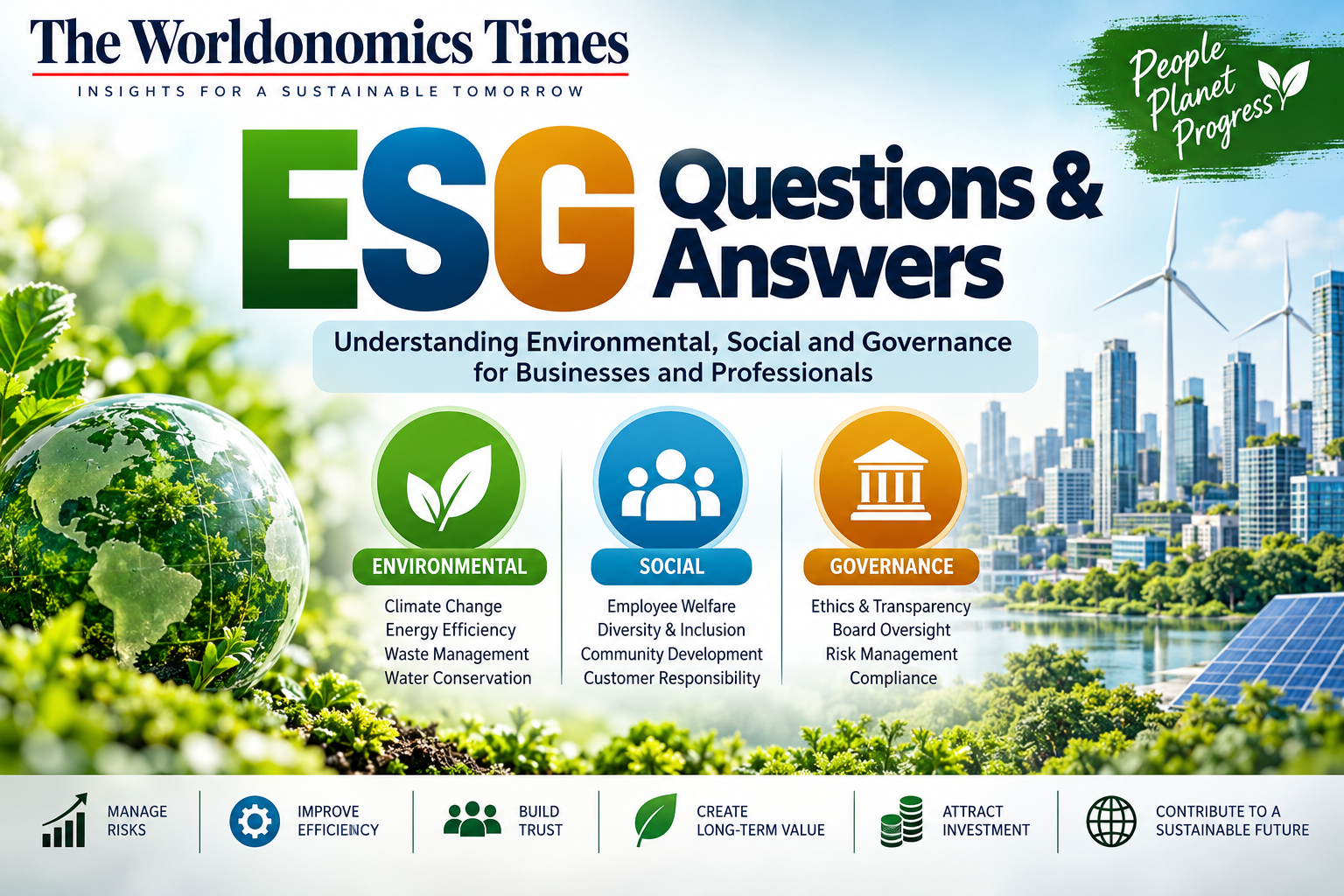
China’s Basic Standard identifies environmental, social and governance topics.
Environmental areas include:
- Climate change
- Pollution
- Water and marine resources
- Biodiversity and ecosystems
- Resource use
- Circular economy
Social areas include:
- Employees
- Consumers
- Communities
- Suppliers
- Customer relationships
- Rural revitalization
- Social contribution
Governance includes matters such as business conduct.
Q19. Does China use the concept of materiality?
Yes.
China’s Basic Standard contains requirements concerning materiality, materiality assessment, aggregation and disaggregation.
Companies are expected to identify and disclose sustainability information that is material to users of the information.
Q20. Does China’s ESG framework use double materiality?
China’s stock-exchange framework has characteristics that consider both sustainability impacts and financially relevant risks and opportunities.
However, China’s framework should not simply be treated as identical to the EU’s CSRD double-materiality system.
The detailed Chinese requirements and terminology are established through Chinese regulatory standards and stock-exchange guidelines.
Q21. What are the six information-quality requirements?
China’s Basic Standard identifies six information-quality characteristics:
- Reliability
- Relevance
- Comparability
- Verifiability
- Understandability
- Timeliness
Q22. Why is comparability important?
Comparability allows investors and other users to evaluate sustainability performance:
- Between different years
- Between companies
- Against targets
- Across industries
It also improves the usefulness of ESG information for investment and risk-management decisions.
Q23. What climate information must companies disclose?
Climate-related reporting can cover:
- Climate governance
- Climate risks
- Climate opportunities
- Strategy
- Transition plans
- Adaptation
- Emissions
- Climate targets
- Climate-related investments
The Shanghai Stock Exchange sustainability guideline includes specific climate-related disclosure requirements.
Q24. Does China require companies to disclose Scope 1 emissions?
Applicable companies are expected to disclose relevant greenhouse-gas information under the sustainability-reporting framework and applicable sectoral requirements.
Scope 1 represents direct emissions from sources owned or controlled by the company.
Q25. What is Scope 2 emissions?
Scope 2 represents indirect emissions associated with purchased or acquired energy such as electricity, heating, cooling or steam.
Q26. What is Scope 3 emissions?
Scope 3 covers other indirect emissions throughout the company’s value chain.
Examples include:
- Purchased goods
- Transportation
- Business travel
- Employee commuting
- Waste
- Use of sold products
Q27. Is Scope 3 mandatory for all Chinese companies?
No.
Scope 3 requirements depend on the applicable reporting rules, company category, industry and transition arrangements.
Companies are nevertheless increasingly expected to understand value-chain emissions as China’s ESG reporting framework develops.
Q28. What is China’s approach to climate transition?
China has established national objectives to:
- Reach carbon emissions peak before 2030
- Achieve carbon neutrality before 2060
These national targets influence corporate climate strategy and sustainability reporting.
Q29. Do Chinese companies need to disclose climate transition plans?
Specified reporting companies may be required or encouraged to disclose information concerning climate-related strategies, transition plans and measures, depending on the applicable requirements.
The Shanghai Stock Exchange guideline, for example, requires covered companies to disclose transition plans and their implementation progress where applicable.
Q30. Is environmental information already mandatory in China?
Yes, in several areas.
China has environmental information disclosure requirements separate from the broader ESG framework.
Companies included within applicable environmental-information disclosure lists can face specific environmental reporting obligations, including pollutant-emission information.
Q31. Are state-owned enterprises required to report ESG information?
State-owned enterprises have played an important role in China’s sustainability and corporate social responsibility reporting.
Central state-owned enterprises have longstanding expectations regarding sustainability and CSR disclosure, and ESG governance is increasingly integrated into their management and performance systems.
Q32. Are non-listed companies required to publish ESG reports?
Not universally.
China’s national standards are designed to expand progressively from listed companies to non-listed companies, and from large enterprises toward smaller companies.
The Ministry of Finance has specifically stated that implementation will be gradual rather than a one-size-fits-all mandatory approach.
Q33. Are Chinese SMEs required to publish ESG reports?
Generally, there is no universal ESG-reporting requirement covering every Chinese SME.
However, the national framework is designed to gradually expand coverage.
SMEs can also face ESG data requests from:
- Large customers
- Banks
- Investors
- State-owned enterprises
- Multinational corporations
- Export customers
Q34. Can supply-chain companies be affected by ESG reporting?
Yes.
Large listed companies may require suppliers to provide information concerning:
- Carbon emissions
- Energy
- Labour practices
- Environmental compliance
- Product safety
- Human rights
- Business ethics
This means smaller companies can be indirectly affected even when they are not directly subject to mandatory reporting.
Q35. Is ESG reporting mandatory for companies listed in Hong Kong?
Hong Kong has its own regulatory framework and should not be treated as identical to China’s mainland stock-exchange requirements.
A Chinese group with Hong Kong and mainland listings may therefore need to manage multiple sustainability-reporting regimes.
Q36. What role does the Shanghai Stock Exchange play?
The Shanghai Stock Exchange issued Self-Regulatory Guidelines No. 14 – Sustainability Report (Trial) for listed companies.
The guidelines apply to Main Board and STAR Market companies and establish sustainability-reporting requirements for specified companies.
Q37. What role does the Shenzhen Stock Exchange play?
The Shenzhen Stock Exchange has issued its own sustainability-reporting self-regulatory guidelines covering applicable listed companies.
These requirements form part of China’s coordinated stock-exchange sustainability-disclosure framework.
Q38. What role does the Beijing Stock Exchange play?
The Beijing Stock Exchange has also developed sustainability-reporting requirements for companies within its market.
Together, the three mainland exchanges provide a more consistent ESG disclosure architecture.
Q39. Must the sustainability report be approved by the board?
Yes, under the applicable stock-exchange framework.
The CSRC has highlighted that sustainability reports should be reviewed and approved by the board, reinforcing board responsibility for sustainability disclosures.
Q40. Is third-party ESG assurance mandatory in China?
Third-party assurance is not yet universally mandatory for all sustainability reports.
The CSRC encourages listed companies to use third-party assurance or verification to improve disclosure quality and has established expectations concerning independence, expertise and the scope of assurance.
Q41. Why is ESG assurance becoming important in China?
As ESG disclosures become more quantitative and regulatory, companies need stronger evidence supporting:
- Emissions data
- Energy data
- Environmental indicators
- Social indicators
- Targets
- ESG KPIs
Assurance can improve credibility and reduce reporting risks.
Q42. What is greenwashing?
Greenwashing occurs when a company makes environmental or sustainability claims that are misleading, exaggerated or unsupported.
As ESG reporting becomes more regulated, inaccurate sustainability claims can create regulatory, investor and reputational risks.
Q43. What is the role of the CFO in China’s ESG reporting?
The CFO can play a major role in:
- ESG data governance
- Carbon accounting
- Financial impact analysis
- ESG budgeting
- Internal controls
- Sustainability reporting
- Risk management
- Assurance
Q44. What role can accountants play in China’s ESG reporting?
Accountants can contribute to:
- ESG reporting systems
- Data controls
- Carbon accounting
- Sustainability metrics
- Internal audit
- Assurance
- Financial impact assessment
- Regulatory compliance
Q45. What role can CMAs and management accountants play?
Management accountants can connect ESG performance with financial and operational decision-making.
Their responsibilities can include:
- Environmental cost accounting
- Carbon costing
- ESG budgeting
- Sustainability KPIs
- Investment appraisal
- Scenario analysis
- Performance measurement
- Management dashboards
Q46. Does China’s ESG framework follow international standards?
China is increasingly aligning its sustainability-disclosure architecture with international developments while adapting the framework to Chinese regulatory and economic conditions.
The national Basic Standard explicitly describes a strategy of convergence with international standards.
Q47. Is China adopting IFRS S1 and IFRS S2 directly?
China is developing its own national standards rather than simply adopting IFRS S1 and IFRS S2 without modification.
China’s national framework has been influenced by international sustainability standards, while retaining Chinese regulatory characteristics.
A climate-specific standard based on international developments is also part of the country’s continuing standards-development process.
Q48. What should a Chinese company do to prepare for mandatory ESG reporting?
A practical ESG-readiness plan should include:
- Determine whether the company falls within mandatory stock-exchange requirements.
- Establish board and management responsibility.
- Conduct a sustainability materiality assessment.
- Identify climate-related risks and opportunities.
- Establish Scope 1 and Scope 2 emissions inventories.
- Begin assessing Scope 3 emissions.
- Build ESG data controls.
- Establish ESG policies and targets.
- Integrate sustainability risks into enterprise risk management.
- Prepare evidence for potential third-party assurance.
Q49. What is the future of ESG reporting in China?
China is moving toward a nationally coordinated sustainability-disclosure system.
The Ministry of Finance’s stated roadmap envisages basic and climate-related standards and application guidance by 2027, followed by substantial completion of the national unified sustainability-disclosure standards system by 2030.
The direction is therefore:
Listed companies → large enterprises → broader corporate coverage → voluntary disclosure → progressively mandatory disclosure.
Q50. How does China’s ESG reporting framework compare with the EU and US?
China’s approach is different from both.
European Union: The EU has a broad, legally codified sustainability-reporting framework built around CSRD and ESRS.
United States: The U.S. framework is more fragmented, combining federal securities regulation with state-level requirements.
China: China is developing a government-led national framework while simultaneously using stock-exchange rules to mandate sustainability reporting for specified listed companies.
China’s approach therefore combines government standards, securities regulation, stock-exchange rules and national sustainability objectives.
Conclusion
China’s ESG reporting environment is moving rapidly from predominantly voluntary disclosure toward a more structured and increasingly mandatory sustainability-reporting system.
The key development is the combination of the 2024 stock-exchange sustainability-reporting guidelines with the CSRC’s 2025 information-disclosure rules. Specified listed companies are now required to publish sustainability reports under the relevant stock-exchange framework, with the first mandatory 2025 reports due by April 30, 2026.
At the national level, China’s Corporate Sustainability Disclosure Standards – Basic Standard (Trial) provides the foundation for a future unified system. However, the Ministry of Finance has made clear that implementation will be gradual rather than a one-size-fits-all requirement.
The expected roadmap is broadly:
- 2024: National Basic Standard and stock-exchange sustainability guidelines
- 2025: CSRC sustainability-reporting requirement incorporated into information-disclosure regulation
- 2026: First mandatory sustainability reports for specified listed companies covering FY2025
- 2027: Target for basic and climate-related national standards and application guidance
- 2030: Target for substantial completion of China’s unified sustainability-disclosure standards system
For CA, CMA, CPA, finance and accounting professionals, China’s ESG transition creates opportunities in sustainability reporting, carbon accounting, ESG controls, assurance, climate-risk management, environmental management accounting and strategic decision-making.
For Indian and international companies doing business with China, the implications are also significant. ESG information may increasingly become part of supplier qualification, financing, investment analysis, export requirements and multinational supply-chain management.
China’s ESG journey demonstrates that mandatory sustainability reporting does not necessarily emerge through a single comprehensive ESG law. It can develop progressively through securities regulation, stock-exchange rules, environmental requirements and national sustainability standards.
The Worldonomics Times will continue tracking ESG reporting developments across China, India, the United States, Canada, Malaysia, the EU and other major economies.