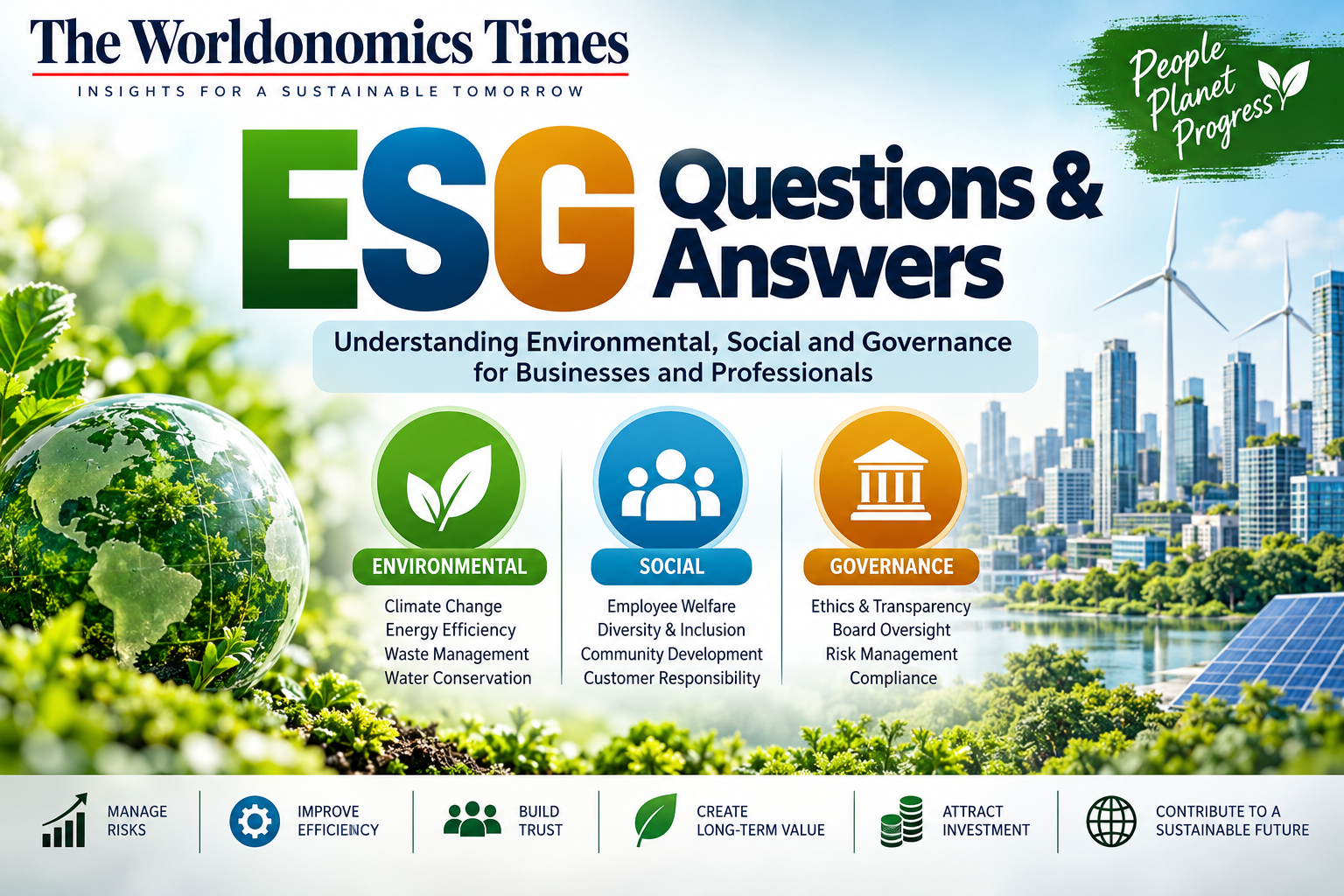
ESG Investing: Complete Guide for Investors
What Is ESG Investing, How It Works, ESG Funds, Risks, Returns and the Future
Investors traditionally evaluated companies using financial indicators such as revenue, profit, earnings growth, debt, cash flow and valuation.
Today, another set of questions is becoming increasingly important:
How does the company manage environmental risks?
How does it treat employees and other stakeholders?
Does it have strong corporate governance?
Could climate change affect its future business?
These questions form the foundation of ESG investing.
ESG investing incorporates environmental, social and governance considerations into investment analysis and decision-making. The objective is not simply to invest in companies that appear environmentally friendly, but to understand how material ESG risks and opportunities can affect a company’s prospects, risk and long-term value.
The ISSB describes ESG integration as incorporating material ESG factors into investment analysis and investment decisions, including valuation, modelling, portfolio construction, voting and engagement.
1. What Is ESG Investing?
ESG investing is an investment approach that considers relevant Environmental, Social and Governance factors alongside traditional financial analysis.
The three pillars are:
Environmental
- Climate change
- Greenhouse-gas emissions
- Energy use
- Renewable energy
- Water
- Waste
- Pollution
- Biodiversity
- Resource efficiency
Social
- Employee welfare
- Health and safety
- Human rights
- Labour practices
- Diversity
- Customer responsibility
- Data privacy
- Supply-chain practices
- Community impact
Governance
- Board structure
- Business ethics
- Anti-corruption
- Risk management
- Internal controls
- Executive remuneration
- Shareholder rights
- Transparency
The objective is to identify information that may affect the company’s financial performance, risk profile or long-term prospects.
2. Is ESG Investing the Same as Sustainable Investing?
The terms are related but not necessarily identical.
ESG investing generally incorporates environmental, social and governance factors into investment analysis.
Sustainable investing is a broader term that may include ESG integration, thematic investing, impact investing and other strategies.
For example:
An investor may use ESG analysis when investing in a traditional manufacturing company.
Another investor may specifically seek investments in renewable-energy companies.
Both may be described as sustainable investment approaches, but their strategies are different.
3. Why Do Investors Consider ESG Factors?
ESG factors can affect a company’s future financial performance.
For example:
Environmental risk
A company exposed to water shortages may face production disruptions.
Social risk
Poor labour practices may lead to employee turnover, litigation or reputational damage.
Governance risk
Weak internal controls may increase the risk of fraud or regulatory penalties.
Climate risk
Extreme weather events may damage assets or disrupt supply chains.
Therefore, ESG analysis can help investors identify risks that may not be immediately visible from conventional financial statements.
The ISSB’s investor-focused standards similarly concentrate on sustainability-related risks and opportunities that could reasonably be expected to affect a company’s cash flows, access to finance or cost of capital.
4. How Does ESG Investing Work?
A typical ESG investment process can include:
Screen → Analyse → Score → Value → Select → Monitor → Engage
The investor may first screen companies, analyse ESG risks, assess financial implications, compare companies and then make investment decisions.
ESG analysis should ideally be integrated with financial analysis rather than conducted as a completely separate exercise.
5. ESG Screening
Screening is one of the oldest ESG investment techniques.
Negative Screening
Investors exclude certain companies or industries.
Examples may include:
- Tobacco
- Certain weapons
- Thermal coal
- Gambling
- Companies violating specified international norms
The exclusions depend on the investor’s policy.
Positive Screening
Investors actively look for companies demonstrating strong ESG characteristics.
Best-in-Class Screening
Companies are compared with their industry peers.
An investor may select companies that perform relatively better on ESG metrics within their sector.
Norms-Based Screening
Companies may be assessed against specified international standards or principles.
The ISSB’s industry guidance recognises screening as one of the approaches used in ESG investment strategies.
6. ESG Integration
ESG integration means systematically considering material ESG factors alongside traditional investment factors.
For example, an equity analyst may normally examine:
- Revenue growth
- EBITDA
- Cash flow
- Debt
- ROE
- Valuation
ESG integration adds questions such as:
- Is the company exposed to climate regulation?
- Is its supply chain vulnerable?
- Does it have significant environmental liabilities?
- Are there governance weaknesses?
- Could employee issues affect productivity?
The goal is not to replace financial analysis.
It is to improve financial analysis by incorporating financially relevant ESG information.
7. ESG and Company Valuation
ESG factors can influence valuation through several channels.
For example:
Environmental risk → Higher operating cost → Lower cash flow
or:
Strong energy efficiency → Lower cost → Higher margins
Similarly:
Weak governance → Higher risk → Higher cost of capital
Therefore, ESG information can potentially affect valuation assumptions.
Investors may incorporate ESG considerations into:
- Revenue forecasts
- Operating margins
- Capital expenditure
- Discount rates
- Terminal value
- Probability of adverse events
8. ESG and Cost of Capital
A company perceived as having significant unmanaged risks may face higher financing costs.
Potential channels include:
- Higher borrowing costs
- Higher insurance costs
- Greater investor risk premium
- Reduced access to certain funds
- Increased regulatory costs
Conversely, strong risk management and transparent sustainability information may improve investor confidence.
However, investors should avoid assuming that a higher ESG score automatically guarantees a lower cost of capital.
The financial relationship must be evaluated based on the company’s actual risks and circumstances.
9. ESG Ratings and ESG Scores
ESG ratings attempt to measure or assess a company’s ESG performance or risk.
Different providers may use different:
- Indicators
- Weightings
- Methodologies
- Data sources
- Industry adjustments
Therefore, two ESG rating providers can assign different ratings to the same company.
Investors should therefore understand the methodology behind an ESG rating rather than treating a single score as absolute truth.
10. ESG Data Used by Investors
Investors may examine information such as:
Environmental
- Scope 1 emissions
- Scope 2 emissions
- Scope 3 emissions
- Energy consumption
- Renewable energy
- Water use
- Waste
- Pollution
- Climate targets
Social
- Employee turnover
- Gender diversity
- Workplace accidents
- Employee training
- Human-rights policies
- Supply-chain assessments
Governance
- Board independence
- Board diversity
- Executive remuneration
- Related-party transactions
- Anti-corruption controls
- Whistleblower mechanisms
11. What Are ESG Funds?
An ESG fund is an investment fund that incorporates sustainability or ESG considerations into its investment strategy.
However, not all ESG funds follow the same approach.
A fund may use:
- ESG integration
- Exclusionary screening
- Best-in-class selection
- Sustainability themes
- Impact investing
- Combination strategies
Therefore, investors should read the fund’s investment strategy rather than judging it only by its name.
12. ESG Thematic Investing
Thematic investing focuses on particular sustainability-related themes.
Examples include:
- Renewable energy
- Clean technology
- Electric mobility
- Water management
- Sustainable agriculture
- Energy efficiency
- Circular economy
A thematic fund may have significant exposure to a particular sector or technology.
Therefore, thematic investing can carry concentration risk.
13. Impact Investing vs ESG Investing
Impact investing and ESG investing are related but different.
ESG Investing
The investor considers ESG factors in investment decisions.
Impact Investing
The investor generally seeks both financial returns and measurable positive social or environmental impact.
For example, an impact investor may invest in a company providing affordable clean-energy solutions to underserved communities and measure the resulting impact.
14. Green Bonds and ESG Investing
Green bonds are debt instruments where proceeds are intended to finance eligible environmental or climate-related projects under the applicable framework.
Examples may include:
- Renewable energy
- Clean transportation
- Energy efficiency
- Sustainable water management
- Pollution prevention
Investors should examine the bond framework, use of proceeds, reporting and other relevant documentation.
A security should not be considered environmentally credible merely because it carries the word “green.”
15. Sustainability-Linked Bonds
Sustainability-linked bonds differ from green bonds.
Green Bond
Focuses primarily on the use of proceeds for eligible green projects.
Sustainability-Linked Bond
Typically links financial or structural characteristics of the instrument to predefined sustainability performance targets.
This distinction is important for investors.
16. ESG and Portfolio Construction
ESG factors can influence how investors construct portfolios.
An investor may:
- Exclude certain companies
- Overweight stronger ESG performers
- Underweight high-risk companies
- Allocate capital to sustainability themes
- Diversify across sectors
- Consider climate exposure
- Assess portfolio-level ESG risks
The ISSB’s industry-based guidance for asset managers specifically recognises ESG incorporation in areas such as strategic asset allocation, sector/geographic allocation and assessment of risk and return.
17. ESG and Active Investing
Active investors can use ESG information to identify opportunities and risks.
For example, an investor may identify a company with:
High emissions + inefficient operations + rising energy costs
The investor may conclude that operational improvements could create value.
Alternatively:
Strong technology + low-carbon product + growing market
could indicate a potential business opportunity.
ESG analysis can therefore support both risk identification and opportunity identification.
18. ESG and Investor Engagement
Investors do not always need to sell a company because of ESG concerns.
They can engage with management.
Engagement may involve discussions about:
- Climate targets
- Board governance
- Worker safety
- Supply-chain practices
- Diversity
- Disclosure quality
- Capital allocation
Large institutional investors may also use voting rights to influence corporate decisions.
This approach is commonly known as active ownership or stewardship.
19. What Are the Risks of ESG Investing?
ESG investing has its own risks.
Greenwashing
A fund or company may make sustainability claims that are stronger than the underlying evidence.
Data Risk
ESG information may be incomplete or inconsistent.
Rating Differences
Different ESG rating providers may produce different assessments.
Concentration Risk
A thematic strategy may become concentrated in particular sectors.
Methodology Risk
Changes in ESG scoring methodologies can change portfolio rankings.
Regulatory Risk
ESG disclosure and investment regulations continue to evolve.
Investors therefore need proper due diligence.
20. Does ESG Investing Always Produce Higher Returns?
No.
There is no universal rule that ESG investments will always outperform conventional investments.
Investment returns depend on:
- Valuation
- Earnings
- Interest rates
- Economic conditions
- Sector performance
- Management quality
- Market sentiment
- Business strategy
- Risk
ESG factors may affect financial performance, but they should not be treated as a guaranteed return generator.
The purpose of ESG analysis is to improve understanding of relevant risks and opportunities, not to promise superior returns.
21. ESG Investing and Traditional Financial Analysis
The strongest investment approach may combine both.
Traditional Analysis
- Revenue
- Profit
- Cash flow
- Debt
- Valuation
- ROE
- Growth
ESG Analysis
- Climate exposure
- Resource dependence
- Human capital
- Governance
- Supply-chain risk
- Regulatory exposure
Together they can provide a broader picture of the company.
22. ESG and Risk Management
Investors can integrate ESG into risk management through:
Identify → Assess → Quantify → Monitor → Mitigate
For example:
Climate Risk
Assess exposure to flooding, heat or drought.
Transition Risk
Assess exposure to carbon pricing, regulation and technological change.
Social Risk
Assess labour and human-rights issues.
Governance Risk
Assess fraud, corruption and internal-control weaknesses.
23. ESG Portfolio Dashboard
An institutional investor can create an ESG dashboard containing:
| KPI | Portfolio Metric |
|---|---|
| Carbon intensity | tCO₂e / revenue |
| Scope 1 & 2 emissions | Portfolio exposure |
| Scope 3 | Where material |
| Board independence | % |
| Female representation | % |
| Safety performance | Incident rate |
| ESG controversies | Number |
| Governance risk | Rating |
| Climate targets | % companies |
| ESG engagement | Number of engagements |
The dashboard can help investment committees monitor ESG exposure alongside financial performance.
24. What Should Individual Investors Check?
Before investing in an ESG-focused product, investors should examine:
- Investment objective
- Investment strategy
- ESG methodology
- Screening criteria
- Portfolio holdings
- Sector exposure
- Concentration
- Fees and expenses
- Risk level
- Sustainability claims
- Disclosure documents
- Historical performance
Investors should never select an investment solely because it carries an ESG label.
25. Role of CA and CMA Professionals in ESG Investing
Finance professionals can contribute significantly to ESG investment analysis.
Chartered Accountants
CAs can contribute through:
- Financial analysis
- ESG reporting analysis
- Assurance
- Risk assessment
- Governance review
- Investment due diligence
Cost Accountants
CMAs can contribute through:
- Cost analysis
- Carbon costing
- Resource efficiency
- Management accounting
- ESG performance measurement
- Supply-chain analysis
- Sustainability budgeting
The intersection of finance and ESG creates significant opportunities for accounting professionals.
26. ESG Investing and the Future
ESG investing is evolving from a specialised investment strategy toward a broader risk-management and investment-analysis discipline.
The ISSB continues to develop the global sustainability disclosure architecture. In 2026, its work includes supporting implementation of IFRS S1 and S2 and developing research around areas such as workforce-related disclosures and nature-related risks and opportunities.
This means investors are likely to have access to increasingly structured sustainability information.
27. A Simple ESG Investment Framework
Investors can use the following framework:
Step 1 – Understand the Business
What does the company actually do?
Step 2 – Identify Material ESG Risks
Which environmental, social and governance issues could materially affect the business?
Step 3 – Analyse Financial Impact
Could those issues affect revenue, costs, assets, financing or cash flow?
Step 4 – Evaluate Management
How effectively is management addressing the risks?
Step 5 – Check ESG Data
Is the information credible, consistent and sufficiently supported?
Step 6 – Compare Peers
How does the company perform relative to competitors?
Step 7 – Consider Valuation
Is the stock attractively valued after considering ESG-related risks and opportunities?
Step 8 – Monitor
ESG analysis should continue after the investment is made.
Conclusion
ESG investing is not simply about buying companies with high ESG scores.
It is about understanding how environmental, social and governance factors can influence business performance, risk, valuation and long-term investment outcomes.
A disciplined ESG investor should combine:
Financial Analysis + ESG Analysis + Risk Assessment + Valuation + Portfolio Management
The most important principle is simple:
ESG should complement investment analysis—not replace it.
As sustainability disclosure becomes more standardised globally, investors are likely to receive more comparable information about companies’ material sustainability-related risks and opportunities. The challenge will increasingly shift from finding ESG information to understanding it correctly and integrating it into investment decisions.