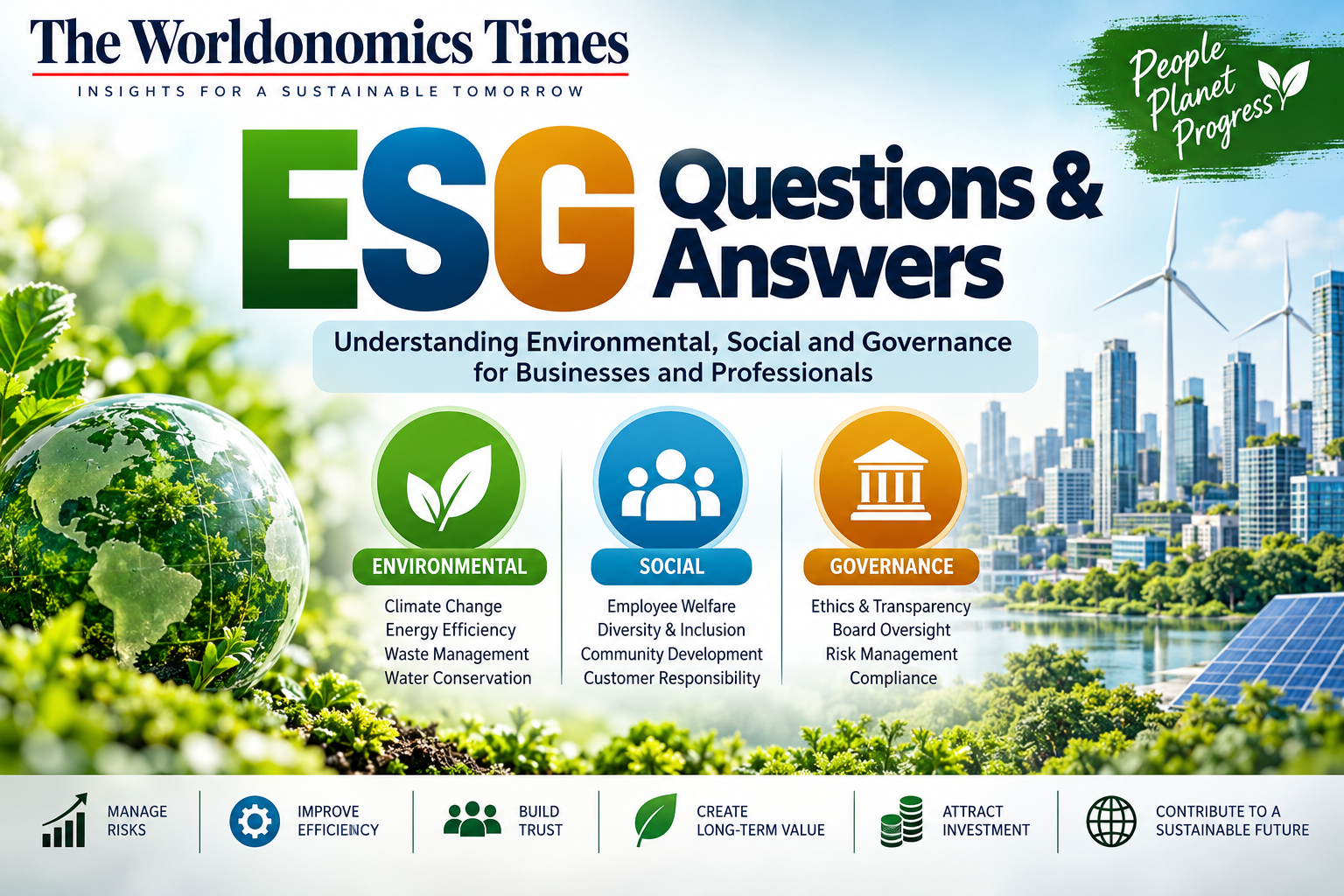
Environmental, Social and Governance (ESG) has moved from being a voluntary corporate initiative to an important part of business strategy, risk management, financing, supply-chain management and corporate reporting.
For many organisations, however, the biggest question is simple: Where should we start?
An effective ESG journey does not require a company to transform everything at once. The better approach is to understand the organisation’s most significant sustainability impacts, risks and opportunities, establish a baseline, set measurable priorities and gradually integrate ESG into everyday business decisions.
Global frameworks such as the GRI Standards and the IFRS Sustainability Disclosure Standards provide useful reference points. GRI focuses strongly on an organisation’s impacts on the economy, environment and people, while IFRS S1 and S2 focus on sustainability-related risks and opportunities that could reasonably be expected to affect an organisation’s prospects.
1. What is an ESG journey?
An ESG journey is the process through which an organisation identifies, manages, measures and communicates its environmental, social and governance performance.
It normally progresses through several stages:
Understand → Assess → Prioritise → Measure → Set Targets → Implement → Monitor → Report → Improve
The journey is continuous. ESG should not be treated as a one-time certification or annual reporting exercise.
2. Why should a company start its ESG journey?
There are several reasons.
ESG can help organisations:
- Identify emerging business risks.
- Reduce energy, water and resource costs.
- Improve operational efficiency.
- Strengthen employee engagement.
- Improve supply-chain resilience.
- Meet customer requirements.
- Respond to investor expectations.
- Improve access to sustainable finance.
- Prepare for regulatory reporting.
- Strengthen reputation and stakeholder confidence.
For investors and lenders, sustainability-related risks and opportunities can be relevant to decisions about providing capital. IFRS S1 is specifically designed around this investor-focused perspective.
3. Should ESG start with reporting?
No.
A common mistake is to begin by asking:
“What should we disclose in our ESG report?”
A better question is:
“What sustainability issues are most important to our business and stakeholders?”
Reporting should be the result of a well-designed ESG management process.
An organisation should first understand its risks, impacts, opportunities, policies, performance and data before deciding how to communicate them.
4. Step One: Obtain leadership commitment
The ESG journey should start at the top.
The board and senior management should establish:
- ESG vision.
- Strategic objectives.
- Governance responsibilities.
- Reporting responsibilities.
- Resources and budget.
- Accountability mechanisms.
- Key performance indicators.
Without leadership commitment, ESG can become an isolated activity handled only by the sustainability or CSR department.
5. Step Two: Understand your business
Before identifying ESG priorities, understand the organisation’s business model.
Map:
- Products and services.
- Manufacturing and operational locations.
- Employees.
- Customers.
- Suppliers.
- Contractors.
- Distribution channels.
- Energy consumption.
- Natural-resource dependence.
- Communities affected by operations.
- Major regulatory requirements.
GRI’s material-topic process similarly begins with understanding the organisation’s context, activities, business relationships and stakeholders.
6. Step Three: Identify your stakeholders
Stakeholder engagement is an important part of an ESG programme.
Stakeholders may include:
- Employees.
- Customers.
- Investors.
- Lenders.
- Suppliers.
- Government authorities.
- Regulators.
- Local communities.
- Business partners.
- Civil society organisations.
The company should understand what these stakeholders expect and which ESG issues are most relevant to them.
7. Step Four: Conduct an ESG materiality assessment
Materiality is one of the most important steps in an ESG journey.
The organisation should identify ESG topics that could have significant impacts, risks or opportunities.
Typical topics may include:
Environmental
- Climate change.
- Energy consumption.
- Greenhouse-gas emissions.
- Water management.
- Waste.
- Pollution.
- Biodiversity.
- Circular economy.
Social
- Employee health and safety.
- Diversity and inclusion.
- Human rights.
- Labour practices.
- Training and development.
- Customer welfare.
- Community impact.
Governance
- Business ethics.
- Anti-corruption.
- Board governance.
- Risk management.
- Data privacy.
- Cybersecurity.
- Whistleblower mechanisms.
- Responsible procurement.
GRI’s approach requires organisations to determine material topics systematically and document the process, while IFRS S1 requires assessment of material sustainability-related risks and opportunities from an investor perspective.
8. Step Five: Conduct an ESG gap assessment
Once priorities are identified, compare the organisation’s current position with its desired ESG maturity.
For example:
| Area | Current Position | Desired Position |
|---|---|---|
| Energy | Data partially available | Complete energy dashboard |
| Emissions | No formal baseline | Scope 1 & 2 baseline |
| Diversity | Basic HR data | Defined diversity KPIs |
| Supplier ESG | No formal assessment | Supplier ESG questionnaire |
| Governance | Existing policies | ESG responsibilities formally assigned |
| Reporting | Limited disclosure | Structured ESG reporting |
This creates an ESG roadmap.
9. Step Six: Establish your baseline
You cannot effectively manage what you cannot measure.
Develop baseline information for key ESG indicators.
For example:
Environmental baseline
- Electricity consumption.
- Fuel consumption.
- Renewable-energy percentage.
- Scope 1 emissions.
- Scope 2 emissions.
- Water consumption.
- Waste generation.
Social baseline
- Employee numbers.
- Gender composition.
- Employee turnover.
- Training hours.
- Workplace accidents.
- Employee engagement.
Governance baseline
- Board composition.
- Ethics training.
- Compliance incidents.
- Whistleblower cases.
- Cybersecurity incidents.
- Supplier compliance.
The baseline becomes the starting point against which future performance can be measured.
10. Step Seven: Build ESG data systems
ESG data should be treated with the same seriousness as financial data.
Assign:
- Data owners.
- Data sources.
- Collection frequency.
- Calculation methodology.
- Review responsibilities.
- Documentation requirements.
- Internal controls.
Finance professionals can play a major role here because ESG reporting increasingly requires reliable, traceable and decision-useful information.
11. Step Eight: Set realistic ESG targets
After establishing the baseline, set measurable targets.
For example:
Energy: Reduce energy intensity by 15% over three years.
Emissions: Reduce Scope 1 and 2 emissions by 20% by a defined target year.
Water: Reduce water consumption per unit of production by 10%.
Safety: Reduce lost-time injury frequency.
Diversity: Increase representation of women in management.
Targets should have:
- A baseline year.
- Target year.
- Responsible person.
- Measurement methodology.
- Periodic review.
12. Step Nine: Create an ESG action plan
Targets are meaningful only when supported by actions.
An ESG action plan could include:
- Energy-efficiency projects.
- Renewable-energy procurement.
- Waste reduction.
- Water conservation.
- Employee safety programmes.
- Diversity initiatives.
- Supplier ESG assessments.
- Anti-corruption training.
- ESG data controls.
- Climate-risk assessment.
Each action should have an owner, deadline, budget and KPI.
13. Step Ten: Integrate ESG into enterprise risk management
ESG should not operate separately from risk management.
Companies should identify:
Physical climate risks: floods, heatwaves, droughts and storms.
Transition risks: carbon regulations, technology changes, changing customer preferences and energy transition.
Social risks: labour disputes, health and safety issues, human-rights concerns and employee turnover.
Governance risks: corruption, fraud, cybersecurity, regulatory violations and weak oversight.
IFRS S1 organises sustainability-related financial disclosures around governance, strategy, risk management, and metrics and targets.
14. Step Eleven: Integrate ESG into finance
ESG should eventually become part of financial decision-making.
Finance teams can incorporate ESG into:
- Budgeting.
- Capital expenditure.
- Cost management.
- Investment appraisal.
- Risk assessment.
- Procurement.
- Working-capital decisions.
- Business valuation.
- Financing decisions.
For example, a proposed factory investment can be evaluated not only on its financial return but also on energy consumption, carbon exposure, regulatory risk, water requirements and long-term resilience.
15. Step Twelve: Develop an ESG governance structure
A practical governance model could include:
Board: Oversight and strategic direction.
ESG Committee: Coordination and monitoring.
CFO/Finance: Data, controls, financial implications and reporting.
HR: Workforce and social indicators.
Procurement: Supplier ESG.
Operations: Energy, emissions, waste and resource efficiency.
Legal/Compliance: Regulatory and governance requirements.
Internal Audit: Controls and assurance readiness.
ESG therefore becomes a cross-functional responsibility rather than the responsibility of one department.
16. Step Thirteen: Select appropriate reporting frameworks
The appropriate framework depends on the organisation, stakeholders and regulatory requirements.
GRI can help organisations report their impacts on the economy, environment and people.
IFRS S1 and IFRS S2 provide an investor-focused global baseline for sustainability-related financial and climate-related disclosures. IFRS S1 covers sustainability-related risks and opportunities, while IFRS S2 specifically addresses climate-related risks and opportunities.
Companies should first identify applicable local regulations before selecting additional voluntary frameworks.
17. Step Fourteen: Start with a pilot project
Companies do not necessarily need to implement a full ESG programme immediately.
A practical approach is to begin with a pilot.
For example:
Year 1
- ESG governance.
- Materiality assessment.
- ESG baseline.
- Scope 1 and Scope 2 emissions.
- Key social indicators.
- Governance assessment.
Year 2
- Expand Scope 3 assessment.
- Supplier ESG programme.
- Climate-risk assessment.
- ESG-linked KPIs.
Year 3
- Strengthen controls.
- External assurance readiness.
- Advanced targets.
- Integrated reporting.
This phased approach allows organisations to learn before scaling.
18. What role can CA and CMA professionals play?
CA and CMA professionals are particularly well positioned to contribute to ESG because ESG increasingly intersects with financial reporting, risk management, cost management and internal controls.
Their roles can include:
- ESG data governance.
- Carbon-cost analysis.
- ESG budgeting.
- Sustainability-linked KPIs.
- ESG risk assessment.
- Internal controls.
- ESG assurance readiness.
- Sustainable finance analysis.
- Management reporting.
- ESG performance dashboards.
For management accountants, ESG also creates opportunities to connect sustainability performance with cost reduction, productivity and long-term value creation.
19. What mistakes should companies avoid?
Companies beginning their ESG journey should avoid:
- Treating ESG as only a marketing exercise.
- Collecting data without clear ownership.
- Setting unrealistic targets.
- Ignoring supply-chain risks.
- Publishing unsupported claims.
- Focusing only on environmental issues.
- Treating CSR and ESG as identical.
- Waiting until reporting season to collect data.
- Ignoring internal controls.
- Using different methodologies every year.
The objective should be credible performance improvement, not simply attractive reporting.
20. What should an ESG starter checklist look like?
A company can begin with this simple checklist:
☐ Board-level ESG responsibility identified
☐ ESG team or working group established
☐ Business and stakeholder mapping completed
☐ Materiality assessment completed
☐ ESG regulatory requirements identified
☐ Current ESG policies reviewed
☐ Environmental baseline established
☐ Social baseline established
☐ Governance baseline established
☐ ESG data owners appointed
☐ ESG KPIs selected
☐ Targets established
☐ ESG action plan prepared
☐ ESG risks incorporated into risk management
☐ ESG reporting framework selected
☐ Internal controls documented
☐ Progress reviewed periodically
Conclusion
Starting an ESG journey does not mean becoming perfect overnight. It means creating a structured process for understanding sustainability-related risks and opportunities, measuring current performance and continuously improving.
The most effective ESG journey can be summarised in five principles:
Start with strategy.
Prioritise what is material.
Measure what matters.
Assign responsibility.
Improve continuously.
Organisations that begin building their ESG capabilities today will be better prepared for changing regulations, investor expectations, customer requirements and sustainability-related business risks.
Most importantly, ESG should ultimately move from a reporting exercise to a business-management discipline.
For organisations looking for a practical starting point, the first 90 days can focus on four outcomes: leadership commitment, materiality assessment, baseline data and a clear ESG roadmap. Once these foundations are established, the organisation can progressively build stronger targets, controls, reporting and performance management.