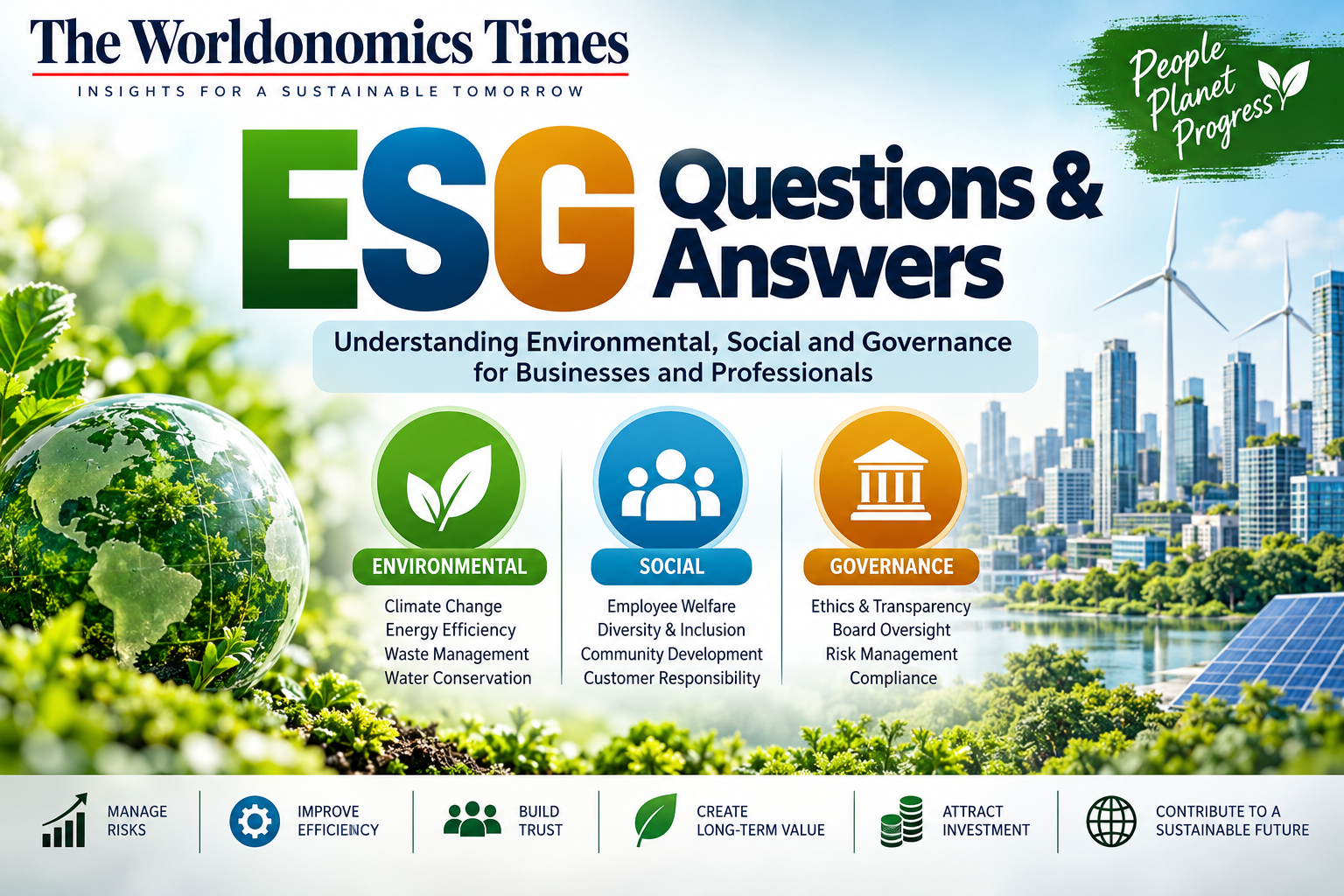
Environmental, Social and Governance—better known as ESG—has become one of the most important concepts in modern business. Companies are increasingly expected to demonstrate not only how much profit they generate, but also how responsibly they manage environmental risks, employees, communities, customers, investors and corporate governance.
ESG is therefore not simply an environmental concept. It is a framework for understanding how sustainability-related issues can affect a company’s operations, reputation, risk profile, access to capital and long-term value creation.
What Does ESG Stand For?
ESG represents three broad areas:
E – Environmental: How a company affects and responds to the natural environment.
S – Social: How a company manages its relationships with employees, customers, suppliers, communities and other stakeholders.
G – Governance: How a company is directed, controlled and held accountable.
What Comes Under Environmental ESG?
Environmental factors can include:
- Greenhouse-gas emissions
- Energy consumption
- Renewable energy
- Climate change
- Water management
- Waste management
- Pollution
- Biodiversity
- Circular economy
- Resource efficiency
- Environmental compliance
For example, a manufacturing company may measure its carbon emissions, electricity consumption, water usage and waste generation.
What Comes Under Social ESG?
The social pillar focuses on people.
Important issues include:
- Employee health and safety
- Diversity and inclusion
- Labour rights
- Human rights
- Employee development
- Fair wages
- Customer welfare
- Data privacy
- Supply-chain labour practices
- Community development
A company with strong social practices generally seeks to create a safe, fair and responsible working environment.
What Is Governance in ESG?
Governance concerns the systems through which an organisation is managed.
It may include:
- Board structure
- Board independence
- Business ethics
- Anti-corruption
- Risk management
- Internal controls
- Whistleblower mechanisms
- Executive remuneration
- Shareholder rights
- Tax transparency
- Regulatory compliance
Good governance provides the foundation for credible environmental and social performance.
Why Is ESG Important?
ESG has become increasingly important because sustainability-related issues can create both risks and opportunities.
Climate change can disrupt supply chains. Poor labour practices can result in legal and reputational problems. Weak governance can lead to fraud or regulatory penalties.
On the other hand, companies that improve energy efficiency, develop sustainable products, retain employees and strengthen governance may improve resilience and create new business opportunities.
ESG and Investors
Investors increasingly examine sustainability-related risks alongside traditional financial information.
ESG information can help investors understand questions such as:
- Is the company exposed to climate risks?
- Is its supply chain resilient?
- Does it have strong governance?
- How does it manage employees?
- Are sustainability claims supported by data?
- Could environmental or social issues affect future cash flows?
This is one reason investor-focused sustainability disclosure standards such as IFRS S1 and IFRS S2 have gained international importance. IFRS S1 covers sustainability-related risks and opportunities, while IFRS S2 focuses specifically on climate-related risks and opportunities.
ESG Is Not the Same as CSR
ESG and CSR are related but different.
CSR, or Corporate Social Responsibility, traditionally focuses on a company’s social responsibilities and community-oriented activities.
ESG is broader and increasingly connected with business strategy, risk management, financial decision-making, measurable performance and disclosure.
CSR may include a company’s contribution to education or healthcare, while ESG may examine employee safety, carbon emissions, governance controls and climate-related financial risks.
ESG Reporting
ESG reporting communicates a company’s sustainability-related performance to stakeholders.
Different jurisdictions use different frameworks and regulations. Globally, ISSB standards are becoming an important baseline for sustainability-related financial disclosures. As of July 2026, S&P Global reported that 35 jurisdictions had adopted ISSB standards on a voluntary or mandatory basis, with another 11 planning adoption.
In India, listed companies are subject to the SEBI Business Responsibility and Sustainability Reporting framework, while BRSR Core provides a more focused set of ESG indicators with assurance requirements.
ESG and Finance Professionals
ESG is no longer restricted to sustainability departments.
Finance professionals increasingly have roles in:
- ESG data management
- Carbon accounting
- Sustainability budgeting
- ESG risk assessment
- Internal controls
- ESG assurance
- BRSR reporting
- Sustainability-linked financing
- ESG performance measurement
This creates significant opportunities for Chartered Accountants, Cost Accountants, auditors, CFOs and management accountants.
How Can a Company Start Its ESG Journey?
A practical ESG journey can follow these steps:
Understand → Assess → Prioritise → Measure → Set Targets → Implement → Monitor → Report → Improve
The company should first identify its most important ESG issues, establish reliable baseline data and develop measurable objectives.
The Future of ESG
ESG is gradually moving from a voluntary communication exercise toward a structured business and reporting discipline.
Companies will increasingly need to connect sustainability with:
- Financial performance
- Enterprise risk management
- Capital allocation
- Supply-chain management
- Corporate strategy
- Investor communication
- Board oversight
The future of ESG will therefore not simply be about producing a sustainability report. It will be about demonstrating how sustainability-related risks and opportunities influence the company’s strategy and long-term value.
Conclusion
ESG is best understood as a framework for responsible and resilient business management. Environmental performance, social responsibility and governance quality can directly influence reputation, operational resilience, regulatory compliance, financing and long-term business value.
For companies, the key question is no longer simply “Should we adopt ESG?” but rather “How can we integrate ESG into the way we manage and grow our business?”