By The Worldonomics Times | Tax & Regulatory Affairs
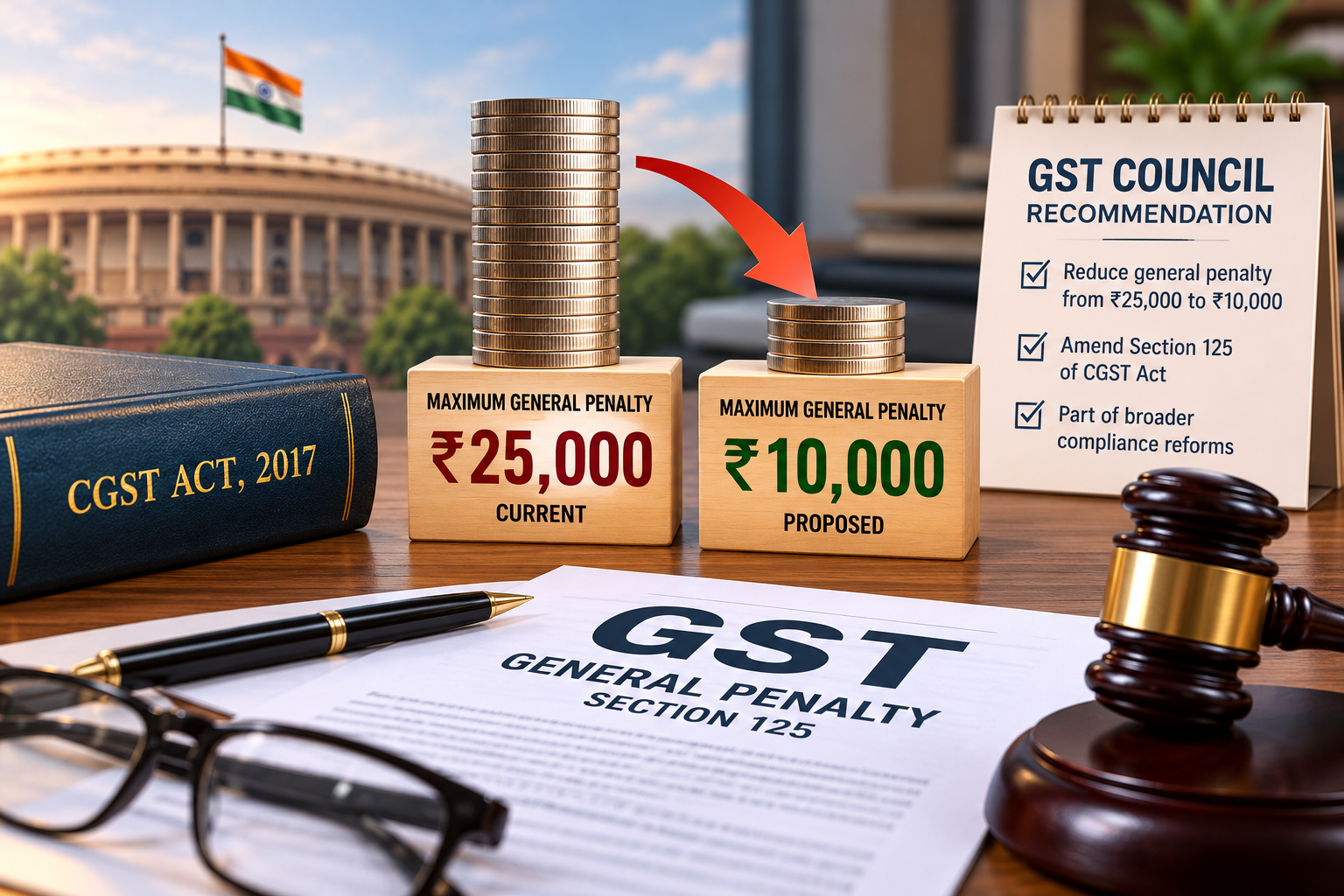
India’s Goods and Services Tax (GST) framework may soon become less punitive for certain procedural and compliance-related violations, following the GST Council’s recommendation to reduce the maximum general penalty from ₹25,000 to ₹10,000. The proposed change could ease the financial burden on businesses, particularly small enterprises, while supporting the government’s broader effort to simplify tax administration and reduce avoidable litigation.
The recommendation was announced after the Council’s 57th meeting on October 8, 2026. However, the key question for taxpayers is not merely how much the penalty may fall, but when the revised limit will become legally enforceable.
According to the government’s official announcement of the 57th GST Council meeting, the Council recommended amending Section 125 of the Central Goods and Services Tax (CGST) Act, 2017, to lower the maximum general penalty from ₹25,000 to ₹10,000. The proposal forms part of a wider package of reforms aimed at improving compliance processes and making dispute resolution more predictable.
Understanding the general penalty under Section 125
Section 125 of the CGST Act provides for a general penalty where a person contravenes a provision of the Act or its rules for which no separate penalty has been prescribed.
Under the existing statutory wording, such a person may be liable to a penalty extending to ₹25,000. The provision therefore operates as a residual mechanism, covering specified contraventions that do not attract a separately prescribed penalty.
The distinction is important because the proposed reduction is not a blanket cap on every penalty imposed under GST law. Several provisions prescribe their own penalties for particular offences, including failures relating to invoicing, tax payment and input tax credit. Those provisions must be examined independently.
The CBIC’s official tax information portal currently reproduces Section 125 with the ₹25,000 maximum. Accordingly, the proposed ₹10,000 ceiling should not be treated as universally applicable until the relevant statutory amendment takes effect.
Why the proposed reduction matters
Reducing the maximum general penalty by ₹15,000 represents a 60% decrease in the existing ceiling. For businesses facing relatively minor compliance lapses, the change could reduce the financial consequences of contraventions falling within Section 125.
Smaller enterprises may benefit particularly from a more proportionate approach to compliance enforcement. Businesses with limited administrative resources can face difficulties in meeting every procedural requirement across invoicing, record-keeping, reconciliations and return filings. A lower maximum general penalty could make the consequences of certain non-compliance less burdensome.
The proposal may also encourage greater confidence in the GST dispute-resolution framework. Predictable penalties help businesses assess potential liabilities, maintain appropriate compliance budgets and resolve disputes with greater certainty.
Nevertheless, the reduction should not be interpreted as permission to disregard statutory obligations. Taxpayers remain responsible for maintaining accurate records, filing returns, issuing appropriate documents and complying with applicable GST requirements.
Not every GST penalty will be capped at ₹10,000
One of the most important considerations is the distinction between a general penalty and penalties prescribed for specific offences.
Section 125 applies where the Act or its rules do not provide a separate penalty for the relevant contravention. Where another provision prescribes a specific penalty, the consequences under that provision must be assessed on their own terms.
For example, certain offences involving fraudulent conduct, incorrect invoices or other specified violations are governed by separate statutory provisions. The Council’s recommendation to reduce the general penalty does not automatically reduce those independently prescribed penalties.
Businesses should therefore avoid assuming that all GST-related liabilities will be limited to ₹10,000. The nature of the contravention, the applicable statutory provision and the facts of the case will continue to determine the potential exposure.
Part of a wider GST compliance reform
The proposed reduction is one element of a broader package of measures recommended by the Council to simplify GST administration and reduce unnecessary litigation.
The reforms include proposals relating to demand notices, adjudication, prosecution thresholds and appeal procedures. The Council has also recommended a minimum threshold of ₹10,000 for issuing show-cause notices in specified tax-demand matters, alongside changes to penalties in certain non-fraud cases.
These proposals address different aspects of GST enforcement and should not be conflated. The proposed ₹10,000 maximum general penalty under Section 125 is distinct from the proposed ₹10,000 minimum threshold for issuing specified notices.
The government has outlined these measures in its backgrounder on Next-Gen GST process reforms. Their individual legal effects will depend on the corresponding amendments, notifications and commencement provisions.
What taxpayers should do now
Businesses should continue complying with the existing statutory framework until the relevant amendment becomes effective. They should not assume that a penalty imposed under the current law is automatically reduced merely because the Council has recommended a lower ceiling.
Taxpayers with pending proceedings should examine the final amendment carefully, particularly any provisions dealing with commencement, transitional arrangements and cases already under adjudication. Professional advice may be appropriate where a proposed change could materially affect an existing dispute.
Businesses should also distinguish between the amount of a penalty and the underlying tax liability. A reduction in the maximum general penalty does not, by itself, extinguish unpaid tax, interest or other liabilities arising under separate provisions.
The road ahead
The proposed reduction from ₹25,000 to ₹10,000 reflects an effort to make GST enforcement more proportionate and business-friendly. If implemented, it could provide meaningful relief in cases involving contraventions for which no separate penalty is prescribed.
For now, however, the legal position must be determined by the statute in force, not solely by the Council’s announcement.
The bottom line: The GST Council has recommended a 60% reduction in the maximum general penalty under Section 125 of the CGST Act. Businesses should welcome the proposed relief while waiting for the implementing amendment and its effective date before relying on the lower limit.