By The Worldonomics Times | Tax & Regulatory Affairs
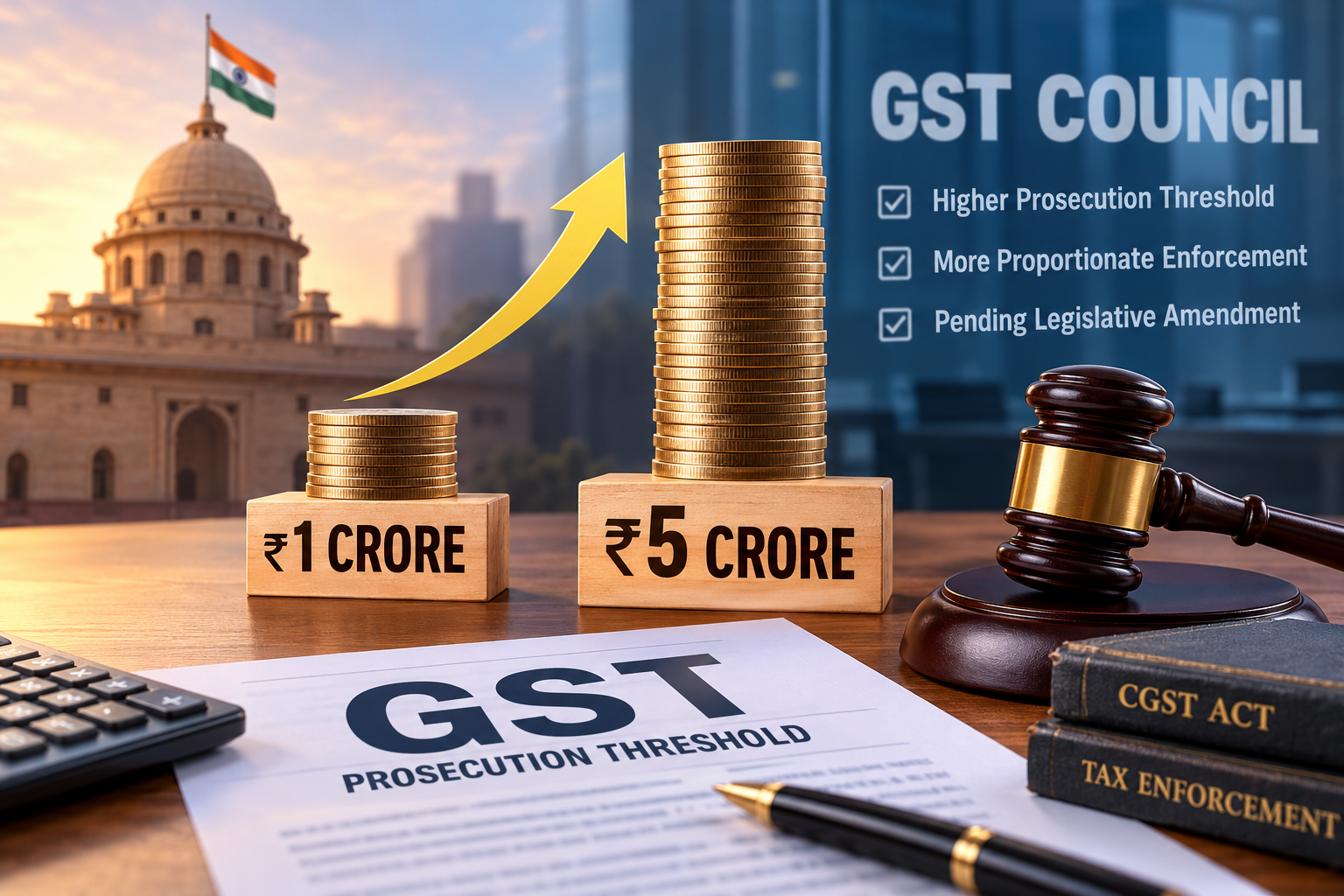
India’s Goods and Services Tax (GST) enforcement framework may be moving towards a more measured approach to criminal prosecution, with the GST Council recommending an increase in the monetary threshold from ₹1 crore to ₹5 crore. The proposal could reduce the exposure of businesses to criminal proceedings for certain tax-related offences involving comparatively smaller amounts. Yet, its practical significance depends on a crucial legal question: has the implementing amendment come into force?
The distinction matters. A recommendation by the GST Council establishes the direction of policy, but it does not, by itself, amend the Central Goods and Services Tax (CGST) Act, 2017. Until the necessary legislative changes take effect, taxpayers should not assume that the proposed threshold automatically replaces the existing statutory framework.
What has the GST Council recommended?
At its 57th meeting on October 8, 2026, the GST Council recommended raising the monetary threshold for prosecution from ₹1 crore to ₹5 crore. The proposal forms part of a wider package intended to rationalise arrest and prosecution provisions, narrow certain offences and provide greater proportionality in the treatment of tax-related violations.
According to the government’s official press release on the 57th GST Council meeting, the proposed changes also include removing the arrest powers provided under Section 69 of the CGST Act and modifying specified offences under Section 132.
The prosecution threshold is particularly significant because Section 132 provides the statutory framework for criminal punishment for specified GST offences, including certain forms of tax evasion, wrongful input tax credit (ITC) claims and fraudulent refunds.
However, the proposed ₹5 crore threshold should not be interpreted as a general exemption from GST enforcement for amounts below that figure. Tax assessments, recovery proceedings, interest, civil penalties and other consequences may continue to apply independently of criminal prosecution, subject to the relevant statutory provisions.
Why the proposed increase matters
The proposed increase from ₹1 crore to ₹5 crore represents a fivefold rise in the monetary threshold. If implemented as recommended, it could narrow the circumstances in which specified GST offences attract prosecution solely by reference to the amount involved.
For businesses, this may improve predictability when assessing criminal-law exposure arising from disputed transactions, input tax credit claims and alleged tax evasion. It could also help distinguish serious, high-value fraud from disputes that are more appropriately resolved through assessment, adjudication and recovery mechanisms.
The potential benefits extend to compliance planning. Businesses operating across multiple states often face complex documentation requirements, reconciliations and interpretations of GST provisions. A more proportionate prosecution framework could reduce uncertainty, provided it is accompanied by clear statutory language and consistent enforcement.
Nevertheless, a higher monetary threshold does not make fraudulent conduct lawful. Nor does it necessarily prevent prosecution for every offence involving less than ₹5 crore. The precise outcome depends on the offences covered by the amended law, the method used to calculate the relevant amount and any applicable statutory exceptions.
The implementing amendment is the decisive test
Before reporting the ₹5 crore threshold as operative law, the relevant amendment must be verified against the existing provisions of the CGST Act.
The Council’s October 8 announcement establishes that the increase was recommended. It does not, on its own, establish the amendment’s commencement date or its application to particular cases.
The official GST Council website provides access to the meeting’s recommendations and related explanatory material. The government’s subsequent frequently asked questions on the proposed prosecution reforms likewise describe the changes as recommendations and proposed amendments.
The next step is to identify the relevant amending Act, examine whether it expressly modifies Section 132, and verify the commencement notification and any transitional or saving provisions. An announcement of a planned implementation date is not a substitute for this exercise.
As of October 29, 2026, the official material reviewed confirms the Council’s recommendation, but does not establish that the specific increase to ₹5 crore has become operative. Accordingly, the proposal should not be presented as an already effective change without confirmation from the applicable amending legislation and commencement instrument.
Other proposed changes to prosecution
The proposed increase is part of a broader reconsideration of GST criminal enforcement. The Council has recommended omitting clause (i) of Section 132(1), removing the words “evades tax” from clause (e), and narrowing clause (h) by deleting the expression “or in any other manner deals with.”
It has also recommended revising clause (c) to focus on fraudulent availment of ITC without receipt of goods or services, or without an invoice or bill.
These changes seek to narrow the scope of specified offences and make their application more precise. The Council has additionally recommended changes to imprisonment provisions, including greater judicial discretion over punishment and the removal of the mandatory minimum six-month imprisonment requirement.
Each proposal must, however, be assessed against the final statutory text. Changes to the prosecution threshold, the definition of offences, arrest powers and sentencing are legally distinct measures; confirmation of one does not establish that all the others have commenced.
What businesses should do now
Businesses should continue to maintain accurate GST records, reconcile returns and ITC claims, preserve supporting invoices and respond promptly to lawful notices. They should also review existing investigations and prosecutions with qualified tax counsel rather than assuming that the proposed increase automatically provides relief.
For ongoing cases, the final amendment’s commencement, scope and transitional provisions will be particularly important. A change in the monetary threshold does not, by itself, settle whether pending proceedings will be affected.
The way forward
The proposed increase to ₹5 crore could mark a meaningful shift towards more proportionate GST enforcement while retaining criminal sanctions for serious tax fraud. Its actual impact, however, will depend on the legislation that implements it.