A Government of India initiative empowering aspiring entrepreneurs, supporting micro-enterprises and strengthening inclusive economic growth
The Prime Minister’s Employment Generation Programme (PMEGP) is one of India’s important credit-linked subsidy schemes for promoting self-employment and entrepreneurship. By helping individuals establish new micro-enterprises in manufacturing and services, the programme aims to create sustainable livelihood opportunities, particularly in rural and urban areas.
For India, where micro, small and medium enterprises (MSMEs) play a significant role in employment generation and economic development, PMEGP provides an important pathway for transforming business ideas into viable enterprises.
What Is PMEGP?
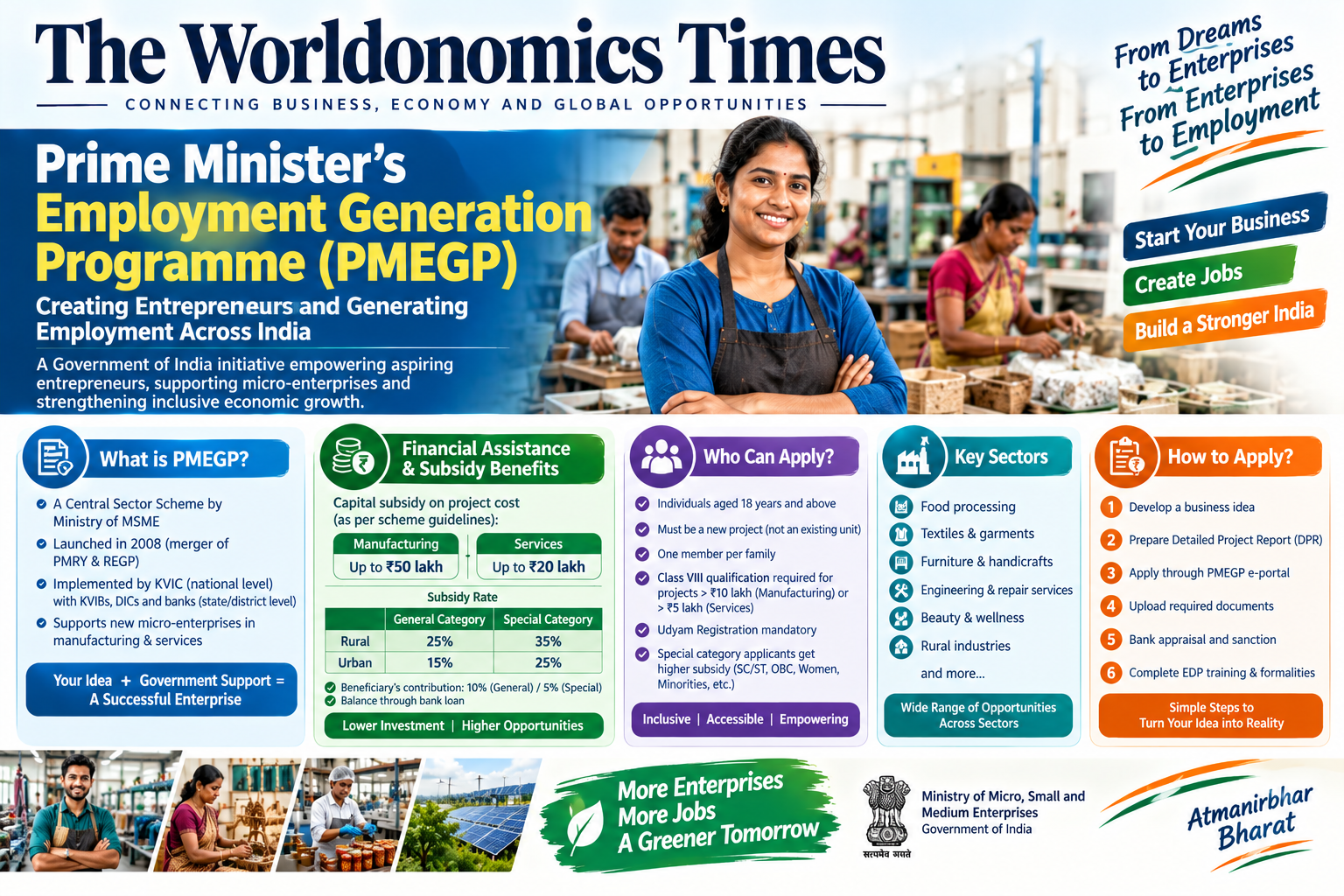
PMEGP is a Central Sector Scheme administered by the Ministry of Micro, Small and Medium Enterprises (Ministry of MSME). It was introduced in 2008 by merging the earlier Prime Minister’s Rojgar Yojana (PMRY) and Rural Employment Generation Programme (REGP).
The Khadi and Village Industries Commission (KVIC) is the national-level nodal agency responsible for implementing the programme. At the state and district levels, it works through State Khadi and Village Industries Boards (KVIBs), District Industries Centres (DICs), KVIC offices and participating banks.
The scheme primarily supports the establishment of new micro-enterprises in the non-farm sector, helping traditional artisans, unemployed youth and aspiring entrepreneurs create sustainable sources of income.
Financial Assistance and Subsidy Benefits
One of PMEGP’s major attractions is its margin money subsidy, which reduces the effective financial burden on eligible entrepreneurs.
Under the current published scheme guidelines, the maximum project cost eligible for subsidy is:
- Manufacturing sector: Up to ₹50 lakh.
- Business and service sector: Up to ₹20 lakh.
The subsidy depends on the applicant’s category and whether the enterprise is established in a rural or urban area.
| Applicant category | Rural subsidy | Urban subsidy |
|---|---|---|
| General category | 25% | 15% |
| Special category | 35% | 25% |
Special categories include SC/ST, OBC, minorities, women, ex-servicemen, transgender persons, persons with disabilities, applicants from the North-Eastern Region, and eligible applicants from notified aspirational districts, hill and border areas.
The beneficiary’s own contribution is generally 10% of the project cost for the general category and 5% for the special category. The remaining eligible project finance is arranged through the participating bank.
The margin money subsidy is back-ended assistance, not an immediate cash payment to the entrepreneur. It is routed through the banking system and adjusted in accordance with scheme conditions and verification requirements.
Who Can Apply?
PMEGP is open to eligible individuals aged 18 years and above. There is no income ceiling for setting up a new enterprise under the scheme.
However, applicants must meet certain conditions:
- Only new projects specifically sanctioned under PMEGP are eligible for assistance.
- For projects costing more than ₹10 lakh in manufacturing or ₹5 lakh in business and services, the applicant must have passed at least Class VIII.
- Only one member from a family can receive financial assistance under the scheme.
- Existing units that have already received government subsidy under specified earlier schemes are generally not eligible for assistance as new units.
- Projects must include eligible capital expenditure; projects without capital expenditure are not considered.
Self-help groups, eligible institutions and other categories may also qualify subject to the applicable scheme guidelines.
Sectors and Business Opportunities
PMEGP supports a wide range of viable non-farm business activities. These include food processing, textile and garment manufacturing, furniture production, handicrafts, engineering workshops, packaging, repair services, beauty and wellness services, rural industries and other eligible service enterprises.
For example, an aspiring entrepreneur may establish a small food-processing unit, a tailoring and garment-production facility, a furniture workshop or a rural packaging enterprise.
The scheme can also help traditional artisans modernise their operations, improve product quality and build stronger market connections.
However, applicants must check the scheme’s negative list and applicable environmental, local and sector-specific restrictions before selecting a business activity.
How to Apply for PMEGP
The application process is designed to connect aspiring entrepreneurs with implementing agencies and participating banks.
Applicants can follow these steps:
Step 1: Develop a business idea. Identify a viable manufacturing or service activity based on local demand and market opportunities.
Step 2: Prepare a Detailed Project Report (DPR). The report should include project cost, machinery requirements, working capital, expected sales, employment generation and financial projections.
Step 3: Register and apply. Submit the application through the official PMEGP e-portal and select the appropriate implementing agency.
Step 4: Upload documents. Common requirements include Aadhaar, PAN, photograph, bank details, educational qualification certificate where applicable, category certificate and project report.
Step 5: Bank appraisal and sanction. The application is examined by the implementing agency and financing bank. The bank assesses the project’s viability and the applicant’s repayment capacity.
Step 6: Complete required formalities. Successful applicants must fulfil applicable Entrepreneurship Development Programme (EDP) training, documentation, verification and other scheme requirements.
After establishment, the enterprise must complete the prescribed registration and verification requirements for subsidy adjustment.
Support for Existing Enterprises
PMEGP also provides a second financial assistance route for the upgradation of eligible existing PMEGP, REGP and MUDRA units.
Under the published guidelines, eligible upgradation projects can receive margin money subsidy of 15%, with a higher rate of 20% for eligible units in the North-Eastern Region and hill states. The maximum eligible project cost is ₹1 crore for manufacturing and ₹25 lakh for business and service activities, subject to the scheme’s conditions.
This provision encourages successful entrepreneurs to modernise machinery, increase production capacity and improve competitiveness.
Contribution to Employment and Economic Development
PMEGP has significance beyond financial assistance. By encouraging enterprise creation, it supports local employment, strengthens rural economies and provides opportunities for women, artisans, youth and disadvantaged communities.
It also helps reduce migration by enabling people to establish income-generating activities closer to their communities. New enterprises can create additional demand for raw materials, transport, packaging, marketing and other supporting services.
As businesses grow, they can contribute to formalisation, digital payments, Udyam registration, improved productivity and participation in wider domestic and international markets.
Conclusion: Turning Business Ideas into Employment Opportunities
The Prime Minister’s Employment Generation Programme is an important instrument for building an entrepreneurial India. Its credit-linked subsidy structure helps eligible individuals take the first step towards establishing their own businesses while contributing to employment generation and local economic development.
For aspiring entrepreneurs, the key to success lies in selecting a viable business, preparing a realistic project report, understanding the eligibility conditions and maintaining financial discipline.
With effective implementation and stronger market linkages, PMEGP can continue to support India’s journey towards inclusive growth, stronger MSMEs and sustainable self-employment.