Turning Waste into Wealth Through Recycling, Resource Efficiency and Sustainable Industrial Development
India’s Micro and Small Enterprises (MSEs) are essential contributors to manufacturing, employment generation, exports and economic development. As industries face rising input costs, resource shortages and increasing environmental responsibilities, adopting sustainable production methods has become an important business priority. The Government of India’s MSE Scheme for Promotion and Investment in Circular Economy (MSE-SPICE) aims to help eligible enterprises make this transition by supporting investments in recycling, reuse, waste management and resource-efficient technologies.
Launched on 20 December 2023 under the Raising and Accelerating MSME Performance (RAMP) Programme, MSE-SPICE seeks to strengthen the competitiveness of MSEs while promoting environmentally responsible industrial growth.
Understanding the Circular Economy
Traditional industrial production often follows a linear model: raw materials are extracted, products are manufactured, consumed and eventually discarded. This approach can increase waste, pollution and dependence on fresh natural resources.
A circular economy offers a different approach. It focuses on reducing waste, reusing materials, repairing products, recovering resources and recycling discarded materials so that they can return to productive use.
For example, a plastic-processing unit can invest in machinery to recycle suitable plastic waste into reusable raw material. An electronic-waste enterprise can improve its systems for recovering valuable components. Similarly, metal-processing units can adopt technologies that recover and reuse scrap.
Such investments can help businesses reduce material costs, improve resource productivity and develop new revenue opportunities.
What Is the MSE-SPICE Scheme?
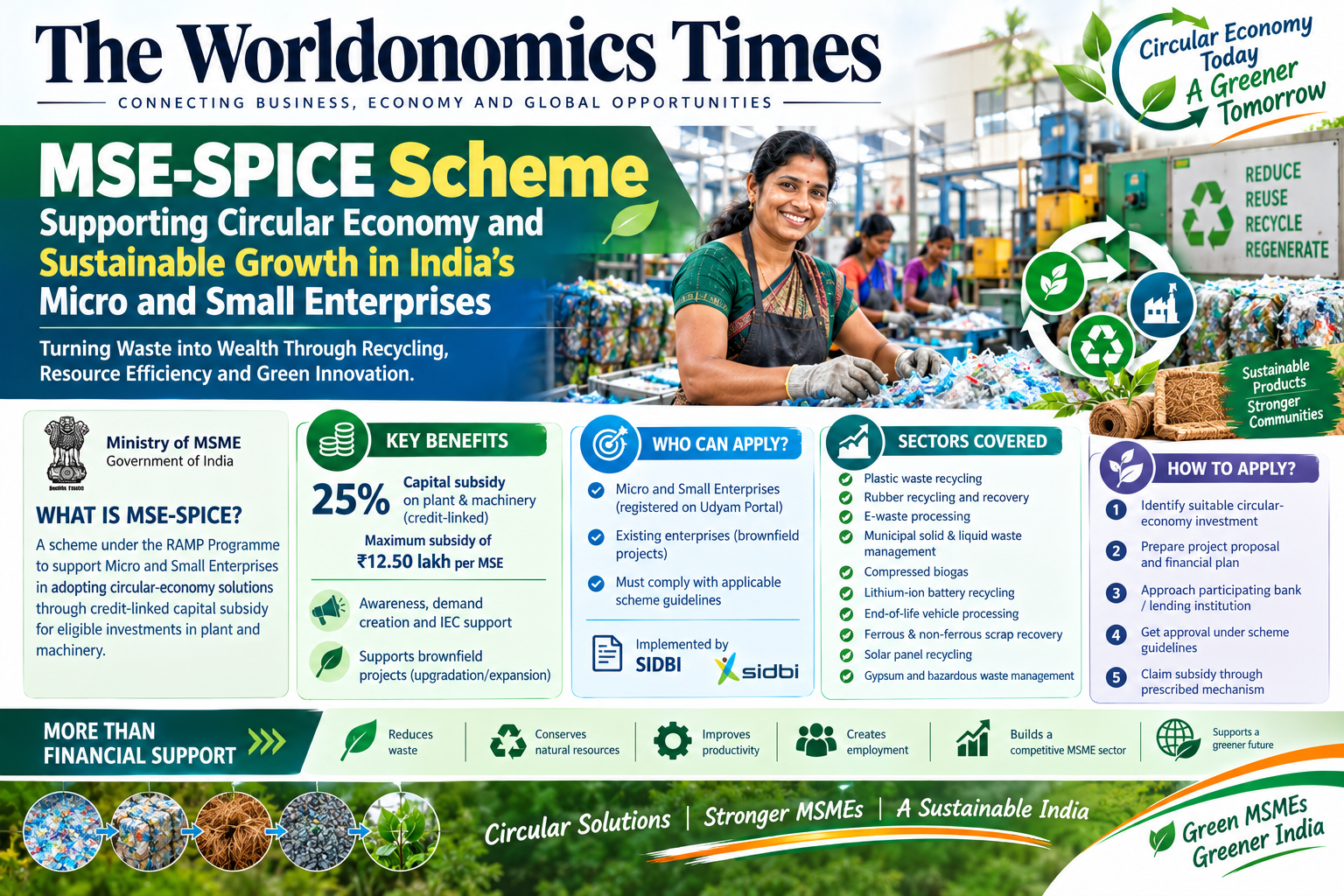
MSE-SPICE is a dedicated government initiative designed to encourage micro and small enterprises to adopt circular-economy solutions. It provides credit-linked capital subsidy support for eligible investments in plant and machinery, particularly for upgrading or expanding existing circular-economy projects.
The scheme has a total financial outlay of ₹472.50 crore for the four-year period from 2023–24 to 2026–27. The Small Industries Development Bank of India (SIDBI) has been appointed as the implementing agency.
Its broader objective is to make sustainable technologies more accessible to smaller businesses, which may otherwise find the initial investment cost difficult to manage.
Key Financial Benefits
One of the most important features of MSE-SPICE is its capital subsidy component.
Eligible enterprises can receive a 25% subsidy on the admissible cost of plant and machinery, subject to a maximum subsidy of ₹12.50 lakh per MSE. The assistance is credit-linked and is intended to support eligible brownfield projects.
The scheme also includes awareness-generation, demand-creation and Information, Education and Communication (IEC) components. These activities are designed to familiarise enterprises and stakeholders with circular-economy opportunities and improve understanding of sustainable technologies.
The subsidy can help reduce the effective investment burden on eligible businesses. However, it should not be treated as an automatic grant: project eligibility, lending arrangements, machinery requirements and approval conditions must be satisfied under the applicable guidelines.
Who Can Apply?
The scheme is intended for Micro and Small Enterprises registered on the Udyam Registration Portal.
A key condition is that support is directed towards eligible brownfield projects—existing enterprises seeking to upgrade, expand or modernise their circular-economy activities. It is not designed as general financial assistance for every new business proposal.
Enterprises should identify whether their proposed investment falls within the sectors and activities recognised under the scheme. They should also examine applicable environmental, waste-management and Extended Producer Responsibility (EPR) requirements.
Sectors Covered Under MSE-SPICE
The scheme identifies several important circular-economy sectors, including:
- Plastic waste recycling
- Rubber recycling and recovery
- Electronic waste processing
- Municipal solid and liquid waste management
- Compressed biogas
- Lithium-ion battery recycling
- End-of-life vehicle processing
- Ferrous and non-ferrous scrap metal recovery
- Solar panel recycling
- Gypsum-related waste recovery
- Toxic and hazardous industrial waste and used-oil waste management
These sectors offer opportunities for enterprises to develop specialised services, improve recycling infrastructure and contribute to cleaner industrial supply chains.
How Enterprises Can Approach the Scheme
Interested MSEs should begin by reviewing their existing operations and identifying a suitable circular-economy investment. The next step is to prepare a project proposal covering the machinery required, project cost, expected environmental benefits, production improvements and financial projections.
Enterprises should maintain valid Udyam Registration and approach a participating bank or eligible lending institution for the required term loan. The lending institution and implementing agency assess the proposal under the applicable scheme guidelines. Subsidy claims are processed through the prescribed institutional mechanism.
Applicants should consult the latest MSE-SPICE operating guidelines and the official RAMP portal before committing funds or purchasing machinery. Approval should be confirmed through the authorised lending and implementing channels.
Benefits for MSMEs and the Indian Economy
MSE-SPICE can support businesses in more ways than simply reducing machinery investment costs. Better recycling and recovery systems can lower dependence on virgin raw materials, improve production efficiency and create additional business opportunities.
The scheme can also encourage innovation, generate skilled employment and strengthen local recycling ecosystems. As larger companies increasingly focus on sustainable sourcing and environmental compliance, MSEs adopting circular-economy practices may become more competitive as suppliers.
At the national level, wider adoption of circular production can support responsible resource consumption, reduce waste sent to landfills and contribute to India’s environmental and sustainable-development objectives.
Challenges and the Road Ahead
Despite its potential, successful implementation requires awareness, technical expertise, affordable finance and reliable markets for recycled materials. Many small enterprises may need assistance in preparing bankable project reports, selecting appropriate technologies and understanding regulatory requirements.
Financial institutions, industry associations, technology providers and government agencies can play an important role through awareness programmes, project guidance and stronger institutional coordination.
Conclusion: Building a Competitive and Sustainable MSME Sector
The MSE-SPICE Scheme represents an important step towards integrating sustainability with enterprise development. By supporting eligible investments in circular-economy technologies, it encourages existing micro and small enterprises to transform waste into valuable resources and adopt more efficient production systems.
For Indian MSMEs, the circular economy is not merely an environmental responsibility; it can become a source of innovation, cost savings, new markets and long-term competitiveness.
With effective implementation, greater awareness and access to suitable finance, MSE-SPICE can help strengthen India’s position as a growing centre for sustainable manufacturing and resource-efficient industrial development.