One worry many businesses have about India’s Consent Manager framework is how much it costs to set up.
Many organisations have already spent a lot of time and money building websites, mobile apps, customer databases and systems that manage privacy.
They might ask:
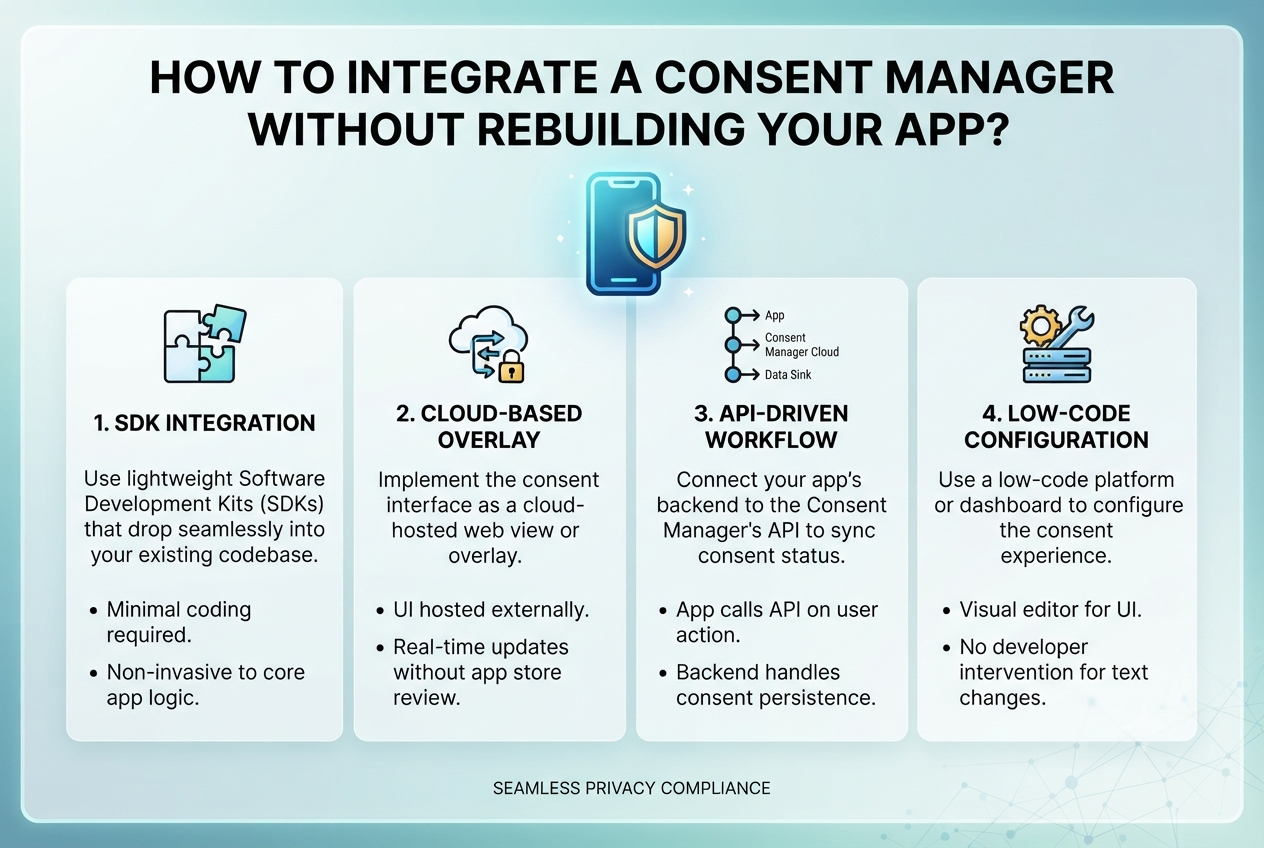
Does adding a Consent Manager mean you must rebuild the application?
The short answer is no.
The goal of the Consent Manager framework is to let you manage consent on a platform that works with systems. Consent Manager does not say that every business must replace its existing application or customer‑facing technology.
You still need good technical planning to integrate.
- Know what you need to integrate
A business application can have many separate systems:
- Customer registration and authentication.
- Consent collection interfaces.
- Customer relationship management software.
- Marketing automation systems.
- Payment and transaction platforms.
- Data storage systems.
- Third‑party service providers.
Consent Manager should be able to talk to the business systems without making the organisation redesign every part.
For example an online insurance platform may already have a customer app where people give details.
Integration should let the customer manage consent through Consent Manager while the insurer keeps using its existing policy administration system.
- Use APIs as the communication layer
APIs let two software systems talk to each other.
Of rebuilding the application a business can build an integration layer between its existing systems and Consent Manager.
A simple process might look like this:
Stage 1: Consent request
The Data Fiduciary creates a consent request that shows the purpose and information needed.
Stage 2: Communication with Consent Manager
The request is sent to Consent Manager through the agreed interface.
Stage 3: Individual’s decision
The individual looks at the request. Gives or denies consent.
Stage 4: Recording the decision
Consent Manager records the consent event.
Stage 5: Updating business systems
The decision is sent to the Data Fiduciary so that its systems can show the consent status.
The exact interface and protocol will depend on the standards that apply and the agreements between the parties.
- Keep a central consent record
One of the mistakes is keeping separate and inconsistent consent records in different departments.
For instance a customer may withdraw marketing consent through Consent Manager. The marketing team may still use an older database that has the original consent status.
Businesses should set up a way to sync consent information.
A central consent‑management repository can help the organisation track:
- The individual concerned.
- The Data Fiduciary involved.
- The specified purpose.
- The consent status.
- The. Time of the decision.
- Subsequent. Withdrawal.
- Communication acknowledgements.
This does not mean that all personal data must live in one database.
It means that the organisation should be able to see the status of relevant consent and trace the events that happened.
- Keep consent management from data storage
An important rule of the Consent Manager framework is that when personal data is shared Consent Manager must not be able to read its contents.
This is a design point.
Consent Manager should not automatically get access to the personal information just because it helps with a consent transaction.
For example if a person authorises a bank to see a bank account statement held by another institution Consent Manager can help make that consent and share the instruction but cannot read the statement contents.
This separation can cut down on exposure of personal data.
- Put withdrawal into existing workflows
Withdrawal should not be seen as an admin task.
Businesses should link withdrawal instructions to their marketing, analytics, customer relationship and other processing systems.
For example if a customer withdraws consent for communications:
- The consent record should be updated.
- The relevant marketing system should receive the instruction.
- Applicable processors should be instructed to stop the processing.
- The organisation should retain evidence of the action taken.
The organisation must also tell the difference, between consent‑based processing and processing that keeps going on another basis. Withdrawal of consent does not stop all kinds of processing for that individual.
- Build failure‑handling mechanisms
a well‑designed integration can have technical failures.
An API may become unavailable. A communication may time out. A third-party system may fail to acknowledge an instruction.
Businesses should therefore implement:
- authentication between systems.
- Encrypted communication.
- Transaction identifiers.
- Timestamped records.
- Retry mechanisms.
- Failure alerts.
- Reconciliation procedures.
- Appropriate access controls.
A withdrawal instruction should not simply vanish even if the receiving system was only temporarily offline.
- Review vendor contracts and responsibilities
Integration is not a technology exercise.
Businesses should review their agreements with Consent Managers and relevant technology providers.
The arrangements should address responsibilities, security requirements, incident reporting, service availability, audit assistance, record retention and exit procedures.
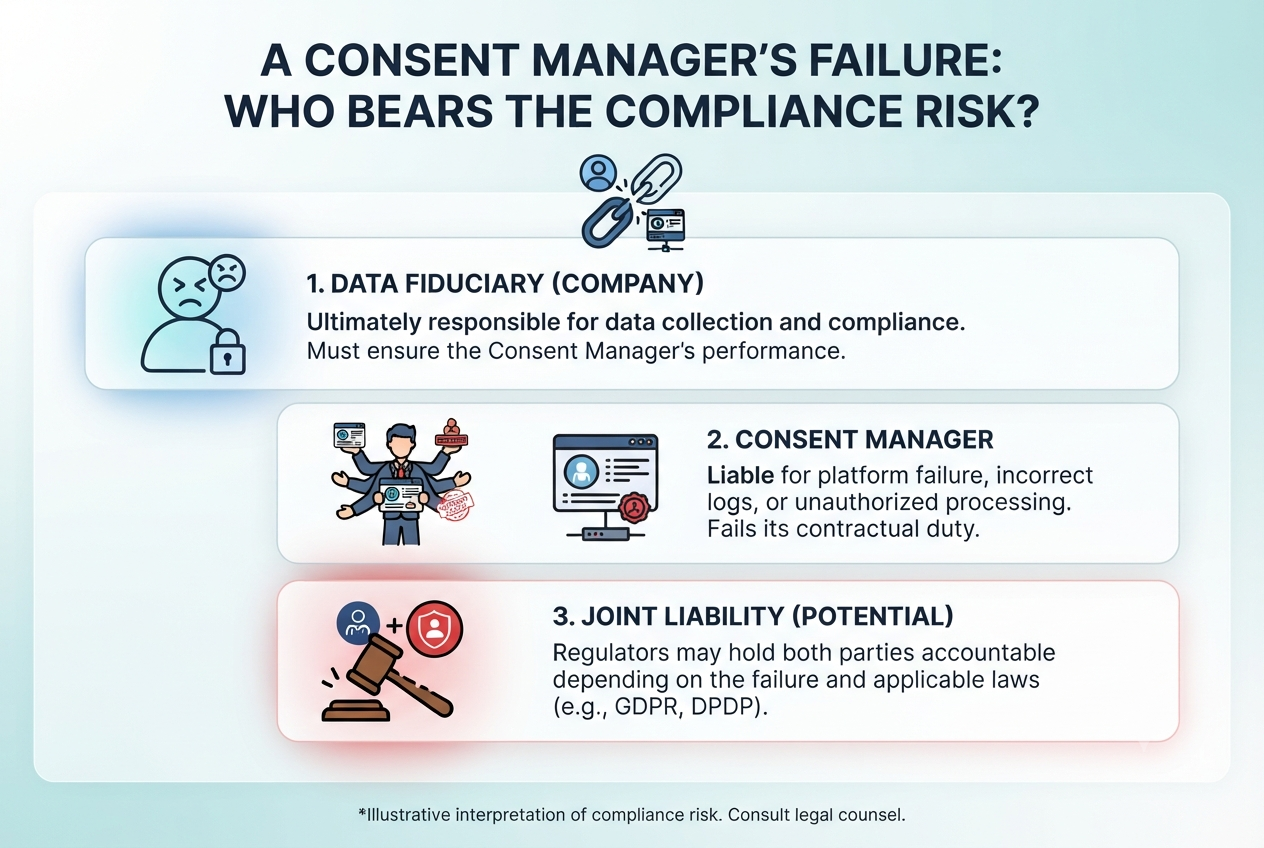
The legal responsibilities of a Data Fiduciary cannot simply be transferred to a technology vendor through a contract.
Further the Rules specifically prohibit a Consent Manager from subcontracting or assigning the performance of its obligations under the Act and Rules. This restriction must be considered when designing the service arrangement.
- Prepare for implementation
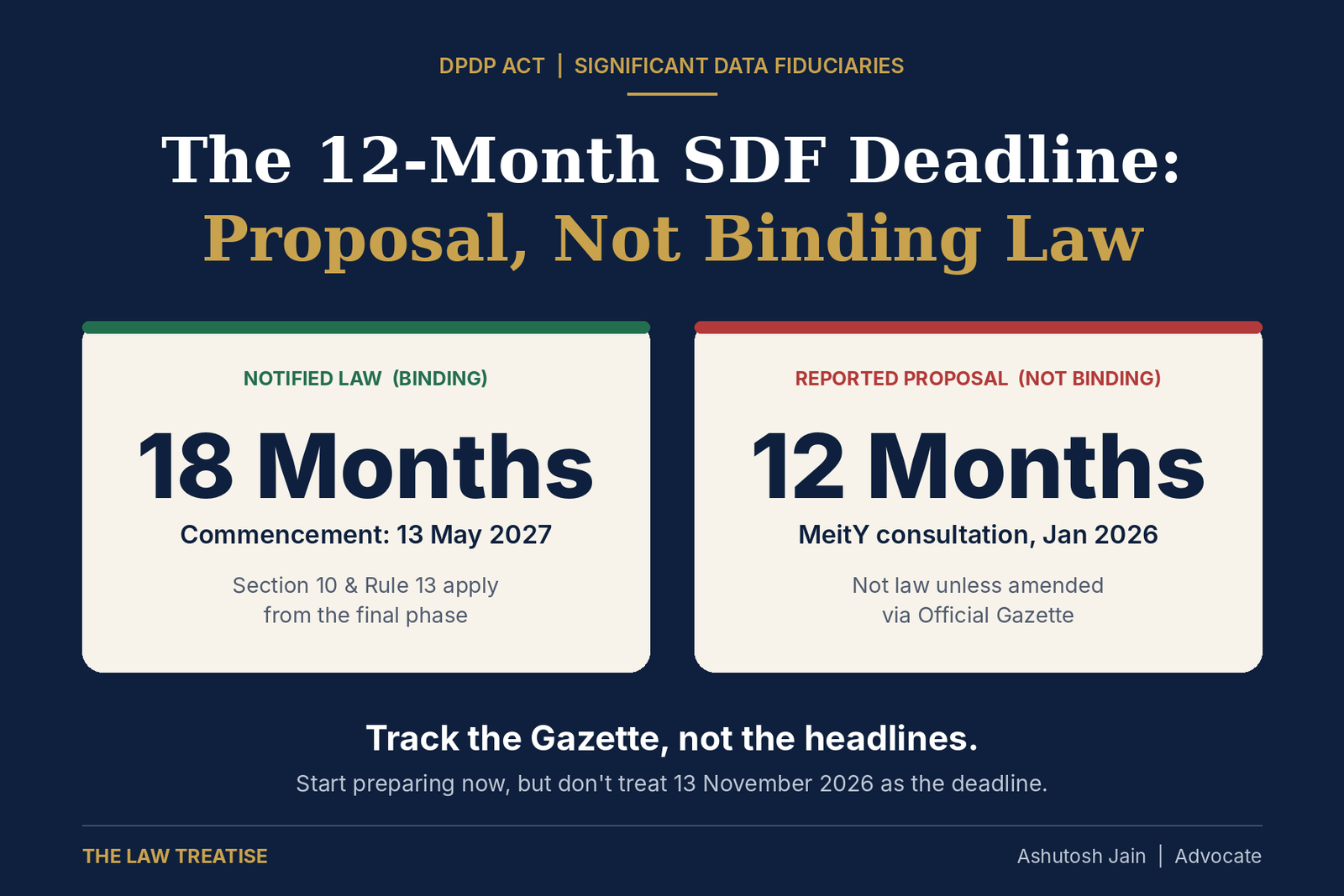
The registration framework under Rule 4 comes into force on 13 November 2026. The broader substantive consent-management provisions under Section 6(1)–(8) are scheduled for commencement on 13 May 2027.
Businesses therefore have an opportunity to assess their existing technology and prepare an integration roadmap than rushing into an unnecessary application redesign.
Integrating a Consent Manager should be approached as an interoperability and governance project not as a technology replacement exercise.
Businesses that already maintain customer databases consent records and well-designed APIs may find the integration considerably easier.
The real challenge is not connecting two applications.
It is ensuring that a consent decision made by an individual is accurately communicated, properly recorded and implemented across every system.
A good integration should make consent management simpler, for the individual without making the businesss existing technology unnecessarily complicated.