By The Worldonomics Times
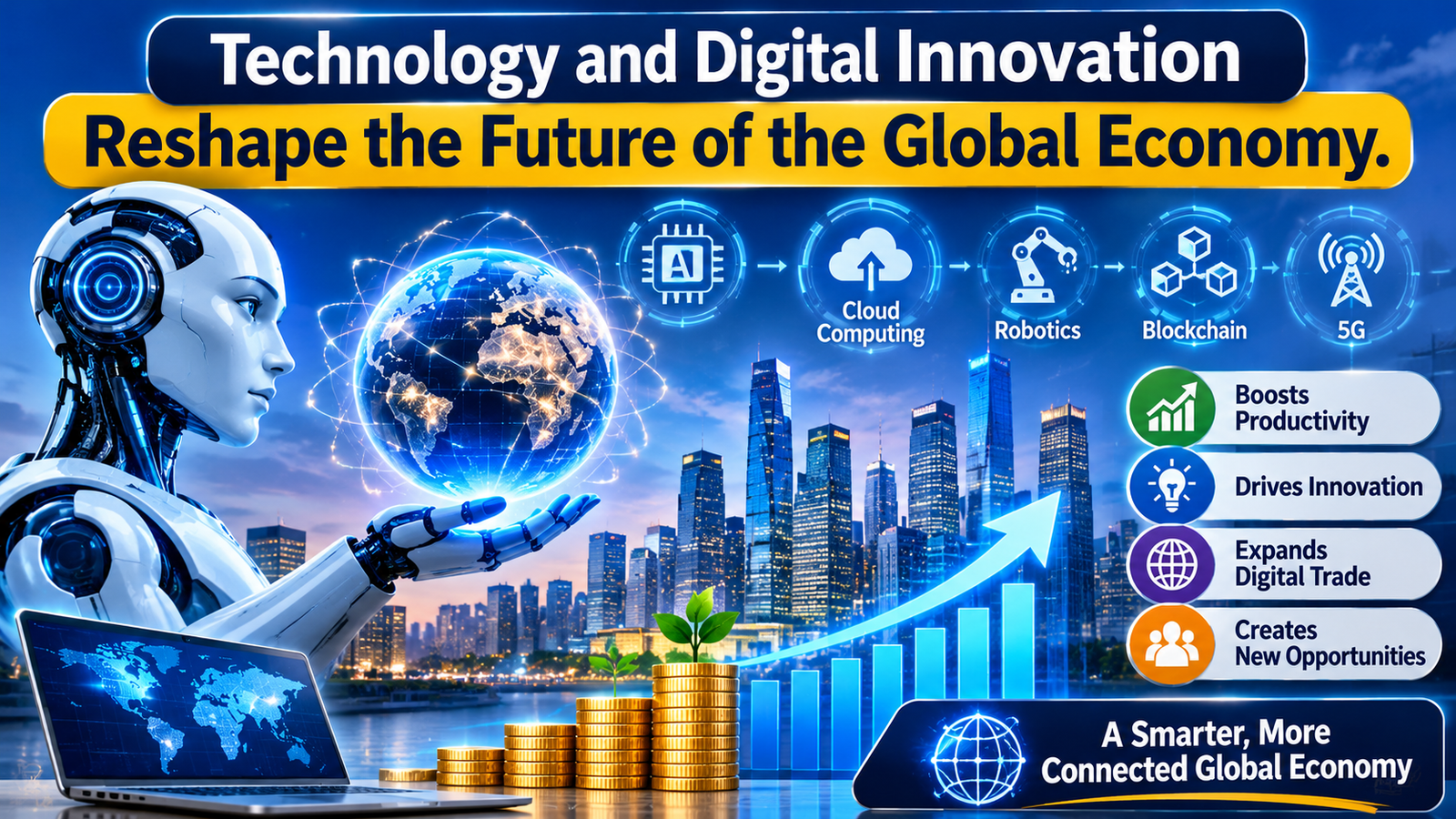
Technology and digital innovation are transforming the global economy, changing how businesses operate, how consumers access services and how countries compete in international markets. Artificial intelligence, cloud computing, automation, advanced data systems and digital financial services are creating new opportunities for productivity and economic growth. At the same time, they are reshaping employment, investment priorities and the skills required across industries.
Digital transformation is no longer limited to technology companies. Manufacturing, banking, healthcare, education, agriculture, logistics and retail are increasingly adopting digital solutions to improve efficiency, reduce costs and reach wider markets. As innovation accelerates, the ability of countries and businesses to adapt will become an important factor in determining their future economic competitiveness.
Artificial Intelligence Becomes a Major Economic Driver
Artificial intelligence has emerged as one of the most influential technologies shaping global business and investment. Companies are adopting AI tools to automate routine tasks, analyse large volumes of information, improve customer services and support complex decision-making.
Investment in AI infrastructure is also expanding rapidly. According to the OECD’s Digital Economy and Society Outlook 2026, venture capital investment in AI companies specialising in information technology infrastructure and hosting more than doubled, rising from $54.5 billion in 2024 to $123.9 billion in 2025.
The IMF has also highlighted the potential economic benefits of wider AI adoption. Its October 2026 analysis suggests that faster diffusion of AI, supported by investment in digital infrastructure and workforce skills, could generate additional productivity gains and strengthen global economic growth.
However, the benefits will depend on how effectively businesses integrate these technologies into everyday operations. Investment in software and computing infrastructure alone may not deliver significant productivity improvements without organisational changes, skilled employees and reliable data systems.
Digital Transformation Changes International Trade
Digital technology is reshaping international commerce by making it easier for businesses to provide services across borders. Online platforms, digital payment systems, cloud-based services and electronic marketplaces allow companies to reach international customers without establishing a physical presence in every market.
UN Trade and Development (UNCTAD) reported in September 2026 that digitally deliverable services accounted for 56% of global services exports in 2025. These services include activities such as information technology, financial services, telecommunications, consulting and other professional services that can be delivered through digital networks.
This expansion creates opportunities for software developers, financial institutions, educational providers and business-service companies. Small and medium-sized enterprises can also use digital platforms to access international markets and participate in global supply chains.
Nevertheless, the benefits are unevenly distributed. Countries with limited broadband connectivity, inadequate digital payment systems and shortages of skilled workers face difficulties competing in technology-intensive services. Improving digital infrastructure and international cooperation will therefore be essential for more inclusive trade growth.
Automation and the Future of Employment
Automation is changing the nature of employment across manufacturing, logistics, customer support and professional services. Robotics and intelligent software can perform repetitive tasks, improve production accuracy and help businesses operate more efficiently.
These developments may increase productivity and create new occupations in areas such as data science, cybersecurity, AI development, digital marketing and technology management. However, they can also reduce demand for certain routine tasks and require workers to adapt to changing job responsibilities.
The transition presents an important challenge for governments and educational institutions. Technical education, vocational training and continuous professional development will be necessary to prepare workers for a technology-driven economy.
Businesses will also need to invest in employee training rather than treating technological adoption only as a cost-reduction exercise. A workforce capable of working alongside advanced technologies can help organisations achieve more sustainable productivity improvements.
Cybersecurity and Digital Infrastructure Become Strategic Priorities
As economic activity becomes increasingly dependent on digital networks, cybersecurity and data protection have become essential components of economic stability.
Financial institutions, hospitals, manufacturers, government departments and energy providers all depend on interconnected digital systems. Cyberattacks, data breaches and disruptions to essential technology infrastructure can therefore create financial losses and interrupt important services.
Governments are responding by strengthening cybersecurity regulations, improving digital governance and developing national technology strategies. The OECD’s November 2026 report identifies cybersecurity as an increasingly important digital policy priority.
Reliable infrastructure is equally important. High-speed internet, cloud computing facilities, advanced semiconductor manufacturing and secure data centres provide the foundation for digital innovation. Countries that invest in these capabilities can strengthen their competitiveness and attract technology-related investment.
Challenges of Unequal Digital Development
Despite rapid technological progress, the digital economy continues to develop unevenly. Large corporations generally have greater financial resources, technical expertise and access to computing infrastructure than smaller businesses.
The OECD reported that AI was used by 20% of enterprises with at least 10 employees across its member economies in 2025, compared with 52% of large enterprises. This gap demonstrates that the benefits of digital innovation are not automatically shared across businesses of different sizes.
Developing economies face additional challenges, including limited connectivity, high technology costs and shortages of specialised skills. UNCTAD has warned that AI could deepen existing economic inequalities because computing capacity, data, finance and technical expertise remain concentrated in a relatively small number of countries and companies.
Addressing these gaps will require affordable connectivity, accessible training, support for smaller enterprises and international cooperation on digital standards.
Implications for India
India is well positioned to benefit from the expansion of the global digital economy. Its information technology services industry, digital payment ecosystem, software development capabilities and growing technology start-up sector provide a strong foundation for further innovation.
Digital public infrastructure has also become an important part of India’s economic transformation. Digital identity, online payment systems and government service platforms have expanded access to financial and public services. These developments can support entrepreneurship, improve service delivery and increase participation in the formal economy.
Artificial intelligence, semiconductor manufacturing, electronics production, fintech and digital healthcare offer further opportunities for Indian businesses. However, realising this potential will require sustained investment in research, reliable infrastructure, cybersecurity and advanced workforce skills.
India must also address the digital divide between urban and rural communities and ensure that smaller enterprises can access affordable technology. Expanding digital literacy and improving access to high-quality education will be important for making innovation more inclusive.
The Worldonomics Times View
Technology and digital innovation are becoming central to the future of global economic growth. Artificial intelligence, automation, digital trade and advanced infrastructure are creating new opportunities for productivity, investment and international cooperation. However, technological progress also introduces challenges involving employment transitions, cybersecurity, data governance and unequal access to innovation.
The Worldonomics Times believes that the long-term success of the digital economy will depend on how effectively countries balance innovation with inclusion and responsible governance. Governments must support research and infrastructure while ensuring that workers and smaller businesses are not left behind.
For businesses, continuous innovation and workforce development will be essential to remaining competitive. For policymakers, the priority should be to create an environment in which technology supports productivity, creates economic opportunities and improves access to essential services.
The future global economy will increasingly be shaped by digital capabilities. Countries that combine technological investment with education, strong institutions and inclusive policies will be better positioned to benefit from this transformation.