Direct Tax Update | November 2026 | Important for Charitable Trusts, NGOs and Tax Professionals
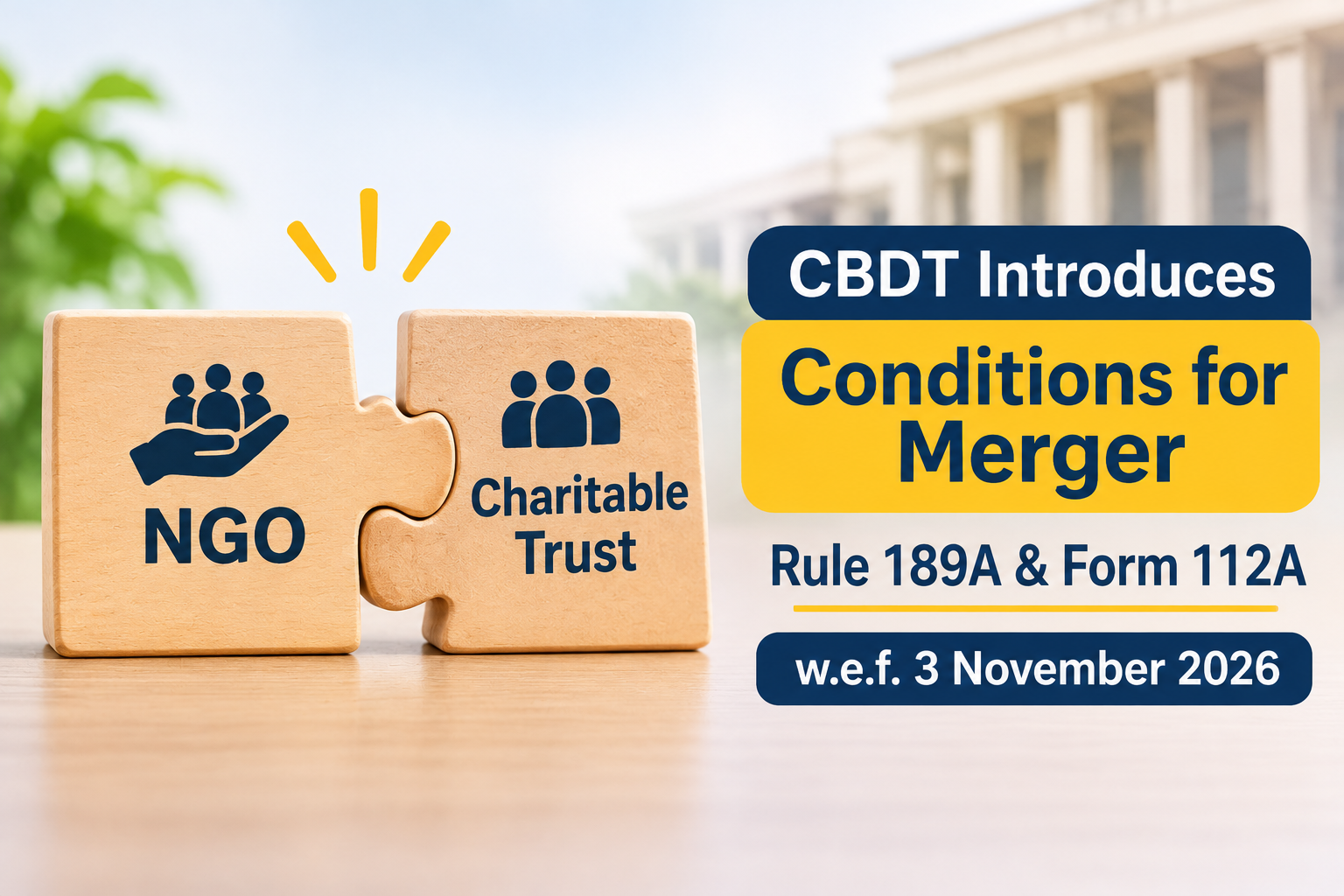
The Central Board of Direct Taxes (CBDT) has introduced a significant regulatory framework governing the merger of registered non-profit organisations through the Income-tax (Eighth Amendment) Rules, 2026, notified vide Notification No. 139/2026 dated 30 October 2026.
The amendment inserts a new Rule 189A into the Income-tax Rules, 2026 and introduces Form No. 112A to prescribe the conditions and reporting requirements for mergers between registered non-profit organisations having the same or similar objectives.
This development is important for charitable trusts, institutions and NGOs considering consolidation of their activities, resources and administrative structures. Income Tax Department+2
1. Background and Objective of the Amendment
Charitable and non-profit organisations frequently consider mergers to improve operational efficiency, reduce administrative costs, strengthen institutional capacity and ensure better utilisation of resources.
However, such mergers also involve important tax considerations, particularly regarding registration status, accumulated income, charitable assets, outstanding tax liabilities and continuity of charitable activities.
To address these aspects, CBDT has prescribed specific conditions under Rule 189A. The objective is to ensure that mergers take place between eligible organisations while safeguarding charitable assets and preventing misuse of tax exemptions.
2. Key Conditions Prescribed Under Rule 189A
The amendment lays down several conditions that must be fulfilled for a merger between registered non-profit organisations:
A. Similar objectives
The merger is permitted only between registered non-profit organisations having the same or similar objectives.
B. Registration status
An organisation registered under Section 332 cannot merge with an organisation holding only provisional registration under the same section, and vice versa.
C. Outstanding tax liabilities
The merging organisation should not have any outstanding tax, interest, penalty, fine or other demand arising from an order that is not under appeal. Where an appeal is pending, the merged organisation must discharge the outstanding demand once the appeal attains finality.
D. Continuity of charitable objectives
The merged organisation cannot amend its objects for a period of five years from the end of the financial year in which the merger takes place.
E. Transfer of assets and liabilities
All assets and liabilities of the merging organisation must become the assets and liabilities of the surviving organisation from the effective date of merger.
F. Restriction on related-party benefits
The merger must not result in any direct or indirect benefit to related persons covered under Section 337(1) of the Income-tax Act, 2025.
These conditions are intended to ensure that charitable resources continue to be utilised for the permitted charitable purposes rather than being diverted for private benefit. Income Tax Department
3. Transfer of Tax Obligations to the Merged Organisation
One of the significant aspects of Rule 189A is that the surviving organisation assumes the tax and compliance obligations of the merging organisation.
These include:
- Application of income in accordance with Section 341.
- Application of accumulated income in accordance with Section 342.
- Payment of tax on specified income under Section 334.
- Compliance with the conditions prescribed under Section 340.
- Investment of funds in the prescribed modes under Section 350.
- Payment of additional income-tax under Section 352, wherever applicable.
The declaration accompanying Form 112A also clarifies that the merged organisation cannot claim depreciation where the cost of acquisition of the relevant asset has already been claimed as application of income by the merging organisation.
Further, contributions received by the merging organisation must be considered while calculating the aggregate contributions of the merged organisation for the purpose of Section 355(h)(ii). Income Tax Department
4. Introduction of Form No. 112A: New Reporting Requirement
To ensure transparency and proper reporting, CBDT has introduced Form No. 112A – Intimation for Merger of Registered Non-Profit Organisations.
The merged organisation is required to furnish this form electronically before the jurisdictional Principal Commissioner or Commissioner within one month from the end of the month in which the merger takes effect.
The form can be submitted using either a Digital Signature Certificate (DSC) or Electronic Verification Code (EVC).
Important information and supporting documents required include:
- Details of both merging and merged organisations, including PAN and contact details.
- Date on which the merger becomes effective.
- Copies of trust deeds of both organisations.
- Copies of registration certificates.
- Resolution passed by the trustees, governing body or management approving the merger.
- Audited books of accounts as on the merger date and for the immediately preceding financial year.
- Reasons for undertaking the merger.
Both organisations are also required to get their books of accounts audited by an accountant as on the date of merger. Income Tax Department+1
5. Continuity of Assessment and Tax Proceedings
Another important feature of the amendment relates to the continuation of pending assessments, reassessments and other tax proceedings.
Where any assessment, reassessment or other proceedings have already been initiated against the merging organisation, such proceedings will be deemed to have been initiated against the merged organisation.
Similarly, proceedings relating to the tax year in which the merger takes place, up to the merger date, and earlier tax years will be undertaken against the merged organisation in the prescribed manner.
This provision ensures that a merger cannot be used as a mechanism to avoid existing tax liabilities or pending income-tax proceedings. Income Tax Department
6. Professional Implications for Chartered Accountants
The introduction of Rule 189A creates an important compliance responsibility for Chartered Accountants advising charitable trusts, NGOs and other registered non-profit institutions.
Before facilitating a merger, professionals should undertake a detailed review of the registration status, charitable objectives, outstanding tax demands, accumulated income, asset ownership and related-party transactions of both organisations.
Particular attention should be given to the five-year restriction on amendment of objects, the treatment of accumulated income and the tax implications associated with assets transferred during the merger.
Further, timely filing of Form 112A and proper audit of books of accounts as on the merger date will be essential to demonstrate compliance with the prescribed conditions.
Conclusion
The Income-tax (Eighth Amendment) Rules, 2026 represent an important step towards establishing a structured tax-compliance framework for mergers of registered non-profit organisations.
By introducing Rule 189A and Form 112A, CBDT has prescribed clear eligibility conditions, reporting requirements and safeguards to ensure continuity of charitable activities and proper utilisation of funds.
Charitable trusts and NGOs planning mergers should carefully evaluate these provisions before undertaking any restructuring exercise. Chartered Accountants and tax professionals will have an important role in ensuring that such mergers are implemented in accordance with the prescribed legal and tax requirements.