In today’s business environment, organisations rarely operate in isolation. Payroll is outsourced, accounting is managed by external professionals, customer databases are hosted on cloud platforms, HR operations are handled by service providers, and technology partners have access to business information.
This interconnected ecosystem makes businesses more efficient. However, it also raises an important question:
When personal data is shared with an external vendor, who is responsible for protecting it?
The answer under India’s Digital Personal Data Protection Act, 2023 (DPDP Act), deserves serious attention from every organisation.
1. Outsourcing work does not mean outsourcing accountability
Consider a company that engages an external payroll service provider. The company shares employee names, PAN details, bank account information, salary structures and contact details to process monthly payroll.
The payroll agency processes this information on behalf of the company.
What happens if the agency accidentally exposes employee data?
Can the company simply state that the information was held by an external service provider and therefore the responsibility lies entirely with the vendor?
Section 8(1) of the DPDP Act establishes an important principle: a Data Fiduciary remains responsible for compliance even when personal data is processed on its behalf by a Data Processor.
In other words, outsourcing the activity does not automatically transfer the statutory accountability.
2. Understanding the Data Fiduciary and Data Processor relationship
The distinction is important.
A Data Fiduciary determines the purpose and means of processing personal data.
A Data Processor processes personal data on behalf of the Data Fiduciary.
For example:
- A company collecting employee information for payroll is generally the Data Fiduciary for that processing.
- An external payroll agency processing salary information on the company’s instructions may act as its Data Processor.
- A cloud service provider hosting customer records may act as a Data Processor.
The actual role depends on the parties’ decisions and activities, not merely the designation written in an agreement.
3. Why vendor agreements need to be revisited
Many organisations have service agreements that focus primarily on commercial matters:
- Scope of work
- Professional fees
- Payment terms
- Service timelines
- Confidentiality clauses
These are important, but data protection requires more.
Section 8(2) contemplates engagement of a Data Processor under a valid contract.
Businesses should therefore examine whether their agreements adequately address:
- The purpose for which personal data may be processed.
- The categories of personal data being shared.
- Permitted access and use of information.
- Security safeguards and access restrictions.
- Reporting and cooperation in case of a data breach.
- Data retention and deletion requirements.
- Sub-processing arrangements, where applicable.
- Assistance with data principal requests and compliance obligations.
A generic confidentiality clause may not adequately address all these operational requirements.
4. The practical risk areas for businesses
Third-party data sharing is not limited to large technology companies.
It exists in everyday business operations.
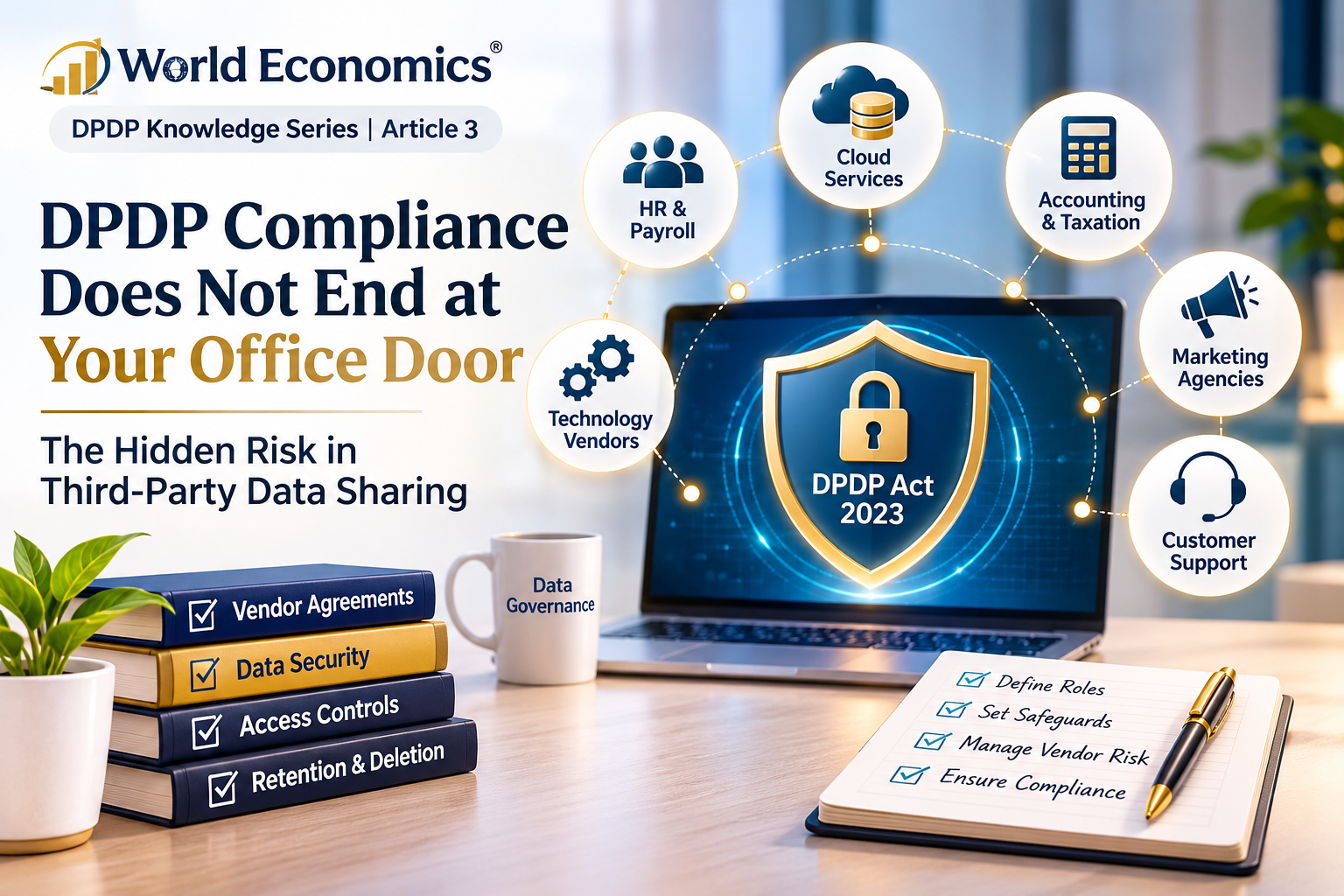
HR and payroll: Employee personal information is shared with payroll agencies, HR consultants and benefits administrators.
Accounting and taxation: Financial records, employee details, customer information and supporting documents may be shared with external accounting professionals.
Cloud storage: Business documents and customer databases may be hosted on third-party servers.
Marketing agencies: Customer contact details may be shared for campaigns, lead management and communication.
Customer support: External teams may access customer complaints, contact information and transaction histories.
Each arrangement should be assessed to determine the parties’ roles, the lawful basis for processing and the safeguards required.
5. Five questions every business should ask its vendors
Before sharing personal data, management should ask:
- Do we know exactly what personal data the vendor can access?
- Is the vendor contractually restricted to the agreed purpose?
- Are access controls and security measures documented?
- What happens if the vendor experiences a data breach?
- How will personal data be returned or erased when the engagement ends, subject to applicable legal retention requirements?
These questions are not merely legal formalities. They are essential elements of sound business governance.
6. The role of finance and compliance professionals
Finance professionals, Chartered Accountants, CFOs and compliance teams have an important role in this transition.
They regularly handle sensitive business information, employee records, customer details, financial statements and tax documentation.
Their responsibility should extend beyond ensuring that information is correctly recorded and reported.
They should also help organisations establish appropriate controls over:
- Who can access financial and employee records.
- How documents are exchanged with external consultants.
- Whether shared folders and email accounts have appropriate access restrictions.
- How long records are retained.
- Whether vendor agreements address data protection responsibilities.
Data protection should become part of internal control systems rather than remain an isolated IT function.
7. A business governance perspective
The DPDP framework encourages organisations to look beyond the traditional approach of collecting information and storing it securely.
Businesses must also consider why information is collected, who accesses it, how it is processed, and when it should no longer be retained.
The real test of compliance is not whether an organisation has signed a data protection agreement.
It is whether the organisation has established a working system that protects personal data throughout its lifecycle, including when third parties are involved.
Think About It
If your organisation shares employee or customer information with five external vendors today, can you confidently explain what each vendor does with that information, who has access to it, and what happens when the engagement ends?
If the answer is no, your organisation may have a governance gap worth addressing.
World Economics Perspective
Responsible data management is no longer simply an IT responsibility. It is a business governance, risk management and leadership responsibility.
The DPDP Act provides the framework. Organisations must now build the discipline to implement it.