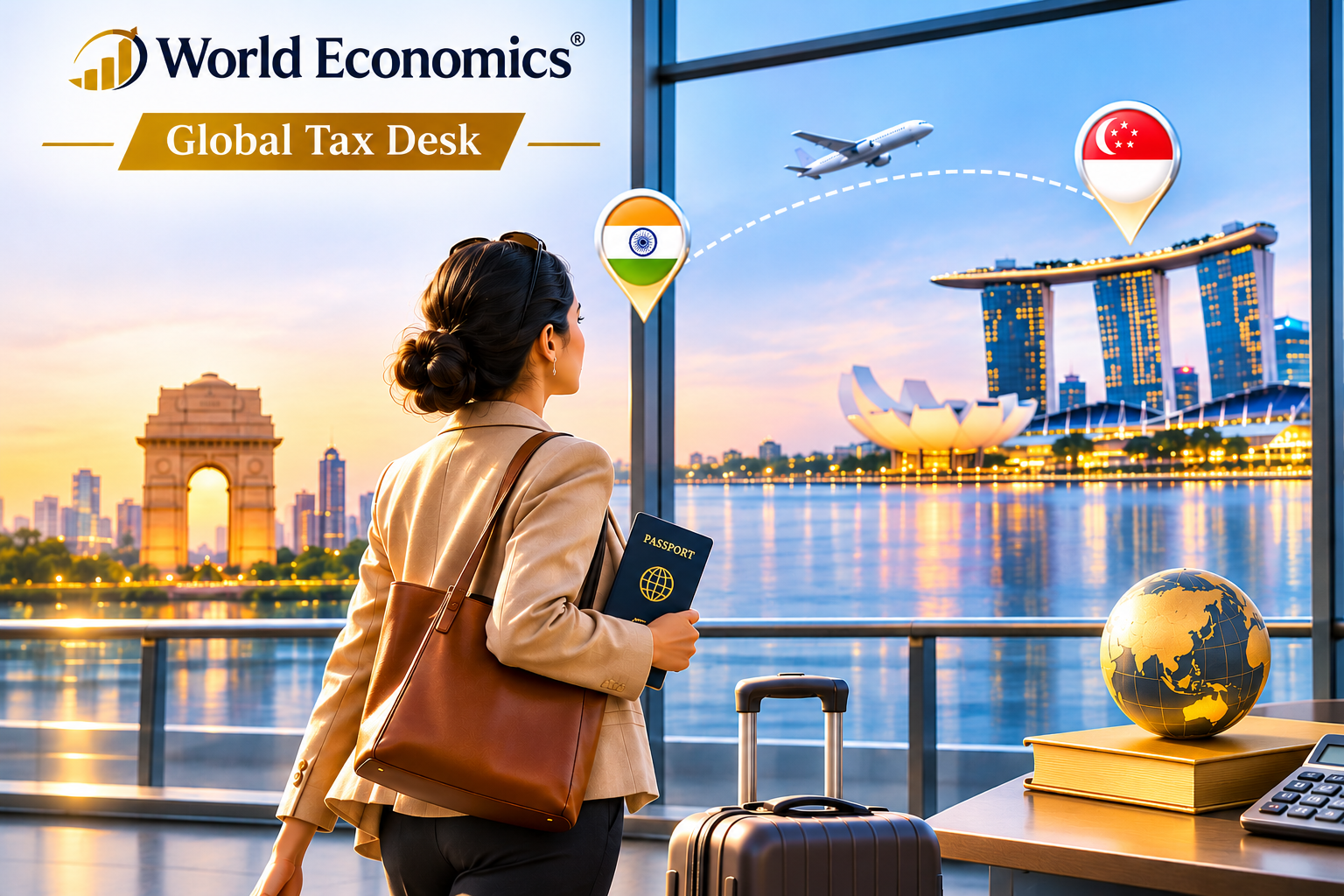
Singapore has become an attractive destination for Indian professionals, entrepreneurs, technology specialists, finance executives and business owners. Better international career opportunities, a globally connected financial ecosystem and a competitive business environment continue to encourage Indians to relocate to Singapore.
But there is one question that many people overlook while planning their move:
If you move to Singapore, does your Indian tax residency automatically end?
The answer is no.
Relocating to another country, obtaining an employment pass, becoming a Singapore tax resident or even spending most of the year outside India does not, by itself, settle your Indian tax position.
Your residential status must be determined under the applicable Indian income-tax provisions for each tax year. Singapore has its own tax residency framework, and the interaction between the two countries’ rules can create situations where careful tax planning becomes essential.
Let’s understand what actually happens when an Indian resident moves to Singapore.
1. Moving abroad does not automatically make you an NRI for tax purposes
One of the most common misconceptions is that an individual becomes a Non-Resident Indian (NRI) immediately after moving abroad for employment.
Indian income-tax law does not determine residential status merely on the basis of:
- The country in which you hold an employment contract.
- Whether you have obtained a Singapore Employment Pass.
- Whether you have rented or purchased a house in Singapore.
- Whether your salary is credited to a Singapore bank account.
- Whether you have obtained Singapore Permanent Residency.
The decisive factor is the residential status test under Indian income-tax law.
For tax years beginning on or after 1 April 2026, the relevant provisions are contained in Section 6 of the Income-tax Act, 2025.
For earlier tax years, the corresponding provisions of Section 6 of the Income-tax Act, 1961 continue to apply.
This distinction matters because FY 2025–26 and Tax Year 2026–27 are governed by different legislative frameworks.
2. Understanding the Indian residential status test
Under Section 6 of the Income-tax Act, 2025, an individual is generally treated as a resident in India if either of the following conditions is satisfied:
Basic condition 1:
The individual stays in India for 182 days or more during the relevant tax year.
Basic condition 2:
The individual stays in India for 60 days or more during the relevant tax year and 365 days or more during the preceding four tax years.
However, the law provides specific exceptions and modifications.
For example, an Indian citizen leaving India during the tax year for employment outside India is generally subject to the 182-day threshold instead of the ordinary 60-day plus 365-day test.
This is an important relaxation for Indian citizens relocating overseas for employment.
But there is an important distinction.
A person of Indian origin or an OCI cardholder is not automatically entitled to the special departure-for-employment relaxation available to an Indian citizen merely because of their Indian origin or OCI status.
The precise statutory conditions must be examined.
3. The 120-day rule: Why frequent visits to India can create tax exposure
Relocation does not mean that an individual can visit India without considering the number of days spent here.
The Income-tax Act, 2025 retains a special provision for Indian citizens and Persons of Indian Origin visiting India.
Where an individual qualifies as a visiting Indian citizen or PIO and has Indian income exceeding ₹15 lakh (excluding income from foreign sources), the 60-day threshold under the relevant residency test is substituted with 120 days, subject to the other statutory conditions.
Consequently, an individual who spends:
- 120 days or more in India during the relevant tax year; and
- 365 days or more in India during the preceding four tax years,
may become resident in India under the applicable provisions.
Such individuals may qualify as Resident but Not Ordinarily Resident (RNOR), depending on the additional statutory conditions.
This provision is particularly relevant for professionals who relocate to Singapore but continue to spend substantial time in India managing businesses, meeting clients or attending to family responsibilities.
4. What about Singapore tax residency?
Singapore follows a separate framework for determining individual tax residency.
According to the Inland Revenue Authority of Singapore (IRAS), a foreign employee may generally qualify as a Singapore tax resident if they:
- Stay or work in Singapore for at least 183 days during the preceding calendar year.
- Work continuously in Singapore for three consecutive years, subject to the applicable administrative concession.
- Qualify under the two-year administrative concession for qualifying employment spanning two consecutive calendar years.
Foreign employees holding a work pass valid for at least one year may also be treated as tax residents, subject to review when employment ends and tax clearance is undertaken.
Singapore’s tax system generally taxes residents at progressive rates, while non-residents may be subject to different rates and tax treatment.
An important point is that Singapore assesses individual tax residency with reference to calendar-year periods, whereas India’s tax year runs from 1 April to 31 March.
This difference can create complications for individuals moving between the two countries during the year.
For example, someone moving to Singapore in October may need to examine Indian residential status for the entire Indian tax year while separately assessing Singapore residency under Singapore’s rules.
5. Can you be a tax resident of both India and Singapore?
Yes.
This is one of the most important aspects of international taxation.
An individual may satisfy the domestic residential status requirements of both countries during the relevant period.
This creates a situation commonly referred to as dual tax residency.
Does this mean that the individual must necessarily pay tax twice on the same income?
Not necessarily.
India and Singapore have a Double Taxation Avoidance Agreement (DTAA).
Article 4 of the India–Singapore DTAA contains rules for determining treaty residence where an individual is considered resident in both countries under their respective domestic laws.
The treaty applies a sequence of tests:
- Permanent home available to the individual.
- Centre of vital interests, considering personal and economic relations.
- Habitual abode.
- Nationality.
- Mutual agreement between the competent authorities, where necessary.
These tests are applied in the prescribed order.
Merely obtaining a Singapore Employment Pass or maintaining a Singapore bank account does not automatically establish treaty residence in Singapore.
The individual’s actual circumstances, personal connections, economic interests and living arrangements may become relevant.
6. Is your Singapore salary taxable in India?
This is perhaps the most frequently asked question by Indian professionals working in Singapore.
The answer depends on the individual’s Indian residential status and where the employment services are actually performed.
Consider three broad situations.
Situation A: The individual becomes Non-Resident in India
If the individual qualifies as a non-resident under Indian tax law, foreign salary relating to employment exercised in Singapore will generally not be taxable in India merely because the individual previously lived in India.
However, income received or accruing in India, including income from Indian sources, may remain taxable.
Situation B: The individual becomes Resident and Ordinarily Resident
A Resident and Ordinarily Resident individual is generally taxable in India on global income, subject to the applicable provisions and treaty relief.
Therefore, Singapore employment income may also enter the Indian tax computation.
Situation C: The individual qualifies as Resident but Not Ordinarily Resident
RNOR status provides a limited scope of taxation.
Foreign income is generally outside the Indian tax net unless it is derived from a business controlled in India or a profession set up in India, subject to the statutory provisions.
This distinction can significantly affect individuals returning to India after spending several years abroad.
It is therefore important to distinguish between residential status and the scope of taxable income.
7. What if tax has already been paid in Singapore?
The India–Singapore DTAA provides mechanisms to address double taxation.
Article 15 deals with employment income and generally permits taxation in the country where employment is exercised, subject to the treaty’s specific conditions.
The 183-day exemption under Article 15(2) is not a blanket exemption. It requires all three conditions to be satisfied:
- Presence in the other country must not exceed 183 days in the specified 12-month period.
- Remuneration must be paid by, or on behalf of, an employer who is not resident in that other country.
- Remuneration must not be borne by a permanent establishment or fixed base maintained by the employer in that country.
Where income is taxable in both countries, the DTAA’s double-taxation relief provisions and the applicable Indian foreign tax credit rules must be examined.
Indian taxpayers may need to consider Form 67, foreign tax payment evidence and the applicable documentation requirements under Rule 128.
The objective is to claim eligible foreign tax credit rather than pay tax twice on the same income without relief.
8. Five tax-planning steps before relocating to Singapore
Before moving abroad, individuals should consider the following:
1. Calculate your Indian residential status
Maintain a record of physical presence in India for the current and preceding four tax years.
2. Understand your Singapore tax position
Obtain clarity on the employment commencement date, Employment Pass validity, expected period of stay and Singapore tax residency.
3. Review Indian financial investments
Examine Indian bank accounts, fixed deposits, mutual funds, shares, rental properties and other investments.
4. Maintain proper documentation
Keep employment contracts, travel records, salary slips, tax assessments, tax residency certificates and foreign tax payment evidence.
5. Review your position every year
Residential status is determined separately for each tax year. A conclusion reached in one year should not automatically be carried forward to the next.
9. The bigger picture: Tax residency is a financial planning decision
Relocating to Singapore is not simply an employment decision.
It can affect investment income, tax reporting, family financial arrangements, property ownership, retirement planning and future repatriation of funds.
A professional earning an attractive salary in Singapore may still have Indian tax obligations arising from Indian investments, rental income, business interests or other Indian-source income.
Similarly, someone returning to India after several years abroad should not assume that all foreign income automatically becomes taxable from the first day of return. The RNOR provisions and the timing of the return need careful examination.
The difference between adequate tax planning and an avoidable tax dispute often lies in understanding these rules before the relocation takes place.
Conclusion
India and Singapore offer significant opportunities for professionals, entrepreneurs and investors. However, cross-border mobility also requires a more informed approach to personal taxation.
The most important lesson is simple:
Moving abroad changes where you live. It does not automatically determine where you are tax resident.
Your residential status, source of income, treaty entitlement and reporting obligations must be evaluated together.
For individuals planning to move from India to Singapore, tax planning should begin before departure, not after the first tax notice arrives.
World Economics Perspective
As international careers and global business structures become increasingly common, understanding cross-border taxation is no longer relevant only to multinational corporations.
It is equally important for individual professionals, entrepreneurs, returning Indians and globally mobile families.
In a world without economic borders, informed tax planning is an essential part of financial confidence.