The Worldonomics Times | Customs, Taxation & International Trade | November 2026
Customs duty is an important component of India’s indirect taxation and international trade framework. However, the Government provides various exemptions and concessional duty benefits to promote domestic manufacturing, encourage exports, support priority industries and facilitate international trade. These benefits are implemented through Customs Exemption Notifications, which specify the goods, applicable duty concessions and conditions under which importers can claim relief.
For importers, exporters, manufacturers, customs brokers and tax professionals, understanding customs exemptions and notifications is essential for reducing import costs, improving business competitiveness and ensuring regulatory compliance.
1. Meaning of Customs Exemptions
A customs exemption refers to the complete or partial relief granted from customs duty on specified imported goods under the provisions of the Customs Act, 1962.
Depending on the applicable notification, an exemption may provide:
- Full exemption from Basic Customs Duty (BCD).
- Partial exemption through a concessional duty rate.
- Exemption from specified additional customs duties.
- Conditional exemption based on end-use or other requirements.
- Duty benefits for eligible sectors, industries or specified imports.
Customs exemptions are designed to support economic development, encourage investment, reduce manufacturing costs and promote India’s integration into global supply chains.
2. Legal Framework: Section 25 of the Customs Act, 1962
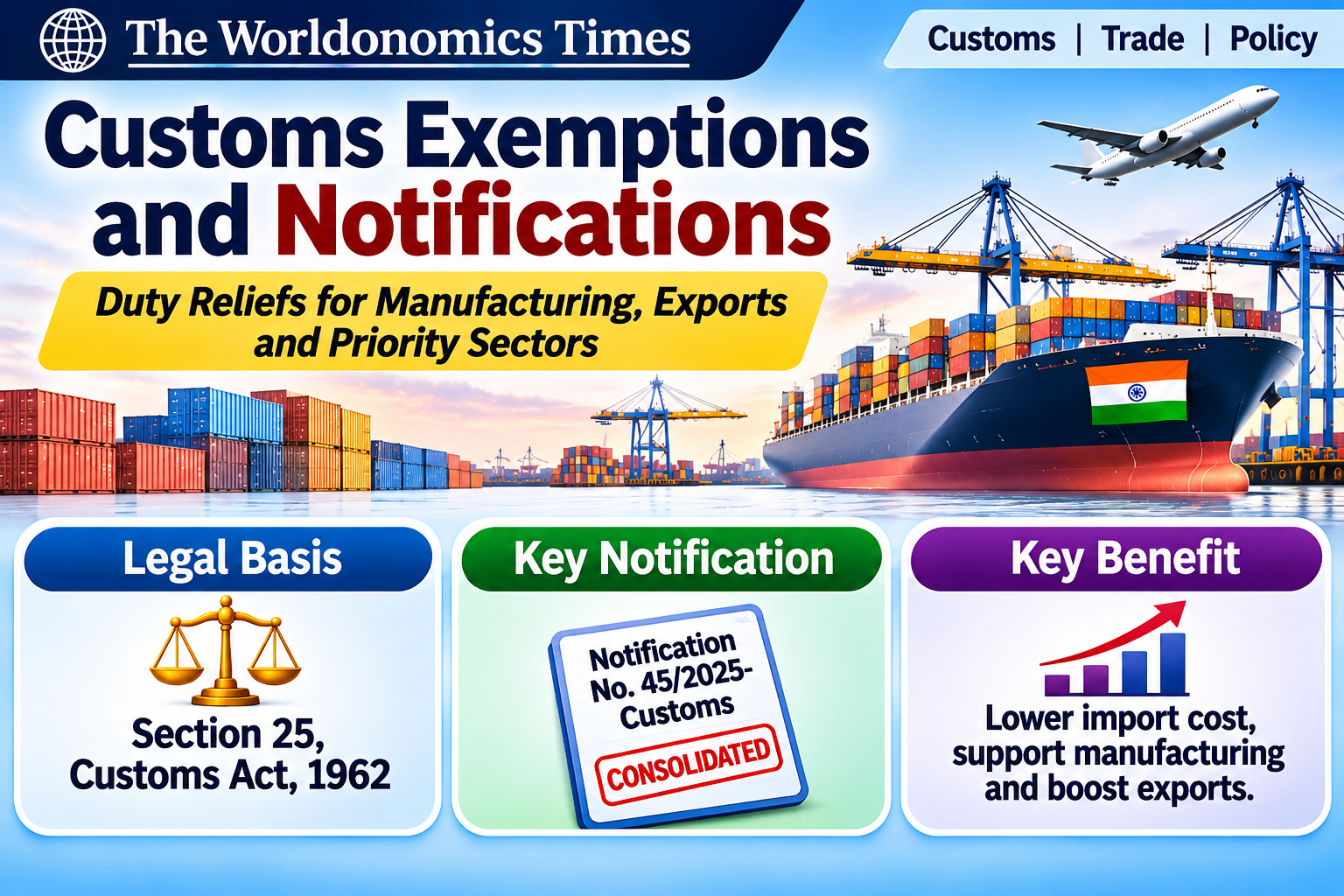
The principal legal provision governing customs exemptions is Section 25 of the Customs Act, 1962.
Under Section 25(1), the Central Government may, in the public interest, issue a notification in the Official Gazette granting exemption from the whole or part of customs duty on specified goods.
Such exemptions may be:
A. Absolute Exemption: The specified goods are exempted from the applicable customs duty without additional conditions attached to the exemption.
B. Conditional Exemption: The exemption is available only when the importer fulfils the conditions prescribed in the relevant notification. These conditions may relate to end-use, manufacturing activity, export obligations, certification or documentation.
Section 25(2) also empowers the Central Government to grant exemption through a special order in exceptional circumstances on a case-by-case basis.
The legal provisions therefore provide flexibility to the Government to modify customs duty treatment according to economic priorities and public interest. <Cite refs={[“turn465624search0″,”turn465624search24”]}/>
3. Types of Customs Exemption Notifications
Customs exemption notifications may be issued for different economic and policy objectives.
Important categories include:
- Manufacturing exemptions: Concessional duty on specified raw materials, components and production inputs.
- Capital goods exemptions: Duty benefits for eligible machinery and industrial equipment.
- Export promotion exemptions: Benefits supporting export production and international competitiveness.
- Healthcare exemptions: Concessions on specified medical equipment, medicines and healthcare-related imports.
- Renewable energy exemptions: Duty concessions for eligible equipment and components used in renewable energy projects.
- Sector-specific exemptions: Benefits for specified industries such as electronics, defence, infrastructure and other priority sectors.
The applicability of each benefit depends on the tariff classification, notification description, effective date and prescribed conditions.
4. Important Customs Notifications and Their Interpretation
A customs exemption notification generally contains several important particulars:
- Notification number and date.
- Legal authority under which it is issued.
- Description of eligible goods.
- Applicable tariff heading or tariff item.
- Exemption or concessional duty rate.
- Conditions and restrictions.
- Effective date and validity.
- Amendments, substitutions or rescission provisions.
Importers must carefully examine the complete notification rather than relying only on its title or a summary.
5. Notification No. 45/2025-Customs: A Major Consolidation Initiative
An important development in India’s customs exemption framework was the introduction of Notification No. 45/2025-Customs dated 24 October 2025, effective from 1 November 2025.
Through this initiative, CBIC consolidated 31 separate customs duty exemption notifications into a comprehensive notification to simplify the identification and application of import duty benefits.
The consolidation aimed to improve transparency, reduce the complexity of referring to multiple notifications and facilitate customs clearance. It also aligned exemption references with the revised customs tariff structure. <Cite refs={[“turn408360search1″,”turn408360search0”]}/>
The consolidated framework covers different categories of eligible goods and specifies applicable exemptions, concessional rates and conditions.
Importers should refer to the principal notification along with all subsequent amendments before claiming any exemption.
6. Customs Import of Goods at Concessional Rate of Duty (IGCR) Rules, 2022
An important compliance mechanism associated with conditional customs exemptions is the Customs (Import of Goods at Concessional Rate of Duty or for Specified End Use) Rules, 2022.
These rules apply where an exemption notification makes their observance mandatory and the benefit depends on using imported goods for specified manufacturing activities, output services or other prescribed end uses.
Key compliance requirements include:
- Providing prescribed information to customs authorities.
- Maintaining records of imported goods.
- Ensuring utilisation for the specified end use.
- Maintaining prescribed accounts and documentation.
- Filing applicable statements and returns.
- Complying with prescribed time limits and other conditions.
Non-compliance with these requirements may result in recovery of differential customs duty along with applicable interest and other consequences.
Therefore, businesses claiming conditional exemptions must establish an effective system for monitoring imported goods and fulfilling end-use obligations. <Cite refs={[“turn408360search25″,”turn408360search26”]}/>
7. Practical Example: Impact of Customs Exemption
Consider an Indian manufacturer importing machinery with an assessable value of ₹10 lakh.
| Particulars | Without exemption | With exemption |
|---|---|---|
| Assessable value | ₹10,00,000 | ₹10,00,000 |
| BCD rate | 10% | 5% |
| Basic Customs Duty | ₹1,00,000 | ₹50,000 |
| SWS at 10% of BCD | ₹10,000 | ₹5,000 |
| IGST at 18% | ₹1,99,800 | ₹1,99,800 |
| Total import taxes | ₹3,09,800 | ₹2,54,800 |
<text color=”secondary” size=”xs”>Illustrative calculation assuming the exemption reduces BCD to 5%, SWS applies at 10% of BCD and no other duties or exemptions apply.</text>
The exemption results in an illustrative customs tax saving of ₹55,000.
This demonstrates how an eligible concessional duty notification can reduce the landed cost of imported machinery and improve the financial efficiency of manufacturing operations.
8. Professional Opportunities and Compliance Responsibilities
Customs exemptions and notifications offer significant professional opportunities for Cost Accountants, Chartered Accountants, customs consultants and indirect tax professionals.
Important professional services include:
- Identification of applicable customs exemptions.
- Verification of notification conditions and eligibility.
- Customs duty saving and cost-benefit analysis.
- Review of exemption claims in Bills of Entry.
- IGCR compliance and end-use monitoring.
- Customs notification amendment tracking.
- Customs audit and duty reconciliation.
- Advisory on exemption disputes and refund matters.
Professionals can help businesses establish exemption registers, notification tracking systems and internal compliance procedures to minimise financial and regulatory risks.
9. Challenges and the Way Forward
One of the major challenges for importers is keeping track of frequent changes in customs notifications, tariff classifications, exemption conditions and validity periods.
A further important consideration is the statutory validity of conditional exemptions under Section 25(4A) of the Customs Act, 1962. Subject to the statutory exceptions and the terms of the relevant notification, conditional exemptions generally have a validity period linked to 31 March falling immediately after two years from their grant or variation.
The Union Budget 2026-27 also reviewed existing customs exemptions, with selected concessions extended and others allowed to lapse or omitted from the applicable schedules. Businesses must therefore verify the current position rather than relying on older exemption lists. <Cite refs={[“turn408360search24″,”turn408360search26″,”turn408360search27”]}/>
The objective should be to establish a transparent and technology-driven customs compliance system that enables businesses to identify eligible concessions and fulfil all statutory conditions.
Conclusion
Customs exemptions and notifications are important instruments of India’s international trade and industrial policy. They provide financial relief to eligible importers, support domestic manufacturing, encourage investment and improve the competitiveness of Indian businesses.
However, claiming an exemption requires more than identifying a lower customs duty rate. Correct tariff classification, interpretation of the notification, fulfilment of conditions and maintenance of supporting documentation are equally important.