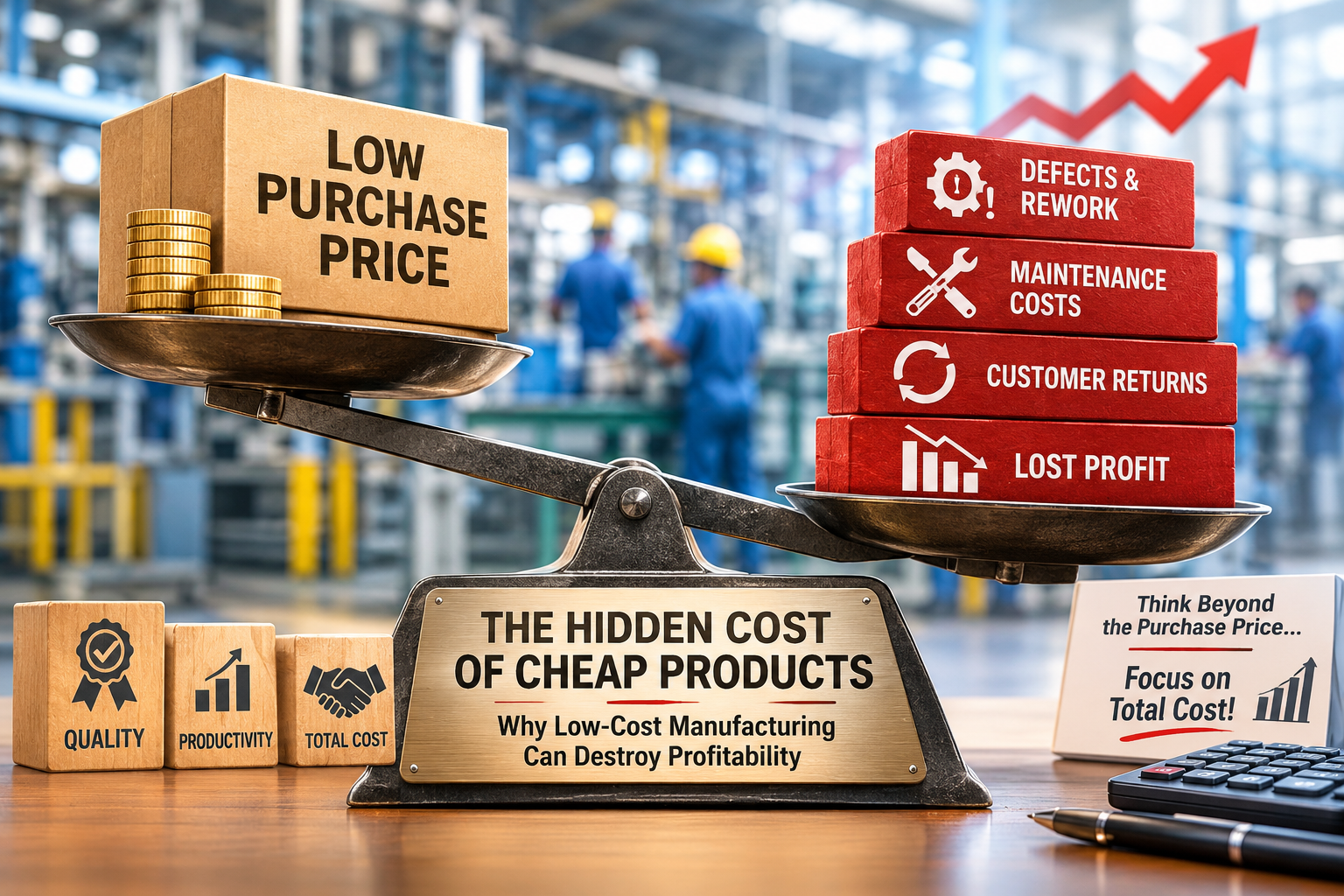
Businesses often associate lower production costs with higher profitability. Reducing raw material prices, negotiating cheaper supplier contracts and minimising labour expenses are commonly viewed as effective cost-control strategies.
However, a lower purchase price does not necessarily mean a lower overall cost.
A company may save money by purchasing cheaper materials, choosing less reliable suppliers or reducing quality-related expenditure, only to incur higher costs through defective products, production delays, maintenance, customer returns and lost sales.
This creates an important business paradox: a product manufactured at a lower cost can ultimately become more expensive to produce, sell and maintain.
1. The Price Trap: When Cheap Inputs Become Expensive Decisions
Procurement departments frequently focus on obtaining the lowest possible purchase price. Although this approach may reduce immediate expenditure, it does not always consider the complete financial consequences of purchasing decisions.
For example, a manufacturer may select a cheaper raw material supplier to reduce input costs. However, inconsistent material quality could increase rejection rates, production interruptions and inspection requirements.
Similarly, purchasing low-cost machinery may reduce initial capital expenditure but increase maintenance expenses, energy consumption and machine downtime.
The problem is that businesses often evaluate purchasing decisions through an immediate price comparison rather than their total economic impact.
This is where the concept of Total Cost of Ownership (TCO) becomes important. It considers not only the purchase price but also transportation, installation, maintenance, operating costs, quality failures and eventual replacement expenses.
The cheapest supplier is not necessarily the most economical supplier.
2. Low Production Costs vs Hidden Operational Expenses
Manufacturing profitability depends on more than the cost of raw materials and direct labour.
Several indirect expenses can increase when businesses pursue aggressive cost reductions without evaluating operational consequences.
These include:
- Higher rejection rates: Cheaper or inconsistent inputs may increase defective production.
- Maintenance expenses: Low-cost machinery may require frequent repairs and replacement parts.
- Production delays: Unreliable suppliers and equipment can disrupt manufacturing schedules.
- Energy inefficiency: Older or less efficient equipment may consume more electricity.
- Labour productivity losses: Insufficient training and inadequate supervision can reduce output per employee.
- Customer-related expenses: Poor product quality may increase warranty claims, returns and replacement costs.
The American Society for Quality (ASQ) identifies scrap, rework, waste, warranty claims and product returns as important components of the Cost of Poor Quality framework.
These expenses demonstrate why reducing one visible cost can sometimes increase several less visible costs elsewhere in the organisation.
3. India’s Manufacturing Challenge: Is Cheap Labour Enough?
India has an important advantage in manufacturing through its workforce, domestic market and growing industrial ecosystem. However, sustainable cost competitiveness requires more than relatively affordable labour.
NITI Aayog’s report, Electronics: Powering India’s Participation in Global Value Chains, examines the cost disadvantages affecting India’s electronics manufacturing sector.
The report estimates that India faces a cumulative cost disadvantage of approximately 10–14% in electronics assembly and 14–18% in component manufacturing compared with China, based on the report’s sector-specific analysis.
Interestingly, India has an estimated 1.5% advantage in conversion costs due to lower labour and utility expenses. However, this advantage is partly offset by lower productivity, logistics expenses, higher financing costs and dependence on imported components.
The findings highlight an important economic reality: lower labour costs alone cannot guarantee lower manufacturing costs.
For Indian manufacturers seeking to compete internationally, improvements in technology, infrastructure, workforce skills, supply-chain efficiency and domestic component production are equally important.
The Confederation of Indian Industry (CII), in its 2025 Manufacturing Competitiveness Study, also identifies technology limitations, skilled labour shortages and the cost of implementing quality systems as challenges, particularly for smaller manufacturers.
4. The Financial Impact: An Illustrative Example
Consider a manufacturing company producing 10,000 units of a product.
It has two purchasing options:
| Particulars | Supplier A | Supplier B |
|---|---|---|
| Material cost per unit | ₹100 | ₹90 |
| Production and processing cost | ₹50 | ₹50 |
| Quality failure and rework per unit (average) | ₹2 | ₹12 |
| Total cost per unit | ₹152 | ₹152 |
| Total cost for 10,000 units | ₹15.20 lakh | ₹15.20 lakh |
Supplier B offers a 10% lower material price. However, higher quality-related expenses eliminate the apparent savings.
In this illustration, the company gains no overall cost advantage despite purchasing cheaper materials.
If additional warranty claims, delivery penalties or customer losses arise, the cheaper option could become significantly more expensive.
The figures are illustrative and demonstrate the importance of evaluating total cost rather than purchase price alone.
5. Cost of Poor Quality: The Expenses Behind Cheap Production
The Cost of Quality (COQ) framework developed in quality management provides a useful way to understand these financial consequences.
It broadly classifies quality-related expenditure into four categories:
| Category | Examples |
|---|---|
| Prevention costs | Training, quality planning and process improvement |
| Appraisal costs | Inspection, testing and quality audits |
| Internal failure costs | Scrap, rework and rejected production |
| External failure costs | Warranty claims, returns and customer complaints |
ASQ explains that measuring these costs helps organisations identify improvement opportunities and evaluate potential savings.
Its 2025 quality-cost research also highlights a significant management challenge: only 31% of respondents reported fully understanding the impact of quality costs on their organisations’ financial performance.
This indicates that even when businesses invest in quality management, they may not fully understand its financial contribution.
The objective should not be to eliminate quality-related expenditure. Instead, businesses should invest appropriately in prevention to reduce recurring failure costs.
6. The Role of CMAs: Finding the Real Cost of Production
Cost and Management Accountants can play an important role in helping businesses distinguish between low purchase prices and genuinely economical production.
Through cost analysis and management reporting, CMAs can:
- Evaluate supplier costs beyond quoted purchase prices.
- Identify material wastage and abnormal production losses.
- Analyse labour and machine productivity.
- Measure the financial impact of scrap, rework and downtime.
- Compare standard costs with actual production costs.
- Calculate product profitability after quality-related expenses.
- Support make-or-buy decisions and supplier selection.
Tools such as Activity-Based Costing (ABC), Variance Analysis, Standard Costing and Cost-Benefit Analysis can help management identify where apparent savings are being offset by additional expenditure.
Rather than simply asking which supplier offers the lowest price, management should ask which purchasing decision delivers the lowest sustainable cost while maintaining the required quality.
Conclusion: The Cheapest Product Is Not Always the Most Profitable
Cost reduction remains essential for manufacturing competitiveness. However, reducing expenses without understanding their operational consequences can create a false impression of efficiency.
A cheaper raw material, lower-priced machine or reduced quality-control budget may improve short-term financial figures while increasing the overall cost of production.
For Indian manufacturers competing in domestic and international markets, sustainable cost advantages must come from productivity, process improvement, technological investment, quality management and efficient supply chains.
True cost competitiveness is not about producing at the lowest possible price. It is about delivering the required quality at the lowest sustainable total cost.
Because in manufacturing, what appears cheap at the beginning can become expensive by the time the product reaches the customer.