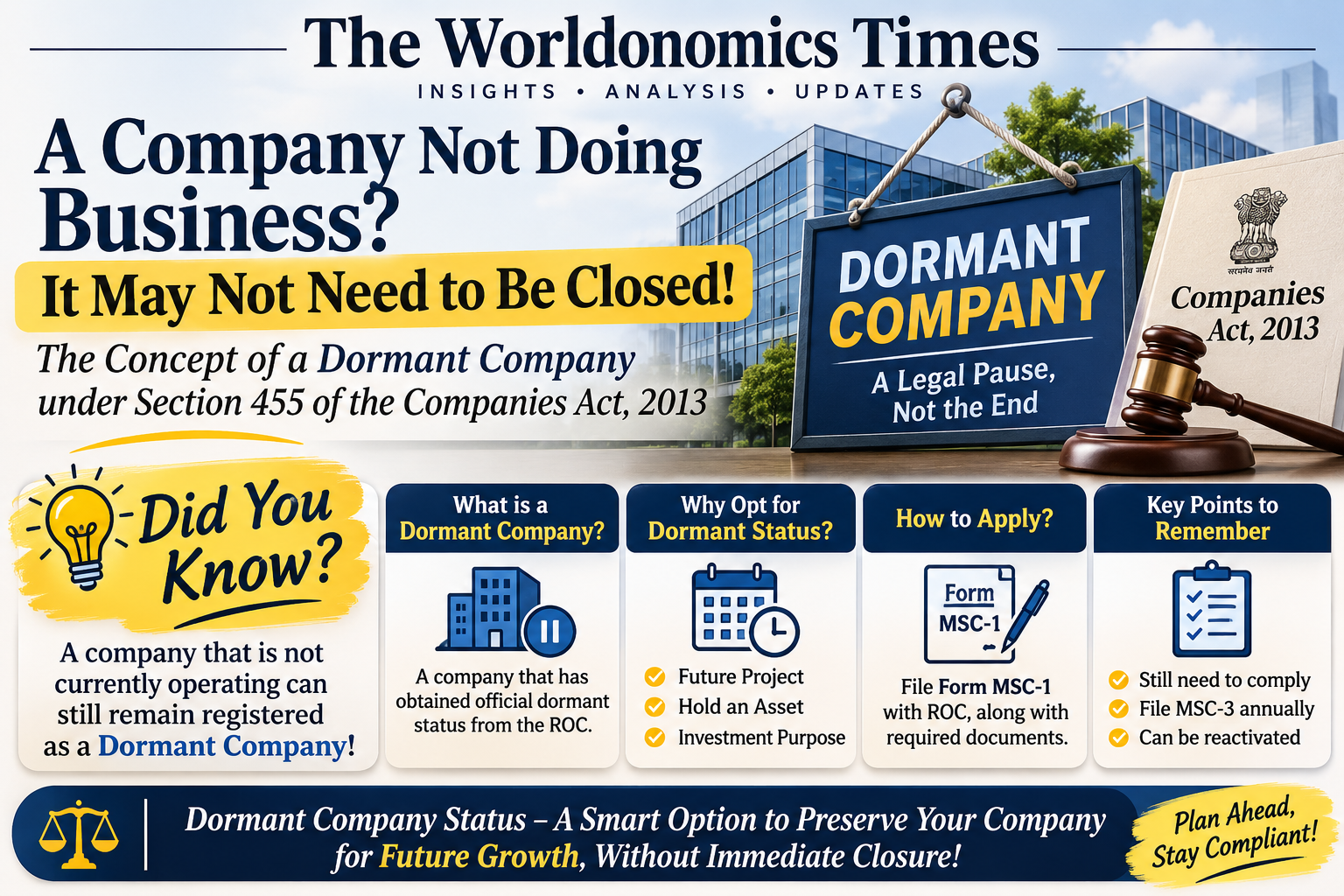
Many people believe that if a company is incorporated but does not start its business operations, it must either continue with all regular compliance requirements or be permanently closed. However, the Companies Act, 2013 provides another option in the form of Dormant Company status, which allows eligible companies to remain registered with a comparatively limited compliance framework.
Under Section 455 of the Companies Act, 2013, a company may obtain dormant status if it was incorporated for a future project, to hold an asset or intellectual property, or if it qualifies as an inactive company under the prescribed provisions. This concept is particularly useful for businesses that have been incorporated for future expansion, investment purposes, or projects that are yet to commence.
What is a Dormant Company?
A dormant company is a company that has obtained official dormant status from the Registrar of Companies. It is not the same as an unregistered business or a company that has simply stopped operating. The company continues to exist as a legal entity, but its status is recognised as dormant under the law.An inactive company, as defined under Section 455, generally refers to a company that has not carried on business or operations, has not undertaken significant accounting transactions, or has not filed financial statements and annual returns during the last two financial years, subject to the statutory provisions.
Why Would a Company Opt for Dormant Status?
There can be several practical reasons for a company to remain dormant rather than proceed with closure. For example, a company may be incorporated for a project that has been postponed due to financial, market or other business considerations. Another company may have been incorporated specifically to hold property, an investment, a trademark or intellectual property for future use.In such cases, closing the company may not be commercially desirable. Dormant status can provide a way to preserve the company’s legal existence while it is not actively carrying on business, provided the statutory eligibility conditions are fulfilled.
How Can a Company Apply for Dormant Status?
An eligible company can apply to the Registrar of Companies by filing Form MSC-1, along with the prescribed fee and documents. The application requires the company to fulfil the applicable conditions under the Companies (Miscellaneous) Rules, 2014.
The company is required to obtain the necessary shareholder approval, either through a special resolution or by following the prescribed consent route. It must also satisfy the eligibility conditions, which include requirements relating to outstanding liabilities, statutory dues, pending proceedings and other matters prescribed under the rules.
The Registrar examines the application and, upon approval, grants dormant status through the prescribed certificate.
Does Dormant Status Mean No ROC Compliance?
This is one of the most common misconceptions. Obtaining dormant status does not mean that the company is completely free from statutory compliance.
A dormant company is still required to maintain the prescribed number of directors, maintain its records and fulfil applicable filing requirements. It is also required to file its annual return of dormant company in Form MSC-3, including the prescribed information about its financial position, within the applicable time limit.
Certain events, such as changes in directors or allotment of securities, may still trigger separate filing obligations. Therefore, dormant status should not be treated as a compliance-free status.
Can a Dormant Company Become Active Again?
Yes. A dormant company can return to active status when it decides to commence operations or when circumstances change. For this purpose, it can apply to the Registrar in Form MSC-4, along with the prescribed documents, fees and applicable return requirements.
Once the application is approved, the Registrar issues the prescribed certificate for restoration of active status. The company can then continue its operations as an active company, subject to the applicable legal and compliance requirements.
Conclusion
Dormant company status is a useful provision for businesses that are not currently operating but wish to retain their corporate identity for future purposes. Instead of immediately opting for closure, eligible companies may consider this statutory option, which can help preserve the company while keeping its legal status intact.
However, dormant status is not a substitute for proper compliance. Companies must carefully evaluate eligibility, statutory requirements, filing obligations and future business plans before applying for it.
Pov:Understanding this provision can help directors, entrepreneurs and compliance professionals make better decisions regarding companies that are incorporated but not currently active.