Indian stock market investors are closely monitoring developments in US trade policy as proposed tariffs targeting 14 trading partners, including India, introduce fresh uncertainty into the market outlook. The announcement by the Trump administration has raised concerns about the potential impact on Indian exports, trade relations and corporate earnings.
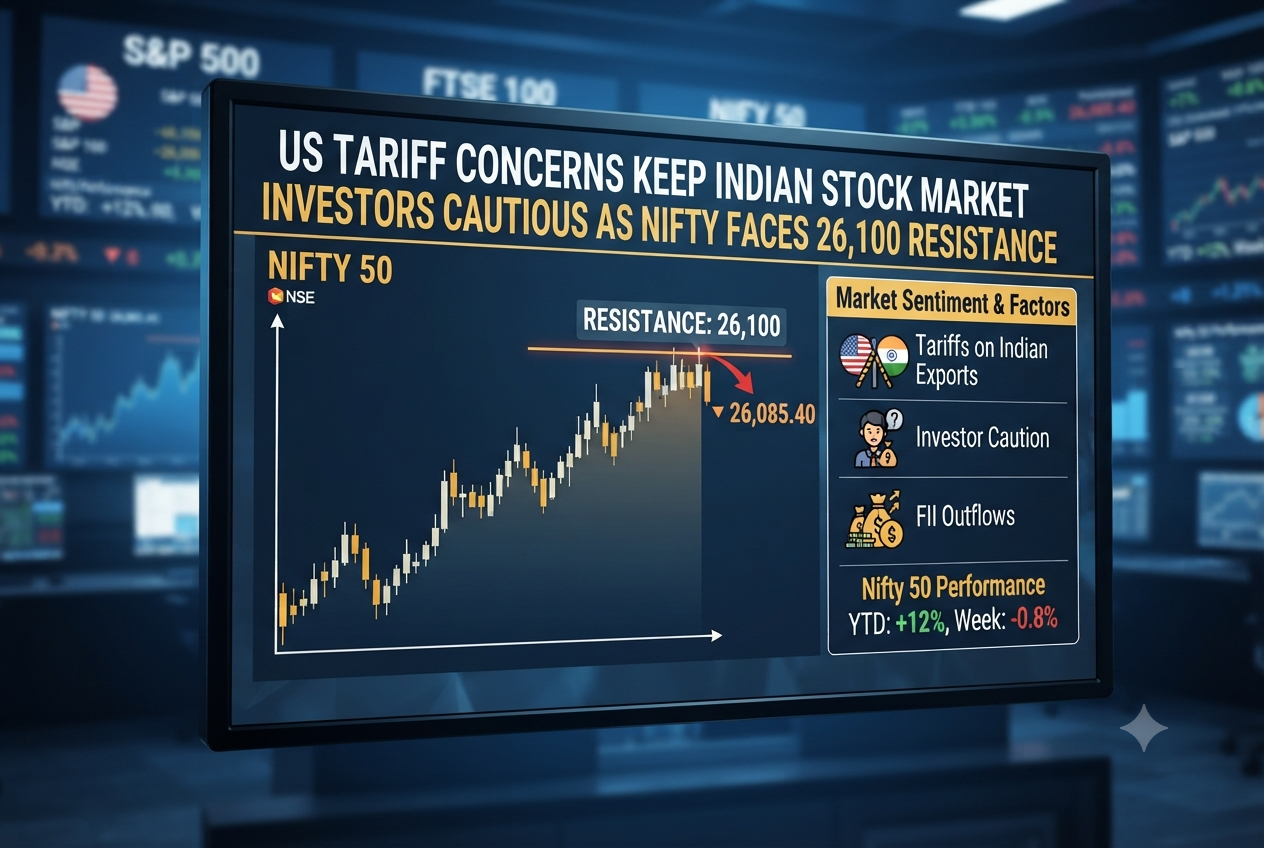
The development comes at a time when domestic equities have staged a strong recovery in November, supported by substantial foreign portfolio investment (FPI) inflows and improving investor sentiment. However, with the Nifty 50 approaching the important 26,000–26,100 resistance zone, market participants are becoming more cautious about the possibility of short-term consolidation.
US Proposes Tariffs on 14 Trading Partners
On November 25, 2026, the Office of the United States Trade Representative (USTR) announced determinations under Section 301 of the US Trade Act covering 14 economies. These include India, China, the European Union, Japan, South Korea, Singapore, Switzerland, Indonesia, Malaysia, Cambodia, Thailand, Vietnam, Taiwan and Bangladesh.
The US administration has cited concerns about structural excess capacity and manufacturing practices in these economies, arguing that certain industrial policies create unfair competitive conditions for American businesses.
For India, the USTR has proposed tariffs of up to 25% on goods, subject to specified exemptions and adjustments. The proposed rate could be reduced to 17% if India and the United States reach a reciprocal trade agreement that addresses the concerns raised in the investigation.
Importantly, these are proposed measures rather than tariffs that have already come into force. The final outcome will depend on the consultation process, trade negotiations and subsequent decisions by the US authorities.
Why the Announcement Matters for India
The United States is an important destination for Indian exports, making trade-policy developments particularly relevant for companies with significant exposure to the American market.
Potentially higher import duties could affect the competitiveness of Indian products in the US, depending on the final tariff structure, exemptions and the ability of exporters to adjust their pricing.
Sectors that could attract investor attention include textiles and apparel, engineering goods, chemicals, pharmaceuticals, automotive components and other manufacturing-oriented industries. The actual impact will vary according to product-specific exemptions, supply-chain arrangements and the extent to which companies depend on US customers.
Exporters may face pressure if additional duties make their products more expensive for American buyers. Some businesses could attempt to absorb part of the additional cost, while others may seek alternative markets or reconsider their supply-chain strategies.
However, the proposed tariff framework should not be interpreted as an immediate or uniform financial burden on every Indian exporter. The final product coverage and implementation details will be important in determining the actual economic consequences.
Indian Stock Market Shows Signs of Consolidation
The tariff announcement has arrived after a strong November rally in Indian equities.
On November 25, the Nifty 50 advanced 1.85% to close at 25,819.25, while the BSE Sensex gained 1.82% to settle at 83,938.28. Both benchmarks recovered sharply, bringing their year-to-date losses below 1.5%.
During morning trading on November 26, the Nifty was up 0.12% at 25,851.90, while the Sensex gained 0.25% to 84,156.68, as of 10:00 a.m. IST.
The relatively modest gains suggested that investors were pausing after the previous session’s strong advance while assessing global developments, including the proposed US trade measures.
Market analysts have identified the 26,000–26,100 range as an important resistance area for the Nifty. A sustained move above this zone could strengthen the bullish outlook, while failure to cross it may encourage profit booking and short-term range-bound trading.
Record Foreign Investment Supports Market Sentiment
Despite external uncertainties, foreign portfolio investment has emerged as a significant source of support for Indian equities.
Foreign investors reportedly purchased approximately US$15.16 billion worth of Indian shares during November up to November 26, marking a record monthly inflow. The strong buying activity has contributed to the market’s recovery and improved investor confidence.
The Nifty and Sensex have gained approximately 12% and 13%, respectively, during the month, according to market reports.
Domestic and international investors will now assess whether these inflows can continue at a similar pace. Sustained institutional buying could help the market absorb short-term volatility, although changing global risk sentiment and trade-related uncertainty could influence investment decisions.
Other external factors, including crude oil prices, currency movements and global equity trends, will also remain relevant for India’s market outlook.
Key Nifty Levels Investors Should Monitor
The 26,000–26,100 resistance range is likely to remain an important technical reference point in the near term.
A decisive breakout above this zone, supported by strong trading volumes and broader participation across sectors, could create room for further gains. Such a move would indicate that buying interest remains strong despite external uncertainties.
On the downside, the 25,550–25,600 range has been identified as an immediate support area by market analysts. A sustained decline below this zone could increase the possibility of further consolidation.
Investors should also watch market breadth, institutional activity and sector-specific performance rather than relying exclusively on movements in the benchmark indices.
The Worldonomics Times View
The proposed US tariffs introduce a fresh challenge for Indian markets, but their impact should be assessed with a clear distinction between policy announcements and implemented measures.
India’s potential exposure to additional duties is important, particularly for export-oriented businesses. Nevertheless, the possibility of a negotiated reduction in the proposed tariff rate provides an important reason to monitor diplomatic and trade developments before drawing conclusions about the long-term consequences.
The market’s recent recovery also has domestic and international drivers beyond trade policy. Record foreign investment, improving participation and expectations around India’s economic growth have helped strengthen sentiment.
For investors, the immediate concern is whether the Nifty can establish itself above the 26,000–26,100 resistance zone. A temporary pause after a strong rally would not necessarily indicate a reversal of the broader trend. However, elevated valuations, global uncertainty and potential export-related risks make selective investing and disciplined risk management important.
The coming weeks could prove significant for both the Indian market and India-US trade relations. A constructive trade agreement may ease uncertainty, while prolonged negotiations or higher final duties could create additional pressure on export-sensitive companies.
Conclusion
US tariff concerns are adding a new layer of uncertainty to the Indian stock market as the Nifty approaches a major technical resistance zone. Although record foreign investment and the November recovery continue to support sentiment, investors are likely to remain attentive to developments in trade negotiations.
The proposed duties are not yet final, and the possibility of a lower rate through an agreement remains relevant. Until greater clarity emerges, consolidation and selective stock movements may characterise the market, even as the broader investment outlook remains supported by domestic economic and institutional factors.