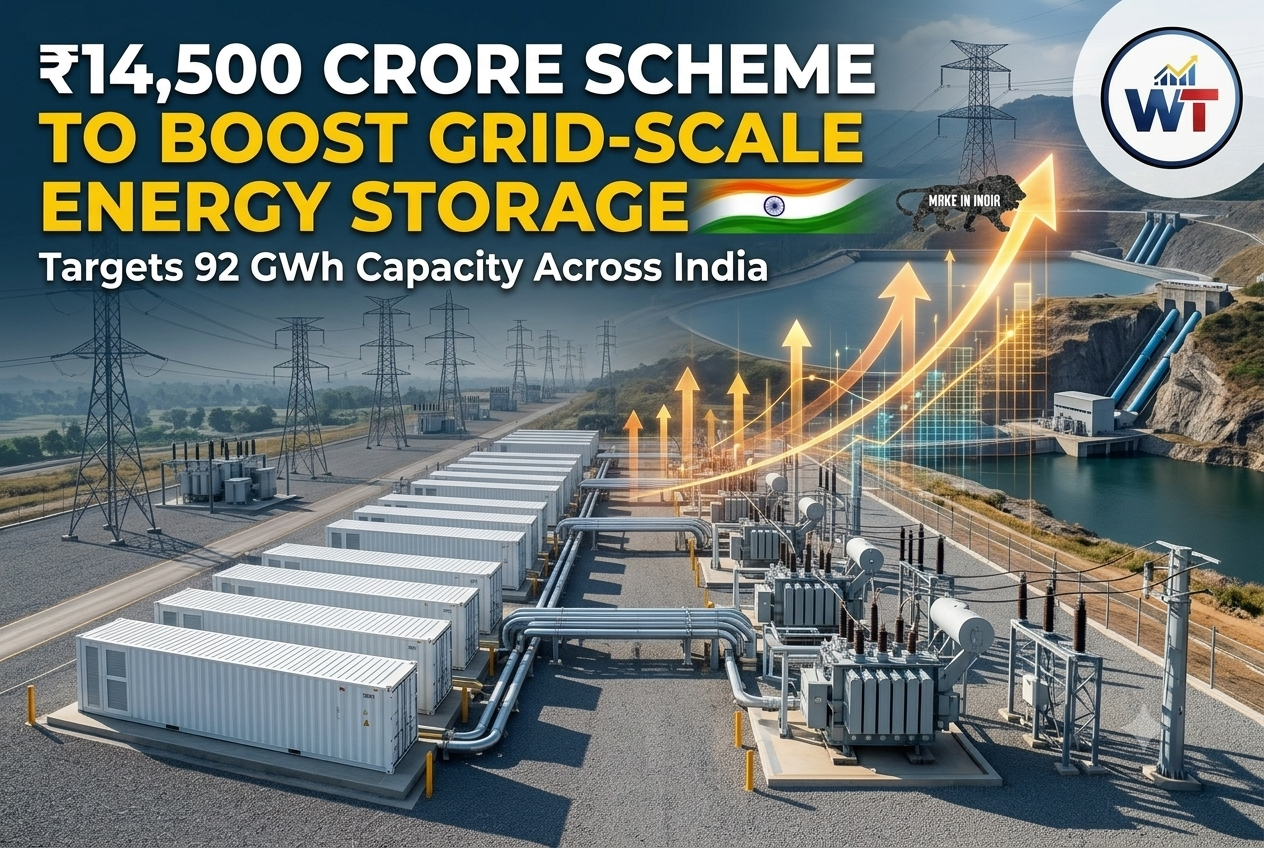
New Delhi, November 27, 2026 — The Union Cabinet has approved a ₹14,500 crore Viability Gap Funding (VGF) scheme to accelerate the development of large-scale energy storage infrastructure across India. Approved on November 4, 2026, the initiative aims to support the creation of 92 gigawatt-hours (GWh) of new grid-scale energy storage capacity between FY2026-27 and FY2030-31.
The scheme is designed to strengthen electricity-grid reliability, improve the integration of renewable energy and support the country’s transition towards a more flexible and sustainable power system. It will provide financial assistance to projects involving battery storage, pumped hydro storage and emerging energy storage technologies.
With renewable energy capacity expanding across the country, the availability of reliable storage infrastructure is becoming increasingly important. The new programme seeks to address this requirement by encouraging investment in large-scale projects and improving their financial viability.
₹14,500 Crore VGF Support for 92 GWh Capacity
The approved scheme provides ₹14,500 crore in government financial support to facilitate the development of 92 GWh of grid-scale energy storage capacity.
The government estimates that these projects will require total investments of approximately ₹97,600 crore. The VGF support is intended to bridge the financial viability gap and encourage public and private sector participation in projects that may otherwise face investment challenges.
The targeted storage capacity is equivalent to approximately 170% of India’s existing grid-scale energy storage capacity, according to the government’s announcement.
The programme will operate over five financial years, from FY2026-27 to FY2030-31. Its implementation is expected to contribute towards meeting India’s projected requirement of approximately 411 GWh of grid-scale energy storage capacity by 2031-32.
The initiative reflects the growing importance of energy storage in maintaining a stable electricity supply as the share of renewable power increases.
Three Technology Segments Under the Scheme
The programme covers three categories of energy storage technologies, allowing India to develop a diversified storage infrastructure rather than relying on a single solution.
The 92 GWh target is divided as follows:
| Storage technology | Target capacity |
|---|---|
| Battery Energy Storage Systems (BESS) | 30 GWh |
| Pumped Storage Projects (PSP) | 60 GWh |
| Emerging storage technologies | 2 GWh |
| Total | 92 GWh |
Pumped hydro storage will account for the largest share of the planned capacity, while battery energy storage and emerging technologies will provide additional flexibility to the electricity system.
This combination is intended to support different operational requirements, including short-duration balancing, longer-duration storage and the management of fluctuations in renewable electricity generation.
Battery Energy Storage to Support Renewable Power
Battery Energy Storage Systems are expected to play an important role in India’s expanding renewable energy infrastructure.
These systems store electricity when generation is high and release it when demand increases or renewable generation declines. They can help manage fluctuations in solar and wind power, particularly when electricity demand remains high after sunset or during periods of lower renewable generation.
The scheme will support the development of 30 GWh of battery storage capacity.
An important feature is the mandatory Domestic Content Requirement (DCR) of at least 40% for Battery Energy Storage System projects receiving support under the scheme.
The requirement is intended to encourage domestic manufacturing, strengthen local supply chains and reduce dependence on imported components. It may also create opportunities for Indian manufacturers involved in battery cells, modules, power electronics and associated equipment, subject to the applicable eligibility and sourcing rules.
By connecting energy storage deployment with domestic manufacturing, the programme seeks to support both power-sector development and industrial growth.
Pumped Hydro Storage to Provide Large-Scale Capacity
Pumped Storage Projects will account for 60 GWh of the overall target, making them the largest component of the scheme.
Pumped hydro storage works by using electricity to pump water from a lower reservoir to a higher reservoir when surplus power is available. When electricity demand rises, the stored water is released through turbines to generate electricity.
This technology can provide large-scale storage and help balance electricity supply and demand over longer periods.
India has significant potential for pumped hydro development because of its geographical features and water-resource infrastructure. However, projects require substantial investment, suitable locations, environmental assessments and long development timelines.
The VGF support is expected to improve project economics and encourage investment in new pumped storage infrastructure.
Competitive Bidding and Private Sector Participation
The scheme will allocate energy storage capacity through a tariff-based competitive bidding process.
Public and private sector electricity distribution companies will be eligible for VGF support for Battery Energy Storage Systems and pumped hydro projects. Projects based on alternative energy storage technologies will be implemented by eligible public and private sector entities.
Competitive bidding is intended to encourage cost efficiency and provide a transparent mechanism for selecting projects.
The participation of private developers, technology providers, infrastructure companies and financial institutions could expand the investment base for energy storage projects.
The estimated total investment of ₹97,600 crore also indicates the potential scale of economic activity that the programme could generate across engineering, construction, manufacturing and power infrastructure.
Strengthening Grid Reliability and Renewable Energy Integration
India’s renewable energy expansion has increased the need for electricity storage and flexible grid management.
Solar power generation is concentrated during daylight hours, while electricity demand can remain high during the evening. Wind generation can also vary depending on weather conditions. Without sufficient storage and balancing infrastructure, these fluctuations can create challenges for grid operators.
Energy storage systems can help address this mismatch by absorbing surplus electricity and releasing it when required.
Greater storage capacity can support more effective utilisation of renewable energy, reduce curtailment during periods of excess generation and improve the availability of electricity during peak demand.
The scheme is also intended to support more reliable and affordable round-the-clock electricity supply as India continues to expand its renewable energy capacity.
Opportunities for Domestic Industry and Investment
The programme could create opportunities for companies operating across the energy and infrastructure value chain.
Battery manufacturers, engineering companies, power equipment suppliers, construction firms and project developers may benefit from increased demand for storage-related infrastructure.
The domestic content requirement for battery projects could also encourage investment in local manufacturing capabilities and component production.
In addition, pumped hydro projects can generate demand for civil engineering, electrical equipment, turbines, generators and associated infrastructure.
The development of these projects may support employment across construction, manufacturing, operations and maintenance. It could also encourage technology development and strengthen India’s energy storage ecosystem.
The Worldonomics Times View
The approval of the ₹14,500 crore VGF scheme marks an important development in India’s efforts to strengthen its electricity infrastructure. As renewable energy becomes a larger part of the power mix, storage capacity will be essential for managing fluctuations in generation and maintaining reliable electricity supply.
The allocation of 60 GWh for pumped hydro, 30 GWh for battery storage and 2 GWh for emerging technologies provides a diversified approach to developing storage infrastructure. The domestic content requirement for battery projects also connects energy security with the development of India’s manufacturing capabilities.
However, the success of the programme will depend on timely project implementation, efficient bidding, access to financing and the availability of suitable locations and technologies. Pumped hydro projects must navigate land, environmental and construction requirements, while battery projects need reliable supply chains and competitive operating costs.
The government must also ensure that storage projects are integrated effectively with transmission networks and electricity distribution systems so that their capacity delivers practical benefits to consumers and grid operators.
If implemented effectively, the scheme could improve renewable energy utilisation, strengthen electricity-grid reliability and attract substantial investment into India’s energy infrastructure. It represents an opportunity to build a more flexible power system while supporting the country’s long-term clean energy and energy security objectives.