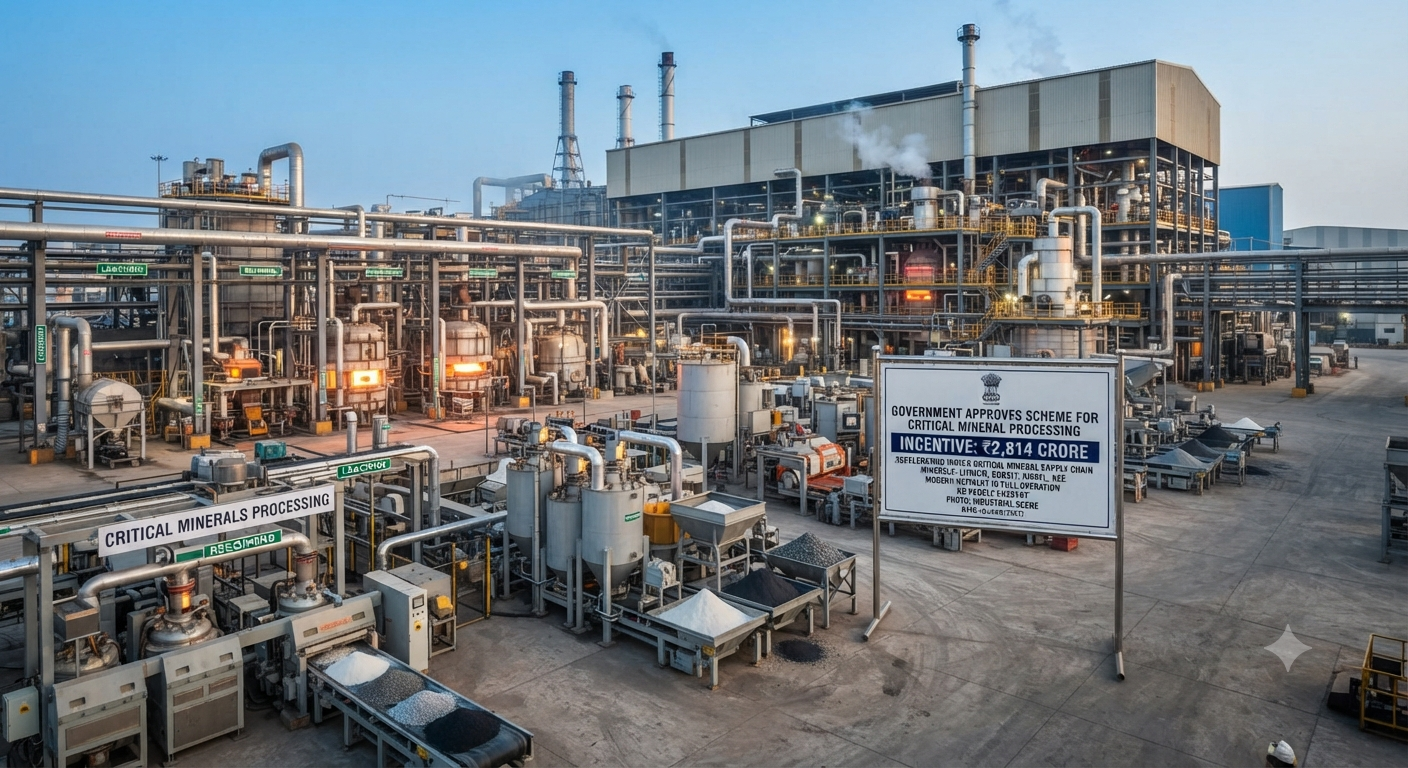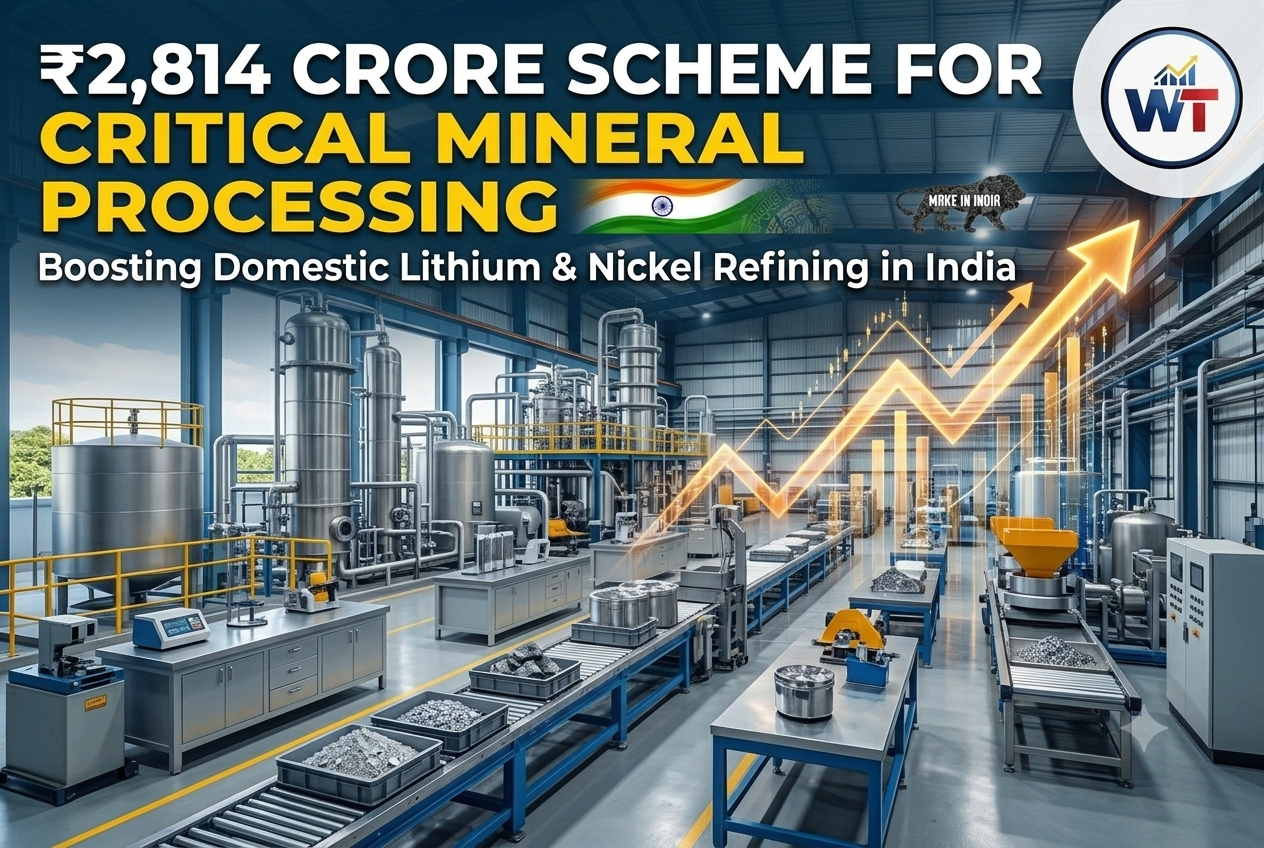
New Delhi, November 27, 2026 — The Union Cabinet has approved a ₹2,814 crore capital expenditure support scheme to strengthen India’s domestic critical mineral processing capabilities, with a particular focus on lithium and nickel. Approved on November 4, 2026, the initiative aims to establish four processing plants and reduce the country’s dependence on imported refined minerals and high-purity materials.
The Capex Support Scheme to Promote Critical Mineral Processing will operate from FY2026-27 to FY2030-31. It will provide capital subsidies to eligible companies investing in domestic processing infrastructure, helping address a critical gap in India’s mineral value chain.
The government expects the scheme to attract approximately ₹10,000 crore in total investment. It is also intended to strengthen supply chains for electric vehicles, battery energy storage systems, electronics, defence equipment and speciality steel.
Strengthening India’s Critical Mineral Supply Chain
Critical minerals are essential raw materials for modern industries and advanced technologies. Lithium and nickel, in particular, are important inputs for battery manufacturing, electric mobility and energy storage.
However, the processing of several critical minerals remains concentrated in a limited number of countries. This creates supply-chain vulnerabilities arising from geopolitical tensions, international trade restrictions, price fluctuations and potential disruptions in global markets.
India has identified 24 critical and strategic minerals as important to its economic and industrial development. Despite growing demand, domestic processing capacity for several minerals remains limited, leaving manufacturers dependent on imported refined intermediates and high-purity materials.
The new scheme seeks to address this challenge by supporting the establishment of domestic facilities capable of converting mineral ores and intermediate products into materials suitable for industrial applications.
The initiative is also aligned with the National Critical Mineral Mission, which aims to strengthen India’s capabilities across mineral exploration, mining, processing, recycling and value addition.
₹2,814 Crore Financial Support for Four Processing Plants
The scheme has a total financial outlay of ₹2,814 crore, including ₹2,800 crore earmarked for capital support and ₹14 crore for administrative expenses.
The government will provide a capital subsidy covering 30% of eligible investment for the establishment of four processing facilities.
The planned allocation is structured as follows:
| Mineral | Number of plants | Minimum capacity per plant | Maximum support per beneficiary |
|---|---|---|---|
| Lithium | 2 | 30,000 tonnes | ₹500 crore |
| Nickel | 2 | 50,000 tonnes | ₹900 crore |
The two lithium plants will have a combined minimum processing capacity of 60,000 tonnes, while the two nickel plants will have a combined minimum capacity of 100,000 tonnes.
The maximum capital support for lithium facilities will total ₹1,000 crore, while nickel facilities will receive up to ₹1,800 crore collectively.
These investments are expected to establish a foundation for domestic processing and increase the availability of materials required by India’s advanced manufacturing industries.
Focus on Lithium and Nickel Processing
Lithium is a key material used in rechargeable batteries, particularly those powering electric vehicles, consumer electronics and stationary energy storage systems.
Under the scheme, supported lithium facilities will process eligible ores and concentrates into high-purity, battery-grade products. The scheme covers ores and concentrates rather than lithium brines.
Nickel is another important industrial mineral, with applications in battery production, stainless steel and speciality alloys. The supported nickel facilities will produce Class-1 nickel or battery-grade nickel sulphate.
Cobalt is also expected to be recovered as a by-product of nickel processing. This could provide an additional domestic source of a mineral used in certain battery chemistries and other advanced industrial applications.
By developing processing capabilities for these materials, India aims to capture a greater share of the value generated within the critical mineral supply chain instead of relying heavily on overseas processing facilities.
Competitive Selection and Milestone-Based Payments
The government has introduced a two-stage competitive selection process to identify eligible beneficiaries.
In the first stage, applications will be evaluated on technical qualifications. Only applicants meeting the prescribed technical requirements will be permitted to participate in the second stage.
The second stage will involve financial bidding. Two beneficiaries will be selected for each mineral based on the least-cost criterion, meaning preference will be given to technically qualified bidders seeking the lowest capital expenditure support.
The approved financial assistance will be released in three instalments linked to project progress.
The first tranche will be released after the beneficiary achieves the prescribed initial investment and equity contribution milestones. The second will follow further capital expenditure and equity milestones, while the final tranche will be linked to the commissioning of the processing plant and fulfilment of the required equity contribution.
This structure is intended to connect government support with actual project development rather than disbursing the entire subsidy upfront.
Selected beneficiaries will generally be required to commission their facilities within three years of receiving the Letter of Award, with an outer limit of five years under the scheme’s provisions.
Opportunities for Electric Mobility and Battery Manufacturing
The development of domestic lithium and nickel processing infrastructure could have a significant impact on India’s electric mobility sector.
Battery manufacturers require reliable access to high-quality raw materials and refined mineral compounds. Greater domestic processing capacity could improve supply-chain resilience and provide manufacturers with additional sourcing options.
The initiative may also support the expansion of battery energy storage systems, which are increasingly important for integrating solar and wind power into India’s electricity grid.
Beyond clean energy, lithium and nickel-based materials have applications across electronics, industrial manufacturing, defence and speciality steel. Strengthening domestic processing capabilities could therefore benefit several industries simultaneously.
The programme may also create opportunities for engineering companies, technology providers, equipment manufacturers and industrial infrastructure developers involved in establishing and operating processing plants.
Reducing Import Dependence and Encouraging Industrial Investment
India’s dependence on imported refined minerals exposes domestic industries to international price movements, supply disruptions and changes in trade policies.
Building domestic processing facilities can help reduce some of these vulnerabilities while encouraging greater value addition within the country.
The expected investment of approximately ₹10,000 crore could support the development of specialised industrial infrastructure, create demand for advanced processing technologies and encourage collaboration between domestic and international companies.
However, establishing commercially viable mineral processing operations will require reliable access to raw materials, suitable technology, skilled personnel, efficient logistics and environmental compliance.
The availability of domestic processing capacity must also be supported by long-term supply arrangements to ensure that newly established facilities can operate consistently.
The Worldonomics Times View
The ₹2,814 crore critical mineral processing scheme represents an important step towards strengthening India’s position in the global advanced manufacturing and clean-energy supply chains. By supporting four lithium and nickel processing plants, the government is addressing a significant gap between mineral availability and the domestic production of high-purity industrial materials.
The 30% capital subsidy and milestone-linked disbursement structure are designed to encourage private investment while maintaining accountability in the use of public funds. The expected investment of around ₹10,000 crore also indicates the potential scale of industrial activity associated with the programme.
However, the long-term success of the initiative will depend on the availability of raw materials, access to advanced processing technologies, environmental safeguards and the commercial competitiveness of domestic facilities.
Processing capacity alone cannot guarantee supply-chain independence. India will also need to strengthen mineral exploration, recycling, technology development and long-term procurement partnerships.
If implemented effectively, the scheme could improve domestic value addition, support electric mobility and battery manufacturing, and reduce exposure to international supply disruptions. It offers an opportunity to build a more resilient critical mineral ecosystem and strengthen India’s industrial capabilities over the coming years.