The Worldonomics Times | Taxation & Finance
New Delhi, October 27, 2026
India is moving towards a faster, more transparent and technology-driven Goods and Services Tax (GST) refund mechanism, with the GST Council recommending significant reforms to reduce processing delays and minimise manual intervention. The proposed changes are expected to benefit exporters, manufacturers, service providers and businesses facing accumulated input tax credit (ITC), particularly those whose working capital remains blocked while refund applications are processed.
The recommendations were announced following the 57th meeting of the GST Council held on October 8, 2026. The reform programme proposes a two-phase system for processing and sanctioning eligible refund claims through automated, risk-based verification. The objective is to improve predictability, reduce compliance costs and ensure that eligible taxpayers receive refunds more efficiently.
According to the Ministry of Finance’s official announcement, the proposals cover excess balances in electronic cash ledgers, refunds relating to zero-rated supplies and refunds arising from an inverted duty structure.
Automated Refund Processing: A Major Step Forward
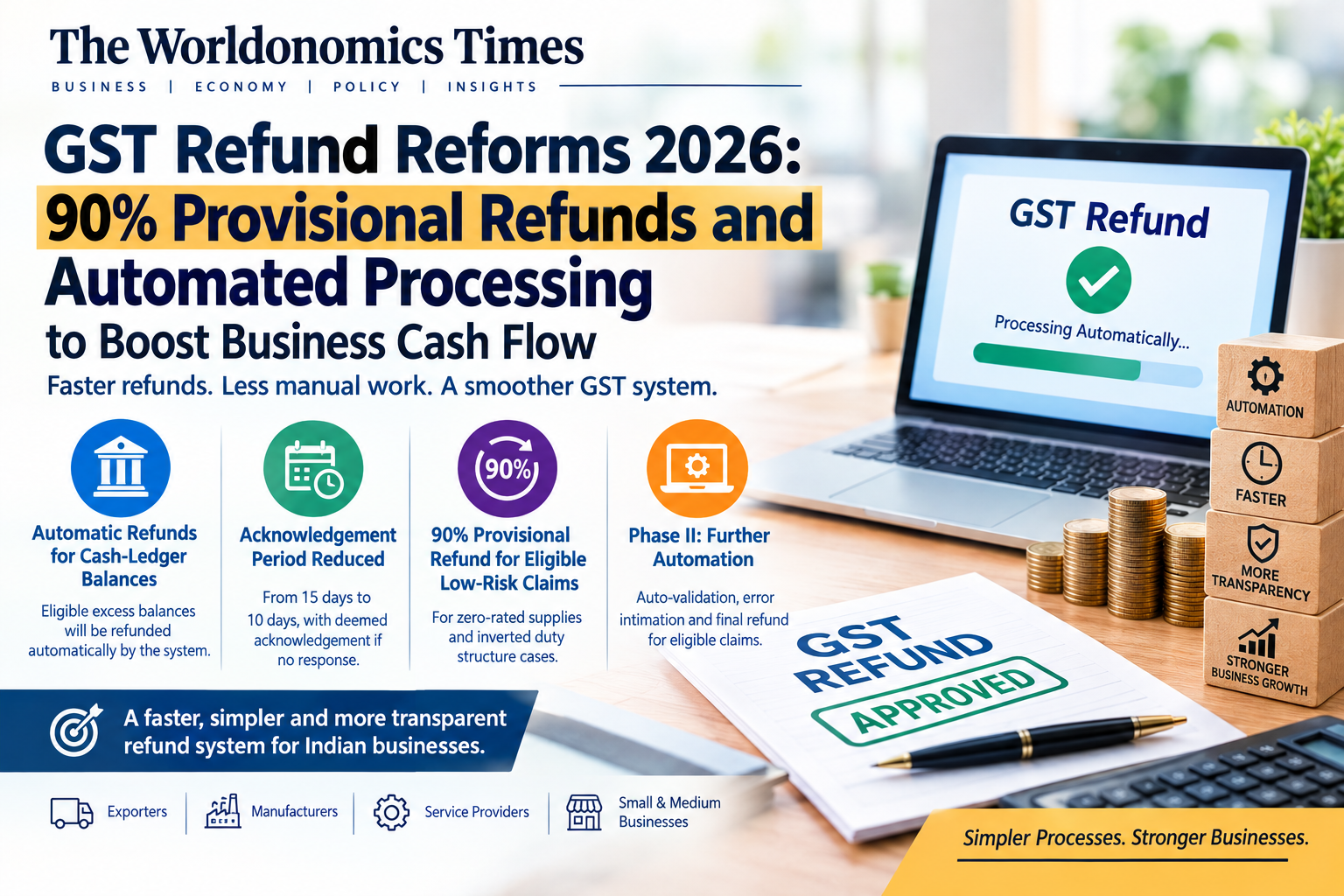
Under the proposed first phase, eligible refunds of excess balances in electronic cash ledgers would be sanctioned automatically by the system without requiring intervention by a tax officer.
This change could significantly simplify the refund process for taxpayers who have excess amounts deposited in their electronic cash ledgers and seek to recover the unutilised balance, subject to applicable conditions.
The proposed system is intended to replace avoidable manual processing with technology-enabled verification. Automated checks could help identify eligible claims more quickly while allowing tax authorities to concentrate their scrutiny on applications presenting higher compliance risks.
For businesses, faster processing could improve liquidity and reduce the need to arrange additional working capital while awaiting eligible refunds.
Acknowledgement Period Reduced from 15 Days to 10 Days
Another important recommendation concerns the time allowed for issuing an acknowledgement or deficiency memo for refund applications.
The GST Council has recommended reducing this period from 15 days to 10 days. If the proper officer does not issue an acknowledgement or deficiency memo within the prescribed 10-day period, the system would provide deemed acknowledgement.
This proposal is intended to reduce uncertainty at the initial stage of refund processing. Businesses would have greater clarity about the status of their applications, while the possibility of prolonged inaction at the acknowledgement stage would be reduced.
Taxpayers should nevertheless ensure that their applications contain accurate information and satisfy the applicable requirements. Acknowledgement does not, by itself, mean that the entire refund claim has been finally approved.
90% Provisional Refund for Eligible Low-Risk Claims
One of the most significant proposed changes is the automated provisional sanction of 90% of eligible refund claims relating to zero-rated supplies and inverted duty structure.
Under Phase I, the system would identify and evaluate low-risk applications and, following acknowledgement, provisionally sanction 90% of the claimed amount without officer intervention, subject to the prescribed conditions and exclusions.
Zero-rated supplies generally include exports of goods or services and supplies made to a Special Economic Zone (SEZ) developer or unit, subject to the statutory conditions.
An inverted duty structure arises when the GST rate on inputs is higher than the rate applicable to the outward supply, potentially resulting in accumulated ITC.
For exporters, manufacturers and other eligible taxpayers, the proposed mechanism could make a substantial difference to working capital management. Instead of waiting for the entire claim to undergo the existing processing sequence, eligible businesses could receive most of the claimed amount provisionally while the remaining claim is dealt with under the applicable procedure.
The measure is expected to support liquidity without eliminating risk-based verification or statutory safeguards.
Phase II: Further Automation of Refunds
The second phase envisages additional automation in refund processing. The GST portal would automatically acknowledge eligible refund applications after validating the information provided.
Where the system identifies mismatches, it would communicate the errors to taxpayers for correction and submission of a fresh application. If validation failures recur, the application may be forwarded to the proper officer for scrutiny and processing.
For eligible low-risk claims relating to zero-rated supplies, Phase II also envisages automated sanction of the final refund after adjustment of any pending dues, where applicable.
This approach would move the refund mechanism towards a more integrated digital process, reducing unnecessary manual handling while retaining safeguards for cases requiring further examination.
Changes to Refund Applications and Eligibility
The Council has also recommended amendments to Form GST RFD-01 to capture refund information in a system-readable format. For specified zero-rated supply and inverted duty structure claims, the proposal would dispense with the requirement to upload scanned documents.
Other recommendations include removing the restriction that caps turnover of zero-rated supplies of goods at 1.5 times the value of like goods supplied domestically for refund calculation purposes.
The Council has additionally recommended clarifying that the ₹1,000 minimum refund threshold applies to the total refund amount across CGST, SGST/UTGST and IGST taken together.
These changes are intended to simplify application requirements and remove procedural obstacles that may affect eligible refund claims.
What Businesses Should Do
Businesses should continue reconciling purchase records, outward supplies, returns and ITC balances before submitting refund applications. Exporters and manufacturers should maintain the required supporting records and verify their eligibility under the relevant refund category.
Tax professionals should monitor CBIC notifications, circulars and GST Portal advisories to establish when the recommended provisions become legally effective. The Council’s recommendations should not be treated as automatically operative amendments until the necessary legal steps have been completed.
Conclusion
The proposed GST refund reforms represent an important effort to improve India’s indirect tax administration through automation, risk-based processing and greater procedural certainty. Automatic refunds of eligible cash-ledger balances, a shorter acknowledgement period and provisional sanction of 90% of eligible low-risk claims could help businesses manage working capital more effectively.
The ultimate impact will depend on implementation, system readiness and clear communication of eligibility conditions. If implemented as proposed, the reforms could make GST refunds more predictable, reduce avoidable delays and strengthen the ease of doing business in India.
Editorial note: This article is based on the GST Council’s recommendations announced on October 8, 2026, and the Ministry of Finance’s published guidance. The applicable CBIC notifications, amendments and implementation dates should be verified before treating any proposed measure as effective law.