The Worldonomics Times | Business, Economy & Taxation
New Delhi, October 27, 2026
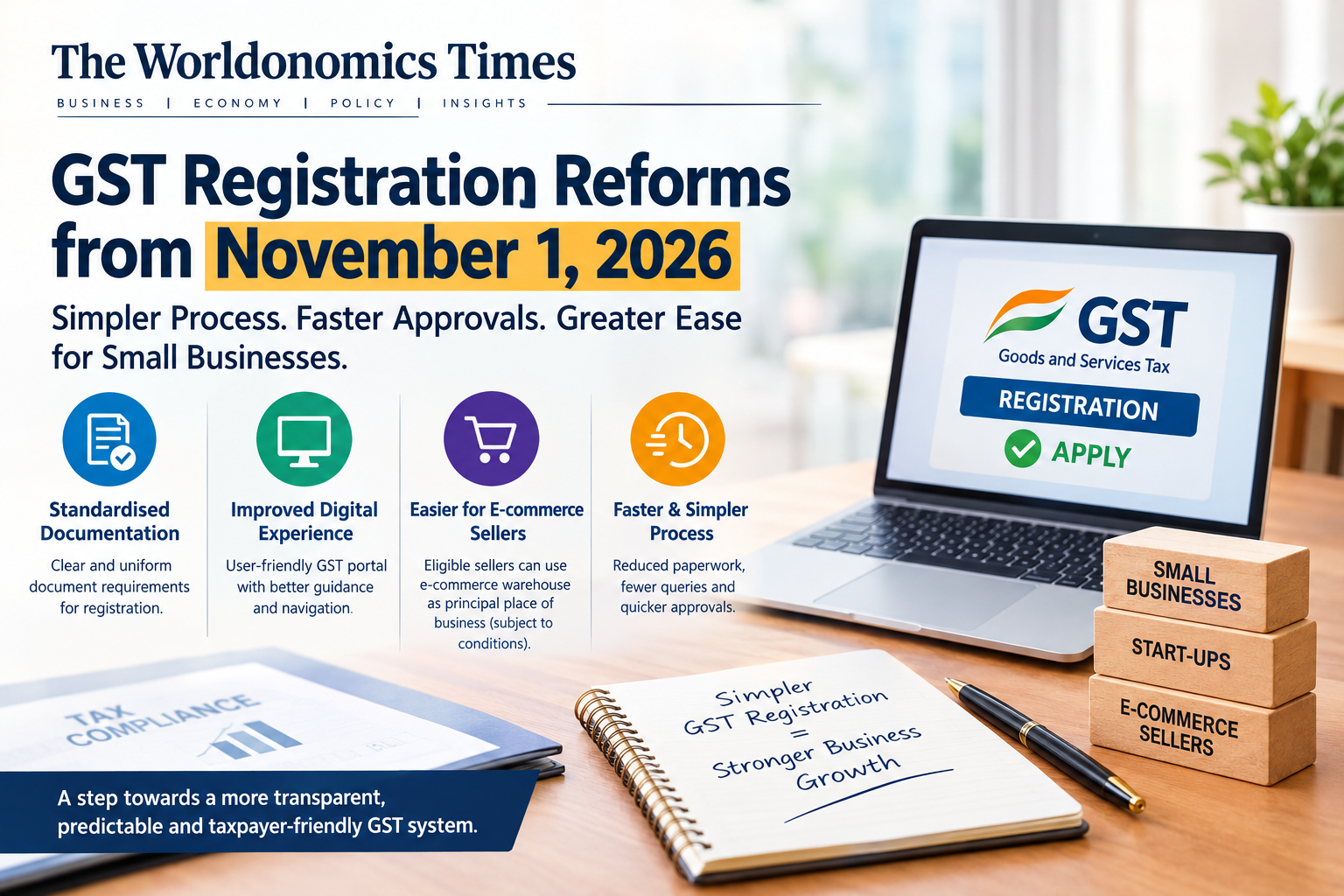
India is preparing to introduce a simplified Goods and Services Tax (GST) registration mechanism for small e-commerce sellers from November 1, 2026, in a move expected to reduce compliance barriers and help smaller businesses expand their operations across state boundaries. The proposed reform will allow eligible sellers to register in additional states without establishing their own physical offices or shops in every state where their goods are stored.
The initiative follows recommendations made at the 57th meeting of the GST Council on October 8, 2026. It forms part of the government’s broader effort to simplify indirect tax administration, encourage digital entrepreneurship and improve the ease of doing business for small suppliers.
For thousands of online sellers operating through marketplaces, the proposed mechanism could provide an opportunity to reach more customers while reducing the administrative burden associated with maintaining business premises in multiple states.
Why Was the Reform Needed?
Under the existing GST framework, businesses operating across multiple states may need separate registrations in the states where registration is legally required. Maintaining a principal place of business and completing registration formalities in each relevant jurisdiction can create additional costs for small businesses.
For online sellers, the challenge becomes particularly significant when an e-commerce platform stores inventory in warehouses located in different states. A seller may have an established business in one state but lack a separate office or shop in another state where the platform stores the seller’s products.
This can make interstate expansion more difficult for smaller enterprises that cannot afford additional premises, administrative staff and professional compliance services.
The proposed simplified registration mechanism seeks to address this issue by allowing eligible suppliers to use an e-commerce operator’s warehouse as their Principal Place of Business (PPoB) in specified states or Union Territories.
How Will the New Registration Mechanism Work?
Under the proposed Rule 14B of the Central Goods and Services Tax (CGST) Rules, 2017, eligible small suppliers selling goods through electronic commerce operators (ECOs) will be able to opt for a simplified registration route in states or Union Territories where they do not have a physical presence.
Instead of establishing their own premises in every such jurisdiction, sellers may declare the relevant e-commerce operator’s warehouse as their Principal Place of Business, subject to prescribed conditions.
The registration is expected to be granted automatically through the GST system, provided the applicant satisfies the applicable eligibility requirements and verification procedures.
The mechanism is optional and is intended specifically for eligible suppliers making supplies of goods through e-commerce platforms. It should not be treated as a general exemption from GST registration requirements or as permission for every online business to operate without state-wise compliance.
Key Eligibility Conditions for Small Sellers
The proposed scheme includes several important conditions that sellers should understand before applying.
1. Monthly input tax credit limit
Eligible sellers must intend to pass on input tax credit (ITC) of not more than ₹2.5 lakh per month. Stock transfers between distinct persons are excluded from this calculation under the proposed framework.
2. Existing business presence
The seller must have a genuine physical business presence and the necessary GST registration in at least one state or Union Territory, which will serve as the seller’s home jurisdiction.
3. Use of the e-commerce operator’s warehouse
The seller may declare the warehouse of the relevant e-commerce operator as the Principal Place of Business in another eligible state or Union Territory, subject to the applicable conditions and the operator’s consent.
4. Supplies restricted to e-commerce platforms
Registration obtained through this special mechanism will be used for making supplies of goods exclusively through the e-commerce operator’s platform.
5. Authentication and verification
Mandatory Aadhaar-based biometric authentication and physical verification in the home state will apply as prescribed under the scheme. Sellers should complete the relevant verification requirements before expecting registration to be granted.
These conditions are intended to make registration easier while preserving appropriate safeguards against misuse of the GST system.
Benefits for Small Businesses and Online Entrepreneurs
The proposed reform could deliver several commercial benefits.
First, it may reduce the cost of expanding into new markets by removing the need to establish separate physical premises in every state where the seller’s inventory is stored.
Second, automatic system-based registration could reduce waiting time and unnecessary interaction with tax officers, provided all eligibility and verification requirements are satisfied.
Third, smaller manufacturers, traders, artisans and emerging consumer brands may find it easier to access customers nationwide through established online marketplaces.
The reform could also support employment generation and entrepreneurship by allowing small businesses to concentrate more resources on product development, inventory management, marketing and customer service rather than additional administrative infrastructure.
For e-commerce operators, the mechanism may help eligible sellers participate more easily in national distribution networks. This could support a broader and more geographically diverse supplier base.
What Should Sellers Do Before Applying?
Small businesses should first review their existing GST registrations and identify the states in which their inventory is stored through e-commerce operators.
They should also verify their monthly ITC position, obtain the necessary warehouse-related consent, ensure that their home-state business details are accurate and complete the prescribed authentication requirements.
Sellers should maintain proper invoices, stock records, sales reconciliations and GST returns. The simplified mechanism reduces certain registration barriers but does not eliminate ongoing tax compliance obligations.
Chartered Accountants, Cost and Management Accountants and GST practitioners should advise clients to review the final CBIC notifications, circulars and GST Portal instructions before submitting applications under the new route.
Conclusion
The proposed simplified GST registration mechanism represents an important step towards making India’s digital marketplace more accessible to small businesses. By enabling eligible sellers to use e-commerce operator warehouses as their principal places of business in additional states, the reform could reduce expansion costs and make nationwide selling more practical.
Its effectiveness will depend on clear implementation, reliable digital systems and awareness among eligible businesses. If implemented as proposed, the measure could strengthen small enterprises, widen participation in e-commerce and support India’s transition towards a more integrated national market.
Editorial note: This article is based on the GST Council’s recommendations and official guidance available as of October 27, 2026. The final legal position, effective date and detailed application procedure should be verified against the applicable CBIC notifications and GST Portal advisories.