Micro, Small and Medium Enterprises (MSMEs) are an important pillar of India’s economic growth, employment generation, manufacturing ecosystem and entrepreneurship. However, many MSMEs face challenges related to productivity, quality, technology adoption, innovation, intellectual property, digitalisation and access to competitive markets.
To address these challenges, the Ministry of Micro, Small and Medium Enterprises (MSME) introduced the MSME Champions Scheme as an umbrella approach for improving the competitiveness and capabilities of MSMEs. The scheme brings together interventions focused on quality, productivity, innovation, design, intellectual property and lean manufacturing. The objective is not merely to provide financial assistance, but to help enterprises improve their processes and become more competitive in domestic and international markets.
What is the MSME Champions Scheme?
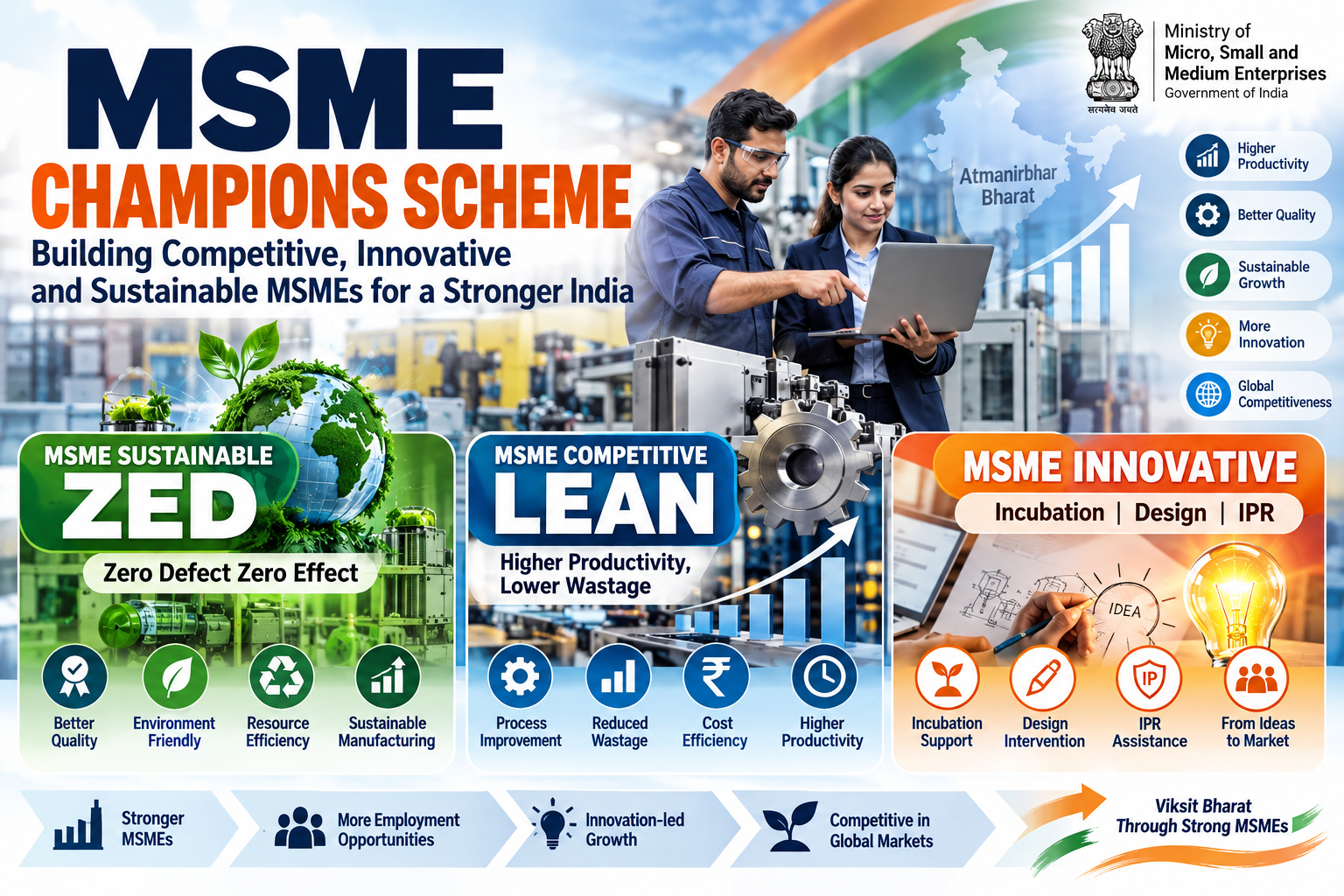
The MSME Champions Scheme is designed as a holistic framework to help MSMEs modernise their business and manufacturing processes, reduce wastage, improve quality and productivity, encourage innovation and strengthen their ability to compete.
The Ministry’s scheme framework includes three major verticals:
- MSME Sustainable – ZED
- MSME Competitive – LEAN
- MSME Innovative – Incubation, Design and IPR
These components address different aspects of an enterprise’s development, while working towards the broader objective of creating competitive and sustainable MSMEs.
1. MSME Sustainable – ZED
The Zero Defect Zero Effect (ZED) component focuses on improving the quality of products while reducing the negative impact of manufacturing on the environment.
The concept of ZED encourages MSMEs to manufacture products with zero defects and zero effect, meaning better quality combined with responsible use of resources and reduced environmental impact.
The initiative encourages MSMEs to improve productivity, reduce wastage, conserve energy and natural resources, standardise processes and adopt better quality-management practices. It is also intended to help MSMEs improve their competitiveness and prepare for domestic as well as export markets.
ZED certification is voluntary and is available to eligible Udyam-registered manufacturing MSMEs. The certification framework includes progressive levels, allowing enterprises to improve their practices over time.
For an MSME, ZED can therefore be viewed not simply as a certificate, but as a roadmap for improving the way the business operates.
2. MSME Competitive – LEAN
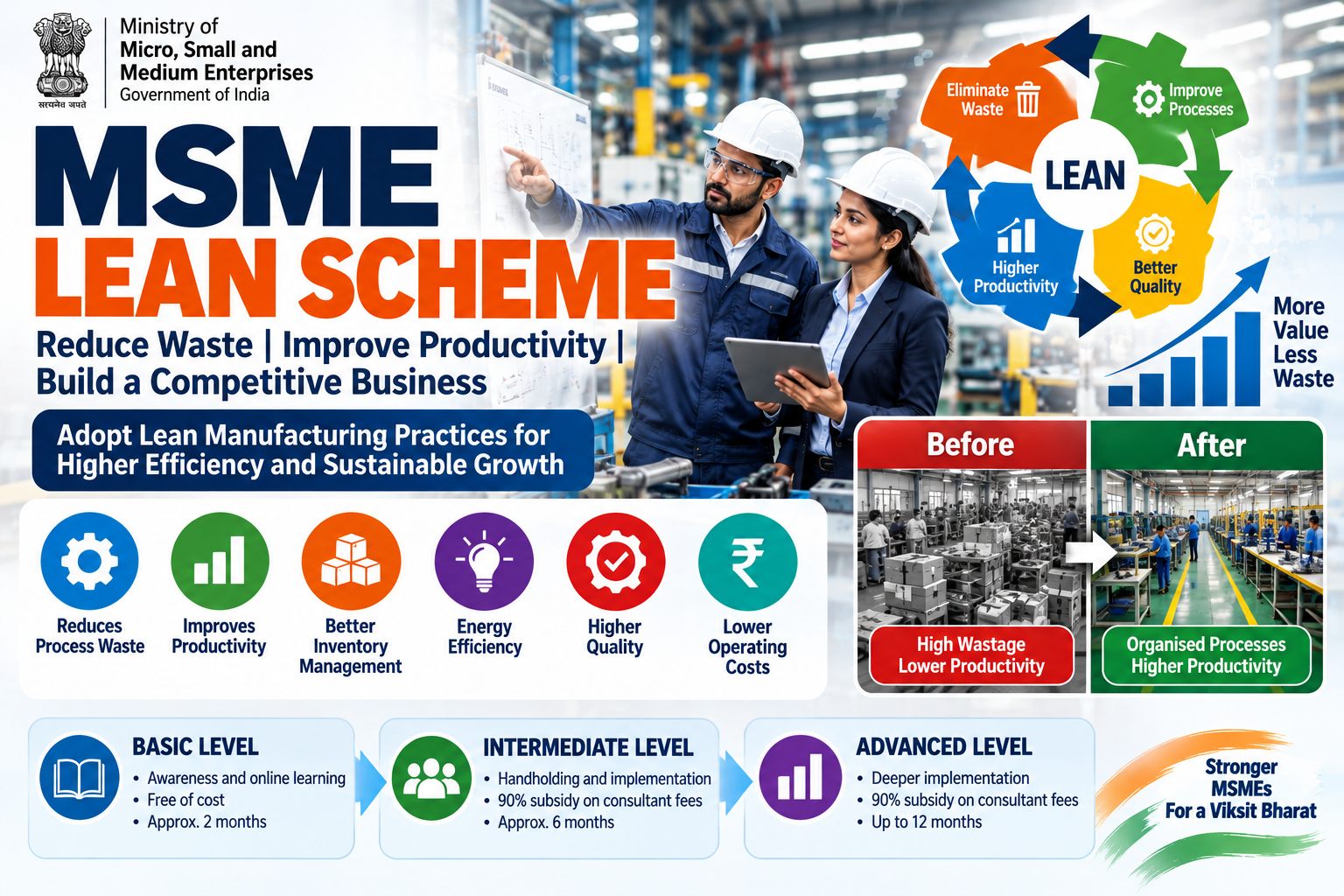
The second major component is MSME Competitive – LEAN, which focuses on improving productivity and reducing unnecessary waste.
Lean manufacturing is based on the principle of creating greater value with fewer resources. MSMEs can use Lean techniques to identify activities that consume time, money, space or materials without creating sufficient value.
The initiative focuses on areas such as:
- Reduction of process wastage
- Better inventory management
- Improved productivity
- Efficient utilisation of space
- Reduction in energy consumption
- Better workflow
- Continuous improvement
- Improved management systems
The Ministry’s Lean programme includes awareness, training, handholding and implementation support to help MSMEs adopt Lean practices.
For manufacturing enterprises, particularly those operating with tight margins, even small improvements in productivity and resource utilisation can significantly improve profitability.
3. MSME Innovative – Incubation, Design and IPR
Innovation is another important pillar of the MSME Champions approach.
The MSME Innovative component combines Incubation, Design and Intellectual Property Rights (IPR). Its objective is to help MSMEs convert ideas into commercially viable products and services while strengthening their design capabilities and protecting intellectual creations.
Incubation
Incubation support can help entrepreneurs develop new ideas and transform them into viable business propositions. It also encourages collaboration between industry, academia, innovators, research institutions and other stakeholders.
Design
Good design can differentiate an MSME’s product in a crowded market. Design intervention can help enterprises improve product appearance, functionality, usability and market appeal.
Intellectual Property Rights
Innovation has little long-term value if it can easily be copied. The IPR component encourages MSMEs to protect eligible intellectual creations through appropriate intellectual property mechanisms, including patents, trademarks, designs and other forms of protection.
Together, these interventions can help an MSME move from simply manufacturing products to developing differentiated and innovative products.
Why MSME Champions Matters
The competitiveness of an MSME depends on much more than access to finance. A business may have adequate funding but still struggle because of inefficient processes, poor quality, outdated technology, weak product design or insufficient innovation.
The MSME Champions approach addresses these issues from multiple directions.
It can help enterprises:
- Improve productivity
- Reduce manufacturing waste
- Improve product quality
- Adopt better management practices
- Encourage innovation
- Protect intellectual property
- Improve product design
- Reduce environmental impact
- Strengthen competitiveness
- Prepare for larger domestic and global markets
The Ministry’s broader objective is to help enterprises modernise their processes, improve competitiveness and achieve greater national and international reach.
Who Can Benefit?
MSME Champions-related interventions are particularly relevant for enterprises seeking to improve their operational efficiency and market competitiveness.
Manufacturing MSMEs can benefit significantly from ZED and Lean interventions, while enterprises working on innovative products, technologies and designs can explore the Innovative component.
Entrepreneurs should, however, check the latest official guidelines for the specific component they wish to access because eligibility, financial assistance, application procedures and implementation arrangements may vary.
How MSMEs Can Get Started
An MSME should first identify its biggest business challenge.
If the primary issue is quality and sustainable manufacturing, ZED may be relevant.
If the challenge is productivity, wastage or operational efficiency, Lean may be appropriate.
If the business is developing new products, designs or innovations, the Innovative component covering incubation, design and IPR may be relevant.
The entrepreneur should then verify eligibility, register where required and review the latest guidelines and application process on the official Ministry platforms.
The Road Ahead for MSMEs
Indian MSMEs are increasingly becoming part of sophisticated domestic and global value chains. Buyers today expect competitive prices, consistent quality, faster delivery, innovation and responsible manufacturing.
This makes programmes such as MSME Champions strategically important.
The future MSME will not compete only on the basis of low cost. It will compete through quality, productivity, technology, innovation, sustainability and strong intellectual property.
Conclusion
The MSME Champions Scheme represents an important shift from viewing MSME development only through the lens of financial assistance to building stronger, more productive and competitive enterprises.
Through ZED, LEAN and MSME Innovative, enterprises can work towards better quality, lower wastage, improved productivity, stronger innovation and greater market competitiveness.
For India’s MSMEs, becoming a “Champion” is therefore not simply about growing bigger. It is about becoming smarter, more efficient, innovative, sustainable and globally competitive.
For entrepreneurs looking to build a stronger business for the next decade, understanding and effectively using the opportunities available under MSME Champions can be an important step towards sustainable growth.