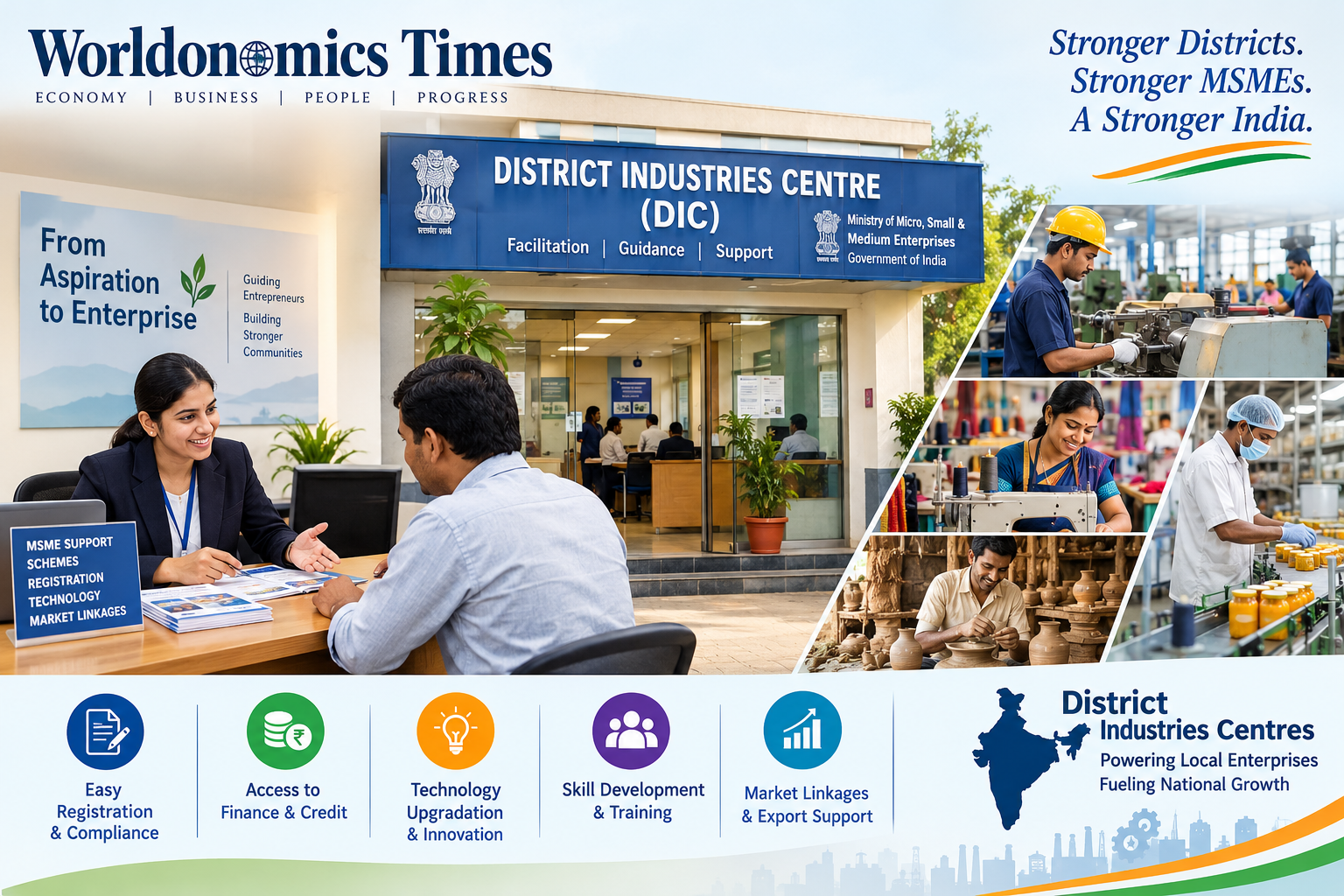
India’s industrial growth story is increasingly being shaped not only by large corporations and major investment corridors, but also by thousands of small businesses operating across its districts. At the heart of this local industrial ecosystem are District Industries Centres (DICs)—institutions designed to bring government support, entrepreneurship development and industrial facilitation closer to businesses at the district level.
Established as part of India’s effort to promote decentralized industrial development, DICs have played an important role in encouraging entrepreneurship and supporting micro, small and medium enterprises (MSMEs). Their relevance has grown further as India seeks to create jobs, strengthen local manufacturing, promote self-employment and develop competitive businesses beyond major metropolitan centres.
Taking Industrial Support to the District Level
For a first-time entrepreneur, navigating government schemes, registrations, finance, licences, technology support and market opportunities can be challenging. DICs were conceived to address this gap by functioning as a local institutional interface between entrepreneurs and government agencies.
Their role varies across states and districts, but typically includes providing information about industrial policies and incentives, facilitating entrepreneurship, assisting prospective entrepreneurs in identifying suitable business opportunities and helping enterprises access relevant government programmes.
This district-level approach is particularly important for smaller entrepreneurs who may not have the resources or professional networks available to larger companies. A local facilitation mechanism can make government support more accessible and help entrepreneurs understand the procedures involved in establishing or expanding an enterprise.
Supporting Entrepreneurship and Employment
One of the most important contributions of DICs is their role in encouraging entrepreneurship as a source of employment and economic opportunity. Districts across India possess different combinations of skills, natural resources, agricultural output, traditional crafts and consumer markets. DICs can help translate these local strengths into viable enterprises.
For example, a district with a strong agricultural base may have opportunities in food processing, packaging, cold-chain services or agro-based manufacturing. Areas with traditional craft skills can develop clusters around handicrafts, textiles, furniture or other specialized products. Such businesses can generate employment locally while reducing the pressure for workers to migrate to large cities.
The impact is therefore broader than the creation of individual enterprises. A successful local industrial ecosystem can generate demand for transport, logistics, repair services, packaging, professional services and other supporting activities, creating a multiplier effect across the district economy.
Connecting MSMEs with Government Schemes
India has developed a wide range of programmes to promote MSMEs, entrepreneurship, credit access, technology adoption, skill development and market participation. However, the effectiveness of any scheme depends partly on whether eligible businesses know about it and can successfully navigate the application process.
DICs can serve as an important information and facilitation point in this regard. By guiding entrepreneurs towards relevant schemes and institutional support, they can help reduce information gaps that often affect smaller enterprises.
The challenge is to make this support increasingly simple, transparent and digitally accessible. Entrepreneurs today expect faster processes, clear eligibility criteria and predictable timelines. The continued integration of digital platforms with district-level facilitation can therefore make the DIC model more responsive to the needs of modern businesses.
Building Competitive Local Industries
The next phase of India’s industrial development requires more than simply increasing the number of enterprises. Businesses must become productive, technology-oriented and capable of competing in wider markets.
DICs can contribute to this transition by encouraging enterprises to explore modern production methods, quality improvement, digital tools, formalization, branding and market linkages. Coordination with financial institutions, technical agencies, training organizations and industry associations can further strengthen the support available to entrepreneurs.
This is especially significant for micro and small enterprises, which often face constraints in accessing technology, skilled workers and organized markets. A coordinated district-level ecosystem can help these businesses overcome some of these barriers.
The Road Ahead
Despite their potential, DICs also face challenges. Their effectiveness can differ from one district to another depending on institutional capacity, staffing, coordination and awareness among entrepreneurs. In some areas, businesses may still find government procedures complicated or remain unaware of available support.
The future of DICs should therefore focus on measurable outcomes rather than merely administrative functions. District-level institutions can evolve into proactive business facilitation centres that understand the local industrial landscape, identify promising sectors, connect entrepreneurs with appropriate institutions and track the progress of supported enterprises.
Greater use of data can also help. District-level information on enterprise creation, employment, investment, sectoral strengths and infrastructure gaps can support better industrial planning. Local authorities can then design interventions around the specific economic potential of each district rather than relying exclusively on uniform approaches.
A Local Foundation for a Larger Economy
India’s ambition to become a stronger manufacturing and entrepreneurship hub ultimately depends on the strength of its local economies. Large industrial projects may attract substantial investment, but sustainable economic development also requires a broad base of competitive small businesses.
District Industries Centres occupy an important position in this landscape. By bringing industrial facilitation closer to entrepreneurs, supporting enterprise development and connecting local businesses with government and institutional resources, they can help transform district-level economic potential into productive activity.
As India advances toward a more formal, digital and globally connected MSME ecosystem, the role of DICs can evolve accordingly. Their greatest opportunity lies in becoming effective bridges between entrepreneurs and the wider support system—helping ideas become enterprises, enterprises become sustainable businesses, and local businesses contribute to national growth.
The future of India’s industrial economy will be built not only in its biggest cities, but also in its districts. Strengthening the institutions that support entrepreneurs at this level could therefore be one of the most practical ways to make industrial growth more inclusive, decentralized and resilient.