The World Economy Shows Resilience Amid Energy Shocks, Geopolitical Tensions and Uneven Growth
By The Worldonomics Times Desk
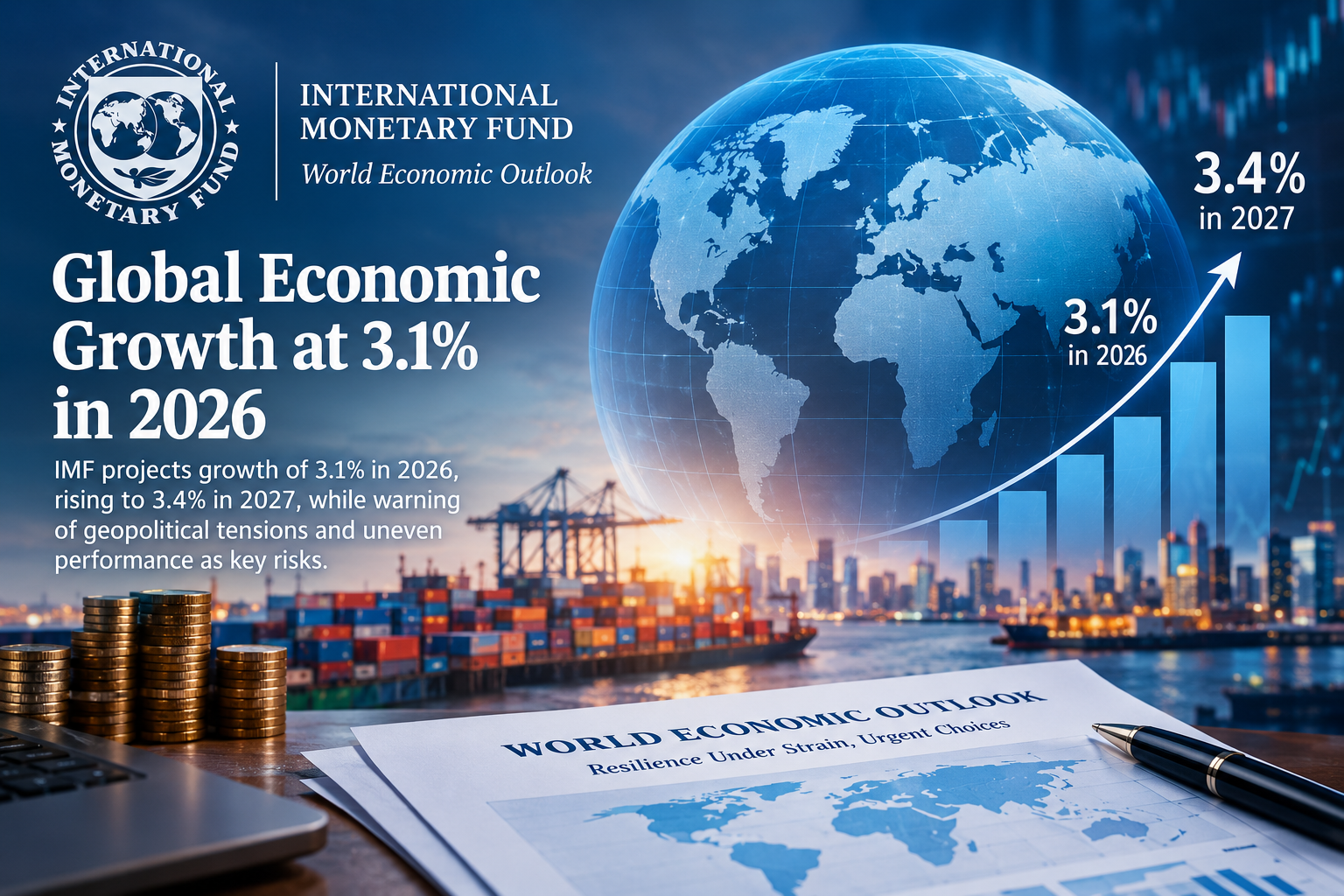
The global economy is expected to grow by 3.1% in 2026, according to the International Monetary Fund’s (IMF) October 2026 World Economic Outlook. Although the forecast indicates that the world economy continues to expand despite mounting challenges, the outlook remains uncertain, with geopolitical tensions, higher energy prices, public debt and trade disruptions threatening economic stability. The IMF projects global growth to improve to 3.4% in 2027, suggesting a gradual recovery if current pressures ease.
The latest projections highlight a significant challenge for policymakers: sustaining economic growth while controlling inflation and protecting vulnerable households. The global economy has demonstrated considerable resilience in recent years, but that resilience is becoming increasingly uneven across countries and regions.
Global Growth Faces Mounting Challenges
The IMF’s forecast reflects the combined impact of several forces shaping the international economic landscape. Investment in artificial intelligence (AI), technology infrastructure and digital services has supported economic activity, while geopolitical conflicts and disruptions to energy supplies have created substantial headwinds.
According to the IMF, global growth is projected to slow from approximately 3.5% in 2025 to 3.1% in 2026 before recovering to 3.4% in 2027. However, the overall figures conceal considerable differences between economies. Countries benefiting from technology investment and favorable export conditions are generally better positioned than those heavily dependent on imported energy.
The concentration of global growth is also increasing. The IMF reports that 32 economies now account for approximately 95% of global economic growth, compared with 54 economies in its earlier assessment. This concentration highlights the risk that a relatively small number of countries could have a disproportionate influence on the direction of the world economy.
Inflation and Energy Prices Remain Key Concerns
Inflation remains one of the most important challenges facing governments, businesses and households. The IMF projects global headline inflation at 4.7% in 2026, before easing to 4.1% in 2027.
Higher energy and food prices are contributing to inflationary pressure, reducing household purchasing power and increasing operating costs for businesses. Rising transportation, electricity and manufacturing expenses can also push up the prices of essential goods and services.
Energy-importing countries face particular difficulties because higher international oil and gas prices can increase import bills, weaken external balances and put pressure on domestic currencies. Governments may consequently face difficult decisions about fuel subsidies, public spending and measures to protect low-income households.
Central banks must also balance competing priorities. Keeping interest rates high for longer may help contain inflation but could discourage borrowing and investment. Cutting rates too early, however, risks allowing inflationary pressures to persist. Monetary policy decisions will therefore depend on domestic economic conditions, inflation trends and exposure to international shocks.
Artificial Intelligence Supports Economic Activity
Despite these challenges, technological investment is providing an important source of momentum. Spending on AI infrastructure, semiconductors, data centres, cloud computing and digital services has supported investment and demand across several economies.
The potential benefits extend beyond technology companies. If businesses successfully integrate AI into manufacturing, logistics, financial services and other industries, productivity could improve, operating costs could decline and new sources of economic growth could emerge.
However, the outlook is not without risks. If expectations surrounding AI investment prove too optimistic, financial markets could experience a correction. Moreover, productivity gains may take time to materialise, and the benefits could remain concentrated in countries with advanced technological capabilities.
For governments, the challenge is to create conditions that encourage innovation while strengthening workforce skills, digital infrastructure and competition. Ensuring that technological progress translates into broad-based economic benefits will be essential for sustainable growth.
Emerging Economies Face Uneven Prospects
Emerging markets and developing economies are experiencing different outcomes depending on their economic structures, trade relationships and exposure to energy prices.
Countries with strong domestic demand, competitive manufacturing industries and growing technology sectors may find opportunities to expand. By contrast, economies that rely heavily on imported fuel, have limited fiscal resources or face high borrowing costs could struggle to maintain growth.
For developing nations, elevated global interest rates and currency volatility can increase the cost of servicing foreign debt. Governments may have less room to invest in infrastructure, education, healthcare and employment-generating programmes.
India and other fast-growing economies have opportunities to benefit from expanding domestic markets, digital transformation, manufacturing investment and international trade. Nevertheless, external risks—including higher energy costs, changing trade policies and global financial volatility—remain important considerations for economic planning.
Trade and Geopolitical Risks Threaten Stability
International trade continues to be affected by geopolitical tensions, policy uncertainty and supply-chain vulnerabilities. Disruptions to shipping routes and energy supplies can increase costs for importers and exporters, while renewed trade restrictions may discourage cross-border investment.
These developments underline the importance of diversified supply chains, reliable energy supplies and constructive international cooperation. Businesses may need to reassess sourcing strategies and build greater resilience against unexpected disruptions.
The IMF has also warned that rising government debt and borrowing costs could limit the ability of countries to respond to future crises. Strengthening public finances while maintaining essential investment will therefore remain a priority.
Policy Priorities for Sustainable Growth
To navigate the current environment, governments must pursue balanced economic policies. The IMF recommends rebuilding fiscal buffers, preserving financial stability, strengthening productive capacity and improving resilience to supply-side shocks.
Support for households affected by higher food and energy prices should be targeted and temporary, helping vulnerable groups without placing unnecessary pressure on public finances. Policymakers should also encourage private investment, improve infrastructure and support education and skills development.
International cooperation remains equally important. Greater coordination on trade, energy security, debt challenges and technological development could help reduce uncertainty and support a more stable global economic environment.
Outlook: Resilience Must Be Strengthened
The IMF’s 3.1% growth forecast for 2026 signals continued expansion, but it should not be interpreted as a guarantee of economic stability. Persistent inflation, geopolitical conflict, rising debt and financial market uncertainty could weaken the outlook if risks intensify.
The projected improvement to 3.4% growth in 2027 offers grounds for cautious optimism. Achieving that outcome will depend on responsible policymaking, resilient supply chains, productive investment and the ability of countries to adapt to technological and geopolitical change.
For the world economy, the priority is not simply to maintain growth, but to make it more inclusive, sustainable and resilient. The decisions taken by governments, central banks and businesses today will play a crucial role in determining whether the current period of uncertainty becomes a temporary setback or a longer-lasting challenge to global prosperity.
The Worldonomics Times View
The IMF’s forecast of 3.1% global economic growth in 2026 presents a mixed picture of resilience and uncertainty. While the world economy continues to expand, the benefits of growth remain unevenly distributed, and persistent inflation, energy market volatility, geopolitical tensions and rising public debt continue to challenge economic stability.
The Worldonomics Times believes that economic growth must be measured not only by percentages, but also by its impact on people’s lives. Stronger growth figures mean little if households continue to struggle with the cost of living, young people face limited employment opportunities, and developing economies find it difficult to finance essential infrastructure and social development.
Governments must therefore look beyond short-term economic indicators and focus on policies that generate productive investment, create sustainable employment, strengthen domestic industries and improve access to education and technology. Central banks must remain vigilant against inflation, while fiscal authorities should protect vulnerable communities without undermining long-term financial stability.
International cooperation will also be essential. At a time when trade restrictions, energy disruptions and geopolitical rivalries threaten economic progress, countries should pursue constructive dialogue, diversify supply chains and strengthen the institutions that support global commerce.
For emerging economies such as India, the present environment offers both opportunities and challenges. Investment in manufacturing, digital infrastructure, renewable energy and workforce development can strengthen economic resilience, provided that the benefits of expansion reach a broad section of society.
Our view is clear: the world needs not just economic growth, but better-quality growth—growth that is inclusive, productive, sustainable and resilient to future shocks. The IMF’s projections offer a useful guide, but the real test will be whether policymakers can turn economic potential into improved living standards and lasting prosperity.
The Worldonomics Times will continue to examine global economic developments through the lens of policy, business, financial stability and their consequences for people around the world.