By Worldonomics Times | Global Economy
Date: October 27, 2026
Introduction
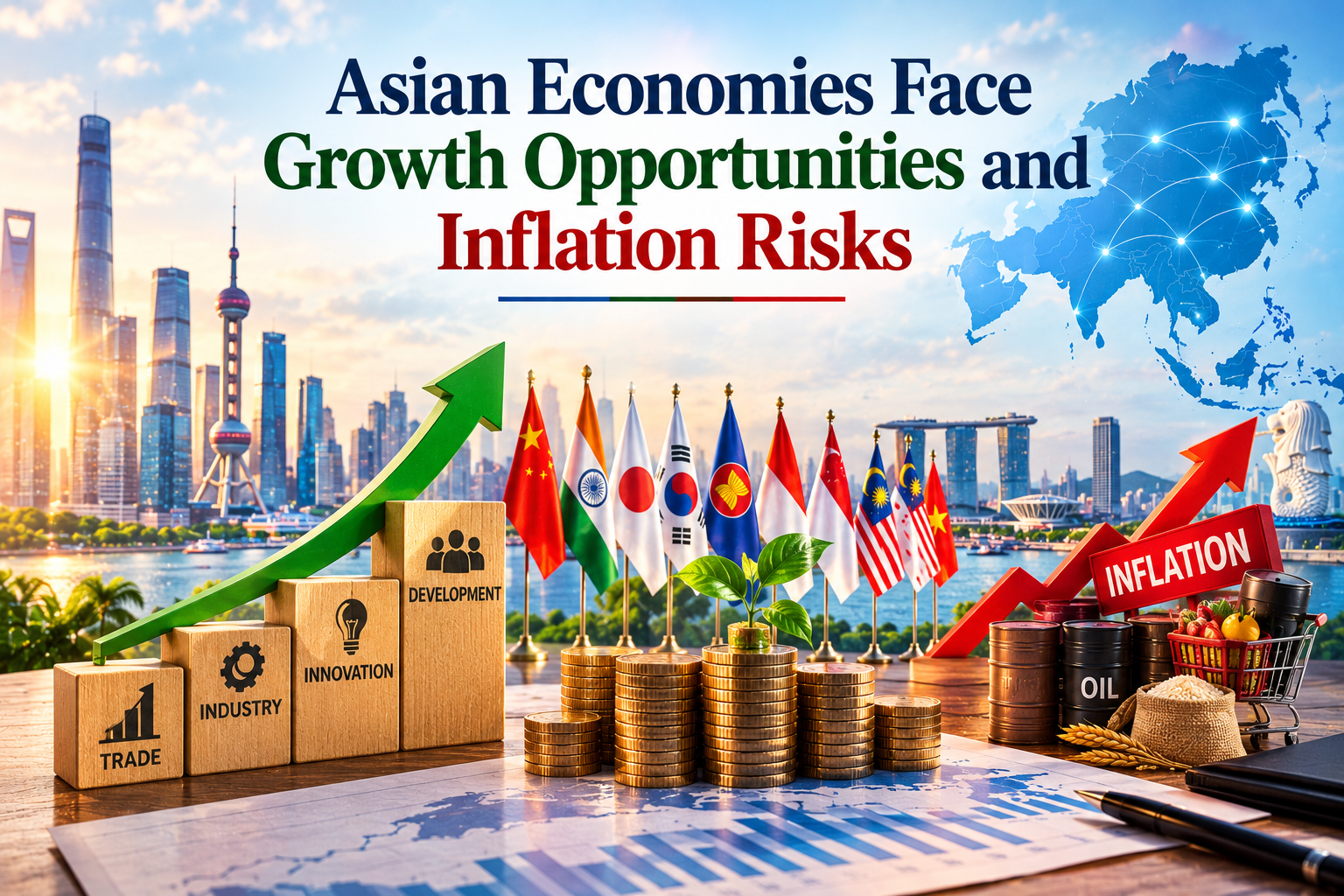
Asia continAsian Economies Face Growth Opportunities and Inflation Risks
ues to play a crucial role in the global economy, supported by strong domestic demand, technological development, manufacturing activity and expanding digital industries. From advanced economies such as Japan and South Korea to rapidly developing markets such as India and Southeast Asian countries, the region offers significant opportunities for economic growth. However, rising energy costs, persistent inflationary pressures and geopolitical uncertainty could complicate the outlook.
Investment in artificial intelligence, semiconductors, digital infrastructure and renewable energy is creating new opportunities for businesses across the region. At the same time, higher fuel prices and international trade disruptions are increasing operating costs and putting pressure on household budgets.
The challenge for Asian policymakers is to sustain economic growth while controlling inflation, protecting consumers and maintaining financial stability in an increasingly uncertain global environment.
Technology Investment Supports Economic Growth
Technology investment has become an important driver of economic activity across Asia. Countries such as South Korea, Japan, Taiwan and China play major roles in semiconductor production, electronics manufacturing and advanced technology supply chains.
Meanwhile, India and several Southeast Asian economies are expanding their digital services, financial technology, e-commerce and information technology sectors. These developments are attracting investment, creating employment opportunities and supporting the growth of new businesses.
The expansion of artificial intelligence is further increasing demand for advanced chips, data centres, cloud computing and digital infrastructure. Companies across the region are investing in technological capabilities to improve productivity, strengthen competitiveness and meet changing global demand.
However, the benefits will depend on whether these investments generate sustainable returns and reach a broad range of businesses and workers. Governments must also address skills shortages, infrastructure gaps and unequal access to digital technologies to ensure that economic gains are widely shared.
Domestic Demand Provides an Economic Cushion
Domestic consumption remains an important source of growth for many Asian economies. Rising urbanisation, expanding middle-class populations and improvements in digital connectivity are supporting demand for housing, transportation, healthcare, education and consumer goods.
India, in particular, benefits from a large domestic market and expanding services activity. Several Southeast Asian economies are also benefiting from growing consumer markets and investment in infrastructure and manufacturing.
Strong domestic demand can help countries withstand weaker external demand or disruptions in international trade. Businesses that serve local consumers may be less exposed to certain global market fluctuations than those that depend heavily on exports.
Nevertheless, sustained consumption requires stable employment, reasonable borrowing costs and adequate household purchasing power. If inflation continues to increase the cost of food, fuel and essential services, consumers may reduce discretionary spending, potentially slowing retail activity and overall economic growth.
Rising Energy Costs Increase Inflation Risks
Energy prices remain a significant concern for Asian economies, particularly those that rely heavily on imported oil and natural gas. Higher international fuel prices can increase transportation expenses, electricity costs and industrial production costs.
These increases can spread through supply chains, making food, manufactured goods and essential services more expensive. Businesses may pass additional costs on to consumers, contributing to inflation and reducing household purchasing power.
Countries with limited domestic energy resources may face additional pressure on their trade balances as they spend more on fuel imports. Currency depreciation can intensify the problem by making imported energy even more expensive.
For lower-income households, the consequences can be particularly severe because food, electricity and transportation account for a substantial share of their spending.
Central banks must therefore carefully balance inflation control with the need to support economic activity. Higher interest rates may help contain inflation expectations, but they can also increase borrowing costs for businesses and households, potentially weakening investment and consumption.
Trade Uncertainty Creates New Challenges
Asia’s close integration with international manufacturing and supply chains makes the region particularly sensitive to changes in global trade policy. Tariffs, export restrictions and geopolitical tensions can affect demand for electronics, machinery, automobiles and other manufactured goods.
Export-oriented economies may face weaker orders, higher compliance costs and greater uncertainty when companies reconsider where to manufacture products or source components.
At the same time, supply-chain diversification is creating opportunities for countries that can provide reliable infrastructure, skilled workers and competitive production costs. India and several Southeast Asian economies are seeking to attract investment as international companies explore alternatives to concentrated manufacturing networks.
However, these opportunities are not guaranteed. Countries must improve logistics, maintain predictable regulations and invest in workforce development to compete effectively for international investment.
Regional cooperation and stronger trade relationships can help Asian economies reduce vulnerabilities and expand access to international markets.
Policy Priorities for Sustainable Growth
Asian governments face the challenge of maintaining growth while responding to inflation, energy insecurity and changing global investment patterns.
Targeted support for vulnerable households can help reduce the immediate impact of higher living costs. At the same time, governments must avoid poorly targeted subsidies that place excessive pressure on public finances.
Investment in renewable energy, electricity grids, public transportation and energy efficiency can reduce exposure to international fuel-price volatility over the longer term. Improvements in education, technical training and digital infrastructure can also help workers benefit from technological change.
Central banks must monitor inflation expectations and adjust monetary policy according to domestic economic conditions. Stronger regional cooperation, diversified energy supplies and resilient financial systems will further improve the region’s ability to withstand external shocks.
The Worldonomics Times View
Asia’s economic outlook reflects a combination of substantial opportunities and significant risks. Technology investment, expanding domestic markets and supply-chain diversification can support long-term growth, but persistent inflation and rising energy costs could undermine these advantages.
The priority for policymakers should be to protect economic momentum without allowing inflation to erode household purchasing power or weaken business confidence. Governments must encourage productive investment, strengthen energy security and ensure that the benefits of technological progress extend beyond a limited number of industries.
For businesses, diversification, innovation and efficient resource management will remain essential to navigating an uncertain international environment.
The Worldonomics Times believes that Asia’s long-term economic success will depend on its ability to combine technological progress with economic resilience and inclusive development. By managing inflation risks, strengthening regional partnerships and investing in sustainable infrastructure, Asian economies can improve their capacity to withstand global uncertainty and build a stronger foundation for future growth.