The Worldonomics Times | Tax & Regulatory Affairs
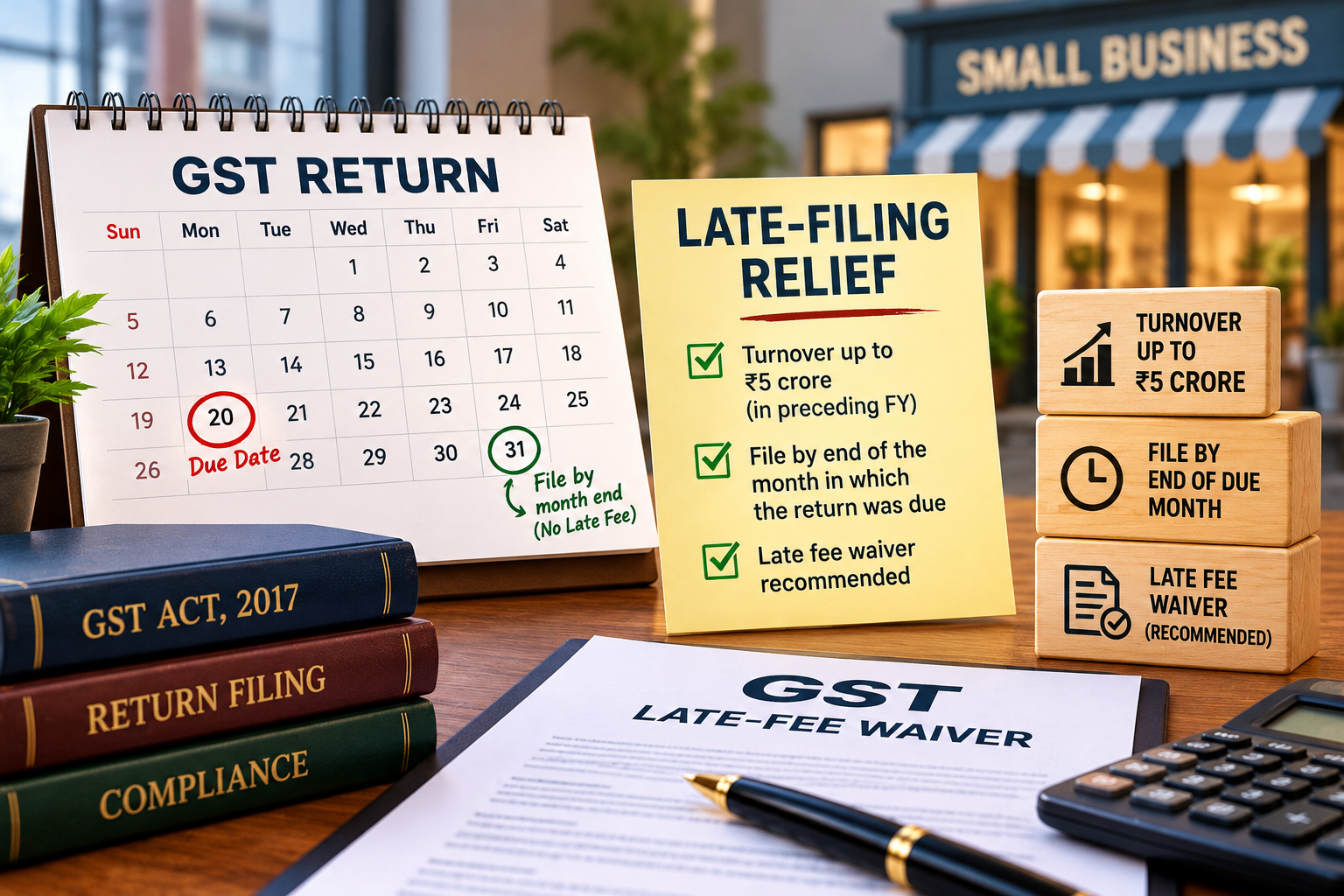
Small businesses that miss their GST return-filing deadlines by a few days could receive significant relief under a proposal recommended by the Goods and Services Tax (GST) Council. The Council has recommended waiving late fees for eligible taxpayers with annual turnover of up to ₹5 crore in the preceding financial year, provided they file the delayed return by the end of the month in which it was originally due.
Announced after the Council’s 57th meeting on October 8, 2026, the proposal forms part of a broader effort to simplify GST compliance and reduce the financial burden associated with procedural defaults.
However, there is an important qualification: the recommendation should not be treated as an operative waiver until the implementing notification or other applicable legal instrument has been verified. The distinction between a policy announcement and an enforceable legal change remains essential for businesses deciding when to file overdue returns.
What has the GST Council recommended?
According to the Ministry of Finance’s official announcement of the 57th GST Council meeting, the Council recommended waiving late fees on delayed returns furnished under Section 39(1) of the Central Goods and Services Tax (CGST) Act, 2017.
The proposed relief has two principal conditions.
First, the taxpayer’s annual turnover in the preceding financial year must not exceed ₹5 crore. Second, the delayed return must be filed by the last day of the month in which it was due.
The proposal is intended to provide relief for short delays rather than remove the obligation to file returns within the prescribed time. It also does not change the original statutory due date merely because a taxpayer may qualify for the proposed waiver.
For businesses, this distinction is significant. A return may still be classified as delayed even if the taxpayer ultimately qualifies for relief from the associated late fee.
How would the month-end condition work?
Consider a regular taxpayer whose monthly GST return is due on October 20. Under the proposed arrangement, an eligible taxpayer who files the delayed return by October 31 could qualify for the late-fee waiver, subject to the final legal provisions.
If the return is filed in November instead, the proposed month-end condition would not be satisfied for that October deadline.
The relevant date is therefore the end of the month in which the return was due, not necessarily the end of the tax period covered by the return.
This makes the proposal particularly relevant for small businesses that experience temporary difficulties in reconciling invoices, collecting information from suppliers or completing return preparation on time.
Nevertheless, taxpayers should not assume that every GST filing attracts the same treatment. The Council’s recommendation specifically refers to returns under Section 39(1). The final notification will need to be examined to determine the precise forms, taxpayer categories, conditions and tax periods covered.
Why the proposed relief matters
For smaller businesses, GST compliance involves recurring administrative work, including reconciling sales and purchase records, verifying input tax credit, calculating tax liabilities and submitting returns through the GST portal.
Even a short delay can create additional costs, especially for businesses operating with limited accounting resources or irregular cash flows. A late-fee waiver for qualifying short delays could reduce these costs and encourage taxpayers to complete outstanding filings promptly.
The measure may also improve voluntary compliance. Where a temporary procedural lapse does not involve deliberate evasion, reducing the financial consequences of a short delay could help businesses return to compliance without an additional penalty burden.
However, the proposal should be understood as targeted relief rather than a general relaxation of GST obligations. Businesses would still need to file accurate returns and comply with applicable payment and reporting requirements.
Late-fee waiver does not mean interest waiver
One of the most important distinctions is between late fees and interest.
Late fees arise from delayed filing of specified GST returns. Interest, by contrast, may become payable when tax is paid after the prescribed deadline.
The Council’s recommendation concerns waiver of late fees. It does not, by itself, waive interest on delayed tax payments or extinguish the underlying tax liability.
Section 47 of the CGST Act provides the statutory framework for late fees, while Section 50 governs interest on delayed tax payments. The CBIC’s official tax information portal sets out the return-filing provisions under Section 39, and its Section 47 reference explains the late-fee framework.
Businesses should therefore calculate their liabilities separately rather than assume that the proposed waiver eliminates every cost associated with delayed filing.
What should taxpayers do now?
Until the relevant implementation measure is confirmed, businesses should continue to follow the existing filing requirements and applicable late-fee rules.
Taxpayers should monitor official announcements from the Central Board of Indirect Taxes and Customs (CBIC) and the GST portal for the implementing notification. Before claiming relief, they should verify the eligibility criteria, effective date and scope of the waiver.
Those with overdue returns should also avoid postponing filing merely in anticipation of the proposed concession. The recommendation does not itself extend deadlines, and any delay beyond the specified month-end condition could fall outside the proposed relief.
Businesses with pending liabilities or multiple outstanding returns may benefit from reviewing their filing history with a qualified tax professional.
A step towards more practical GST compliance
The proposed late-fee waiver reflects an effort to make GST administration more proportionate, particularly for small taxpayers whose compliance difficulties may be temporary rather than deliberate.
If implemented as recommended, it could provide meaningful relief to eligible businesses that regularise delayed returns within the same month as their original due date.
For now, the governing principle remains clear: the Council’s recommendation signals the intended policy direction, but the final legal instrument will determine who qualifies and when the waiver can be claimed.
The bottom line: Small taxpayers with annual turnover of up to ₹5 crore in the preceding financial year may benefit from a proposed late-fee waiver if they file delayed returns by the end of the month in which they were due. Until implementation is officially confirmed, businesses should continue to comply with existing GST requirements.