The Worldonomics Times | Business, Economy & Taxation
New Delhi | October 28, 2026
India’s Goods and Services Tax (GST) framework is set to provide greater flexibility to businesses offering discounts after completing a sale. From November 1, 2026, amendments to the Central Goods and Services Tax (CGST) Act, 2017, will simplify the conditions under which eligible post-sale discounts can be excluded from the taxable value of a supply.
The Central Government has notified the commencement of Sections 153 to 155 of the Finance Act, 2026, through Notification No. 03/2026–Central Tax dated October 26, 2026. Among these changes, the amendment concerning post-supply discounts is particularly relevant for manufacturers, distributors, retailers and companies operating dealer-incentive schemes. Source: SCC Times
What Is Changing Under GST?
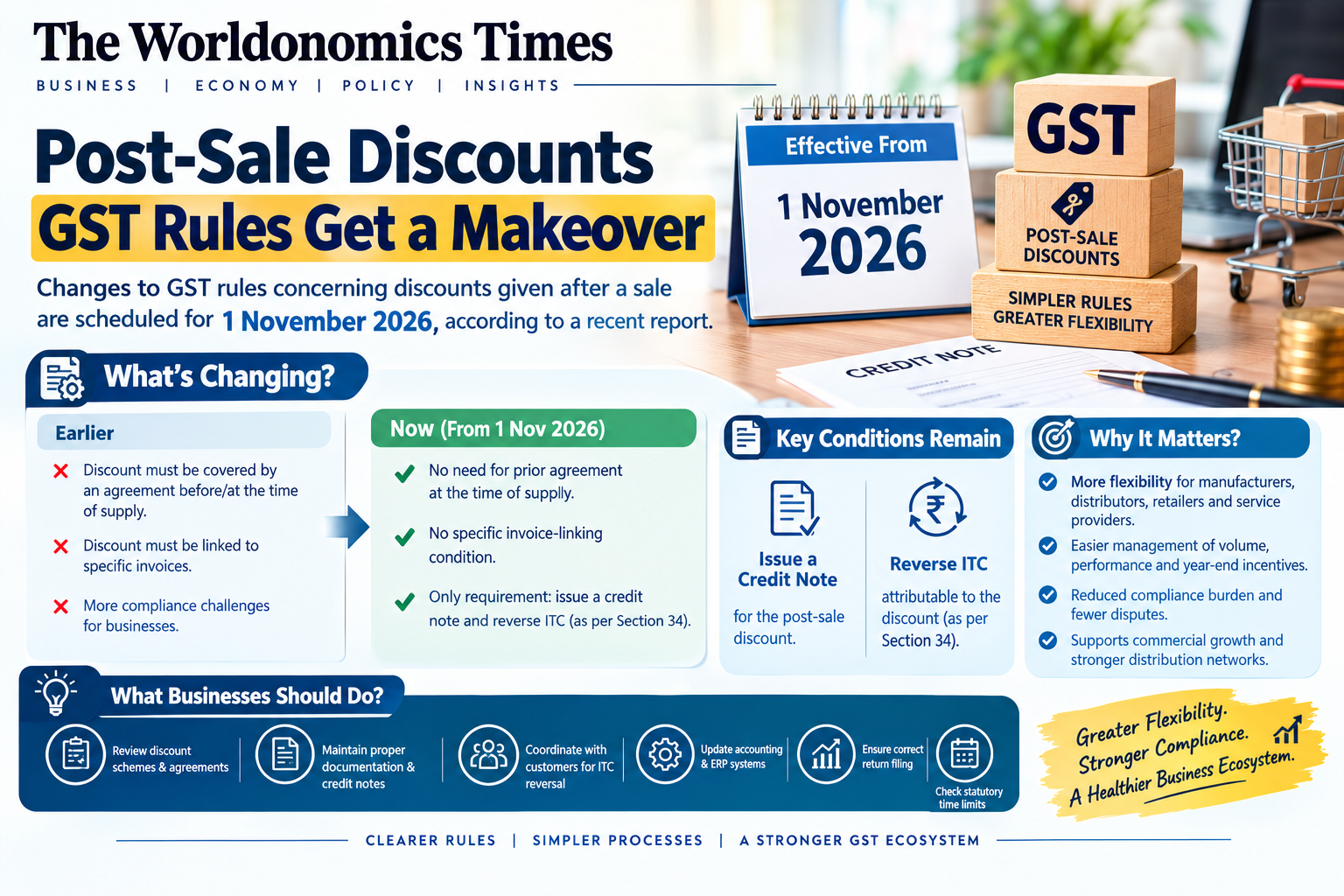
Under the existing framework, Section 15(3)(b) of the CGST Act prescribed conditions for excluding discounts granted after a supply from its taxable value. These included an agreement established at or before the time of supply, a link between the discount and the relevant invoices, and reversal of the corresponding input tax credit (ITC) by the recipient.
The amendment removes the requirement for the discount to have been established through an agreement entered into before or at the time of supply. It also removes the specific invoice-linking condition from this provision.
Under the amended Section 15(3)(b), a post-supply discount may be excluded from the value of supply where the supplier issues a credit note for the discount and the recipient reverses the ITC attributable to it in accordance with Section 34 of the CGST Act.
The change is intended to make the tax treatment of eligible discounts more practical, particularly where the final discount depends on sales performance, purchase volumes or commercial targets determined after the original transaction.
Why Does the Change Matter?
Post-sale discounts are widely used across Indian industry. Companies may offer additional incentives to distributors for achieving sales targets, provide year-end rebates to dealers, reward customers for purchasing specified volumes or grant retrospective discounts under commercial schemes.
Under the earlier conditions, businesses could face difficulties where the final discount was calculated after the original invoice had been issued and the precise amount had not been established in an agreement at the time of supply.
The revised framework offers greater flexibility by removing the prior-agreement requirement for the relevant GST treatment. This could help businesses structure commercial incentives more efficiently while maintaining the necessary tax documentation.
Sectors such as fast-moving consumer goods (FMCG), pharmaceuticals, consumer durables and retail may find the change particularly relevant because post-sale incentives are commonly used to support distribution networks and encourage sales.
However, the amendment does not mean that every commercial discount automatically reduces GST liability. The statutory conditions, including the issue of an appropriate credit note and reversal of the corresponding ITC by the recipient, remain important.
Credit Notes and Input Tax Credit Remain Central
A key feature of the amendment is the continuing role of credit notes and ITC adjustments.
Where a supplier grants an eligible post-supply discount and intends to reduce the taxable value, the supplier must issue a credit note in accordance with the applicable provisions. The recipient must reverse the ITC attributable to that discount as required by law.
Section 34(1) of the CGST Act has also been amended to expressly recognise the issue of a credit note where a discount covered by Section 15(3)(b) is granted after the supply has taken place. This aligns the credit-note provision with the revised valuation framework. Source: TaxGuru
For example, suppose a manufacturer sells goods to a distributor and subsequently grants a qualifying performance discount of ₹1,00,000, excluding GST. If the applicable GST rate is 18%, the associated tax amount would be ₹18,000.
Subject to the applicable legal requirements, the manufacturer may issue a credit note reflecting the discount and associated tax adjustment. The distributor must make the corresponding reversal of ITC attributable to the discount. The actual accounting and return treatment should follow the applicable provisions and procedures.
This approach is intended to ensure that the supplier’s tax adjustment and the recipient’s ITC position remain consistent.
What Should Businesses Do Before Implementation?
Businesses should review their existing discount policies, dealer agreements, incentive programmes and credit-note procedures before the amendment takes effect.
Finance and tax departments should consider the following measures:
- Review discount schemes: Identify volume-based, turnover-linked, year-end and performance-based discounts granted after supply.
- Strengthen documentation: Maintain approval records, discount calculations, supporting commercial correspondence and credit notes.
- Coordinate with customers: Establish a process to communicate credit notes and obtain confirmation of the required ITC reversal.
- Update accounting systems: Check whether ERP and accounting software can record post-supply discounts and related tax adjustments correctly.
- Review return compliance: Ensure that credit-note reporting and corresponding ITC reversals are reflected in the relevant GST records and returns.
- Check statutory deadlines: Continue to comply with the applicable time limits and other conditions governing credit notes and GST adjustments.
Businesses should also distinguish between discounts eligible for adjustment under Section 15(3)(b) and commercial price reductions that do not satisfy the relevant statutory requirements.
Greater Flexibility, but Not Automatic Tax Relief
The amendment marks an important development in the GST treatment of post-sale discounts. By removing the prior-agreement and specific invoice-linking conditions, the revised provision may reduce procedural difficulties for businesses whose discount amounts are finalised after the original sale.
Nevertheless, the requirement to issue an appropriate credit note and ensure reversal of the attributable ITC remains essential. Companies should not assume that a financial or commercial discount alone is sufficient to reduce the taxable value.
From November 1, 2026, businesses should be better positioned to manage eligible post-sale discounts under a more flexible statutory framework. The practical benefits will depend on disciplined documentation, coordination between suppliers and recipients, and consistent implementation of the amended provisions.