Introduction
Micro, Small and Medium Enterprises (MSMEs) play a vital role in India’s economic development by contributing to employment generation, manufacturing, exports and entrepreneurship. Recognising their growing importance and the challenges faced by small businesses, the Government of India has introduced significant reforms through the Micro, Small and Medium Enterprises Development (Amendment) Bill, 2026.
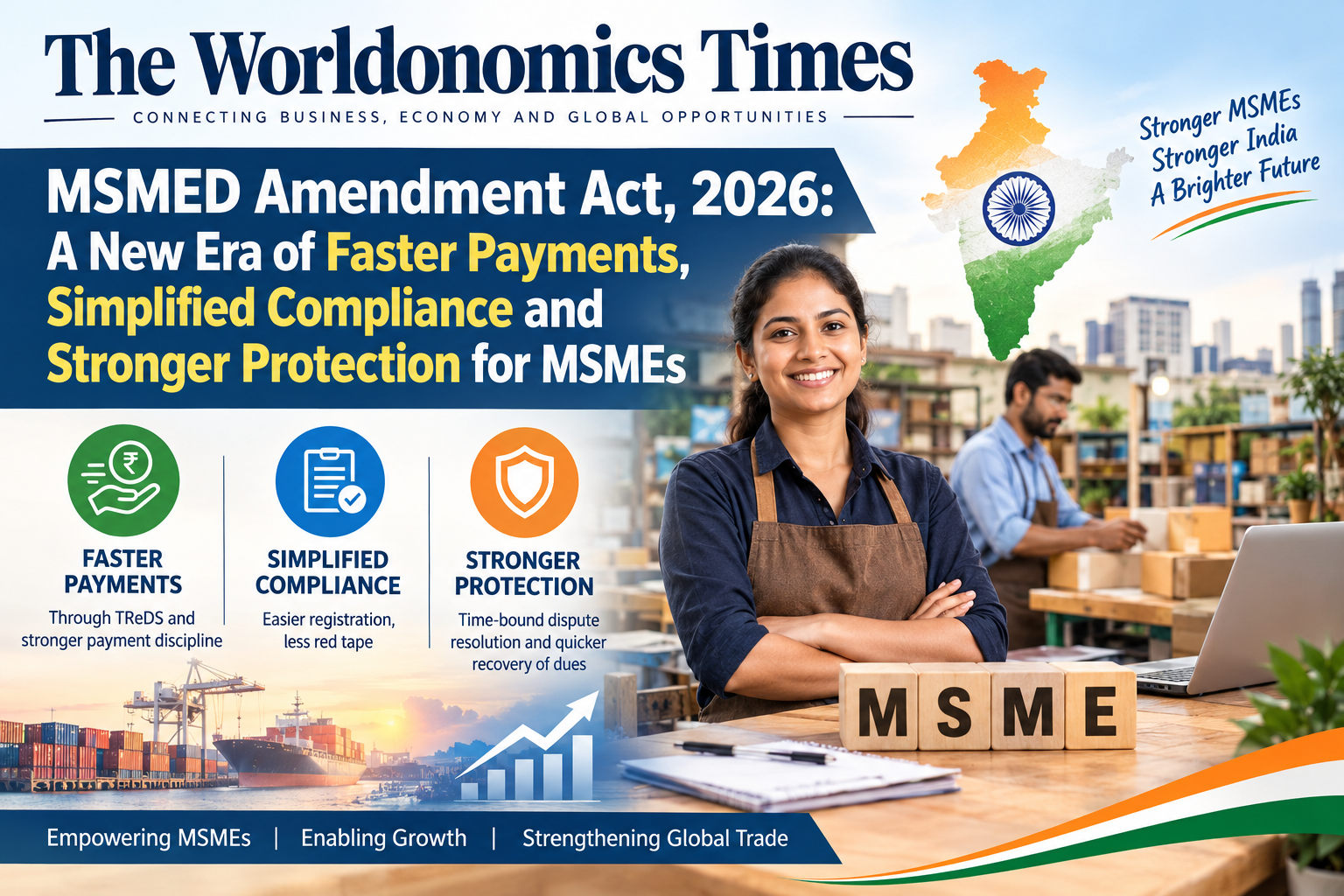
The Bill was passed by the Rajya Sabha on 3 August 2026 and the Lok Sabha on 7 August 2026. It subsequently received Presidential assent on 13 August 2026 and became the Micro, Small and Medium Enterprises Development (Amendment) Act, 2026 (Act No. 16 of 2026). The legislation seeks to modernise the MSMED Act, 2006, with particular emphasis on delayed payments, dispute resolution, digital registration and ease of doing business.
1. Simplification of MSME Registration and Classification
One of the significant changes introduced by the Amendment Act is the incorporation of a dual-criteria approach for MSME classification, based on investment in plant and machinery or equipment and annual turnover.
The amended framework also provides statutory recognition to the Udyam Registration Portal as a digital, free and voluntary registration platform for MSMEs. This is expected to strengthen formalisation and make it easier for entrepreneurs to access government schemes, institutional finance and other benefits.
By providing greater flexibility in registration and classification, the legislation aims to create a more transparent and business-friendly regulatory environment.
2. Stronger Mechanism for Recovery of Delayed Payments
Delayed payments have historically been one of the biggest challenges confronting micro and small enterprises. Many businesses face working-capital shortages because buyers fail to release payments within the prescribed time.
The Amendment Act strengthens the existing mechanism under Section 18 of the MSMED Act by introducing clearer timelines for resolving payment disputes.
The key provisions include:
- Mediation must be completed within 90 days from the date fixed for the first appearance.
- If mediation fails, the matter must be referred for arbitration within 30 days of termination of mediation.
- The arbitral award must be made within 90 days from completion of pleadings.
These timelines are intended to reduce prolonged litigation and help small businesses recover their legitimate dues more efficiently.
3. Introduction of Online Dispute Resolution
The Amendment Act provides for Online Dispute Resolution (ODR) to facilitate faster, cost-effective and technology-driven settlement of disputes.
This is particularly beneficial for small businesses that may not have the financial resources to pursue lengthy legal proceedings or travel repeatedly to dispute-resolution authorities.
The adoption of digital mechanisms can improve accessibility, reduce procedural delays and make the dispute-resolution system more efficient.
4. Stronger Enforcement of Awards and Settlements
Another important reform relates to the enforcement of mediated settlement agreements and arbitral awards.
The amended framework enables the recovery of eligible mediated settlements and arbitral awards as arrears of land revenue through the District Collector, Deputy Commissioner or other notified authority having jurisdiction over the buyer’s assets.
Further, where an application challenging an award, decree or order remains pending for more than six months, the court is required to direct payment of at least 50% of the awarded amount to the micro or small enterprise supplier.
This provision is particularly important because obtaining an award is not sufficient unless the enterprise can effectively recover the money.
5. Mandatory TReDS Mechanism for CPSEs
The Amendment Act introduces an important measure to improve liquidity for MSME suppliers by requiring Central Public Sector Enterprises (CPSEs) to route invoice settlements for goods and services procured from MSMEs through the Trade Receivables Discounting System (TReDS).
TReDS is an RBI-regulated electronic platform that enables MSMEs to obtain financing against their approved trade invoices through participating banks and financial institutions.
This reform is expected to improve transparency, facilitate invoice discounting and reduce working-capital pressures on small suppliers. It also creates an enabling mechanism for State Governments to encourage their public sector enterprises to use TReDS.
6. Decriminalisation and Ease of Doing Business
The Amendment Act also introduces a trust-based regulatory approach by replacing certain conviction-based offences with graded civil penalties.
For specified registration-related violations and failure to furnish information, a warning is provided for the first instance, followed by monetary penalties for subsequent contraventions.
Similarly, the penalty framework relating to buyers’ disclosure of outstanding payments to micro and small enterprises in their annual accounts has been rationalised.
The objective is to reduce unnecessary criminal liability for procedural defaults while maintaining accountability and encouraging voluntary compliance.
7. Greater Flexibility for State Governments
The Amendment Act provides greater flexibility to State Governments in determining the composition of Micro and Small Enterprises Facilitation Councils (MSEFCs).
States can establish multiple councils to improve accessibility and accelerate the disposal of delayed-payment disputes. This is expected to strengthen the institutional mechanism available to small businesses across different regions.
Conclusion
The MSMED Amendment Act, 2026 represents an important step towards strengthening India’s MSME ecosystem. Its emphasis on time-bound dispute resolution, digital registration, TReDS-based invoice settlement, effective recovery mechanisms and decriminalisation addresses several long-standing concerns of small businesses.
However, the real success of these reforms will depend on effective implementation, adequate institutional capacity and awareness among MSME entrepreneurs.
For business owners, the message is clear: maintaining proper Udyam registration, documenting purchase orders and invoices, monitoring payment deadlines and understanding available dispute-resolution mechanisms will become increasingly important.
If implemented effectively, the Amendment Act can strengthen financial discipline, improve liquidity, enhance business confidence and enable MSMEs to become stronger contributors to India’s vision of Viksit Bharat 2047.