How digital dispute resolution and invoice financing are helping small businesses address delayed payments, improve cash flow and strengthen financial stability.
India’s Micro, Small and Medium Enterprises (MSMEs) are essential to the country’s economic growth, employment generation and industrial development. Yet, one of the biggest challenges faced by smaller businesses is delayed payment from customers, particularly large companies, government departments and public sector enterprises. When payments are held up, even profitable businesses can struggle to pay employees, purchase raw materials, maintain production and accept new orders.
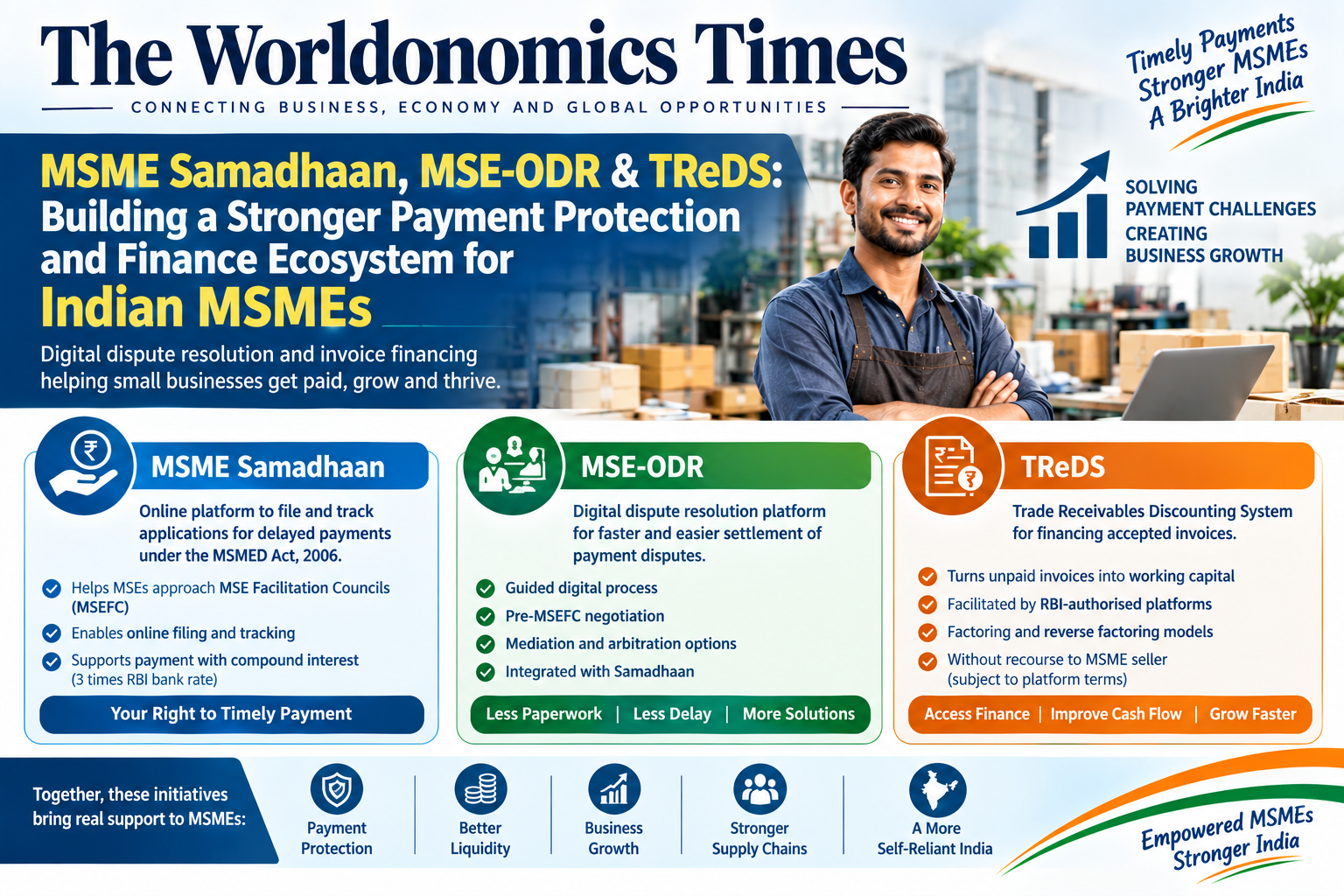
To address this challenge, India has developed a combination of legal protection, digital dispute resolution and invoice financing mechanisms. Three important initiatives are MSME Samadhaan, the MSME Online Dispute Resolution (MSE-ODR) Portal and the Trade Receivables Discounting System (TReDS). Each serves a different purpose, but together they can improve payment discipline and working-capital access for eligible enterprises.
1. MSME Samadhaan: A Legal Route Against Delayed Payments
The MSME Samadhaan Portal was launched by the Ministry of Micro, Small and Medium Enterprises in October 2017. It provides an online facility for eligible Micro and Small Enterprises (MSEs) to file and track applications relating to delayed payments.
Its foundation is the Micro, Small and Medium Enterprises Development (MSMED) Act, 2006. Under Section 15, a buyer must make payment to an MSE supplier by the date agreed in writing. The agreed period cannot exceed 45 days from acceptance or deemed acceptance of goods or services. Where there is no written agreement, the statutory payment period is 15 days.
If the buyer fails to pay within the applicable period, the supplier may approach the Micro and Small Enterprises Facilitation Council (MSEFC). Under Section 16, the buyer may become liable to pay compound interest with monthly rests at three times the RBI bank rate, subject to the Act.
The Samadhaan Portal helps eligible enterprises submit their claims online. The application is forwarded to the concerned MSEFC, which is responsible for examining and deciding the matter. The portal facilitates filing and tracking; it does not itself adjudicate the dispute. MSME RAMP PORTAL+2
2. MSE-ODR: Moving Delayed Payment Disputes Online
The MSME Online Dispute Resolution (ODR) Portal represents a further step towards faster and more accessible resolution of payment disputes. Launched by the Ministry of MSME on 27 June 2025, it provides a digital process designed to reduce paperwork, travel, administrative effort and the time involved in resolving disputes.
The portal supports a structured process that can include:
- Digital Guided Pathway: Helps parties navigate the dispute-resolution process.
- Pre-MSEFC negotiation: Gives the buyer and supplier an opportunity to communicate and attempt settlement before formal proceedings.
- Mediation: Encourages a mutually acceptable solution while preserving business relationships.
- Arbitration and MSEFC proceedings: Provides routes for disputes to proceed through the appropriate mechanism under the MSMED Act.
The scheme guidelines allow eligible MSE suppliers to use digital negotiation and, where appropriate, mediation or arbitration through the MSEFC framework. The supplier’s location as recorded in Udyam Registration or the Udyam Assist Platform is relevant to determining territorial jurisdiction.
An important operational change is that new delayed-payment cases have been filed through the MSME ODR Portal from 15 October 2025, with the Samadhaan Portal being integrated into the newer system. Businesses should therefore check the current portal and filing instructions before submitting a new claim. ODR+3
3. TReDS: Turning Unpaid Invoices into Working Capital
While Samadhaan and ODR help enterprises pursue delayed payments, TReDS addresses a related but different problem: the immediate need for cash.
The Trade Receivables Discounting System (TReDS) is an electronic platform regulated by the Reserve Bank of India (RBI). It enables MSME suppliers to obtain financing against accepted trade receivables from corporate buyers, government departments and public sector undertakings.
The process generally works as follows:
- An MSME supplies goods or services to a buyer and raises an invoice.
- The invoice or bill is uploaded onto a TReDS platform.
- The buyer accepts or confirms the invoice.
- Registered financiers, such as banks and permitted financial institutions, submit financing offers.
- The MSME can choose an offer and receive funds after applicable discounting charges.
- The buyer pays the financier on the invoice’s due date.
TReDS supports both factoring, where the supplier initiates the receivable, and reverse factoring, where the buyer initiates the financing request. A key feature is that transactions processed through TReDS are without recourse to the MSME seller: the seller is not required to repay the financier merely because the buyer defaults, subject to the platform’s applicable rules and transaction terms.
This mechanism can help enterprises convert approved invoices into funds earlier, improve liquidity and reduce dependence on conventional short-term borrowing. Frequently Asked Questions+2
4. Recent Policy Developments: Greater Momentum for TReDS
The Government has taken further steps to expand the use of invoice financing. The monetary threshold for onboarding corporates and CPSEs onto TReDS was reduced to an annual turnover of ₹250 crore through a notification dated 7 November 2024.
In another important development, a notification dated 30 June 2026 requires all operating Central Public Sector Enterprises to route settlement of invoices for goods and services procured from MSMEs through RBI-authorised TReDS platforms. The measure also provides for disclosures and compliance certification, strengthening accountability among large public-sector buyers.
These developments can encourage more buyers to participate in the system and make invoice financing a more widely used working-capital solution for smaller suppliers. Press Information Bureau+1
5. Samadhaan, ODR and TReDS: Understanding the Difference
Although all three initiatives address payment-related challenges, their functions are distinct.
| Initiative | Primary purpose |
|---|---|
| MSME Samadhaan | Online filing and tracking of delayed-payment applications |
| MSME ODR | Digital negotiation, mediation and dispute resolution |
| TReDS | Financing or discounting accepted trade receivables |
Samadhaan and ODR provide routes for addressing payment disputes, whereas TReDS helps businesses access funds against accepted invoices before their maturity date. TReDS is not a substitute for legal recovery proceedings where an invoice is disputed or unpaid.
6. What MSMEs Should Do to Benefit
Businesses can improve their chances of using these mechanisms effectively by following a few practical steps:
- Maintain valid Udyam Registration and ensure that business details are accurate.
- Issue invoices with clear descriptions, amounts, payment terms and due dates.
- Keep purchase orders, delivery challans, acceptance records, work completion certificates and correspondence properly documented.
- Follow up with buyers before invoices become overdue.
- Explore registration with RBI-authorised TReDS platforms and understand the discounting charges offered by financiers.
- For eligible delayed-payment disputes, review the current MSME ODR filing procedure and retain supporting documents.
- Seek professional legal or financial advice where claims involve complex contractual or evidentiary issues.
Enterprises should also remember that the statutory protections under the MSMED Act discussed here apply to eligible Micro and Small Enterprises, not automatically to every medium-sized enterprise.
7. Challenges and the Road Ahead
Despite significant progress, challenges remain. Many small businesses are still unaware of their statutory rights and digital financing options. Some face difficulties obtaining buyer acceptance of invoices, preparing complete documentation or navigating formal dispute-resolution procedures.
Large buyers must strengthen payment discipline, respond promptly to invoice confirmations and avoid unnecessary administrative delays. Financial institutions and TReDS operators can contribute through transparent pricing, accessible onboarding and improved awareness among smaller suppliers.
The success of these initiatives will ultimately depend not only on digital platforms and legal provisions but also on effective implementation, responsible buyer behaviour and timely resolution of disputes.
Conclusion: Timely Payments, Stronger MSMEs, Stronger India
MSME Samadhaan, the MSE-ODR Portal and TReDS represent three complementary pillars of India’s evolving MSME payment ecosystem. Samadhaan provides a formal route for raising delayed-payment claims, ODR introduces a more accessible digital dispute-resolution process, and TReDS helps convert accepted invoices into working capital.
For India’s small businesses, timely payments are not simply an accounting requirement; they are essential for survival, investment, employment and expansion. Greater awareness and effective use of these initiatives can strengthen business confidence, improve financial discipline and build a more resilient MSME sector.