How the Ministry of MSME’s women-focused initiative is creating livelihood opportunities and strengthening India’s traditional coir industry.
Introduction
Women entrepreneurship plays an important role in India’s economic development. Across rural India, women possess traditional skills, local knowledge and the determination to build sustainable livelihoods. However, limited access to technical training, modern machinery, finance and markets often prevents them from converting these capabilities into successful business ventures.
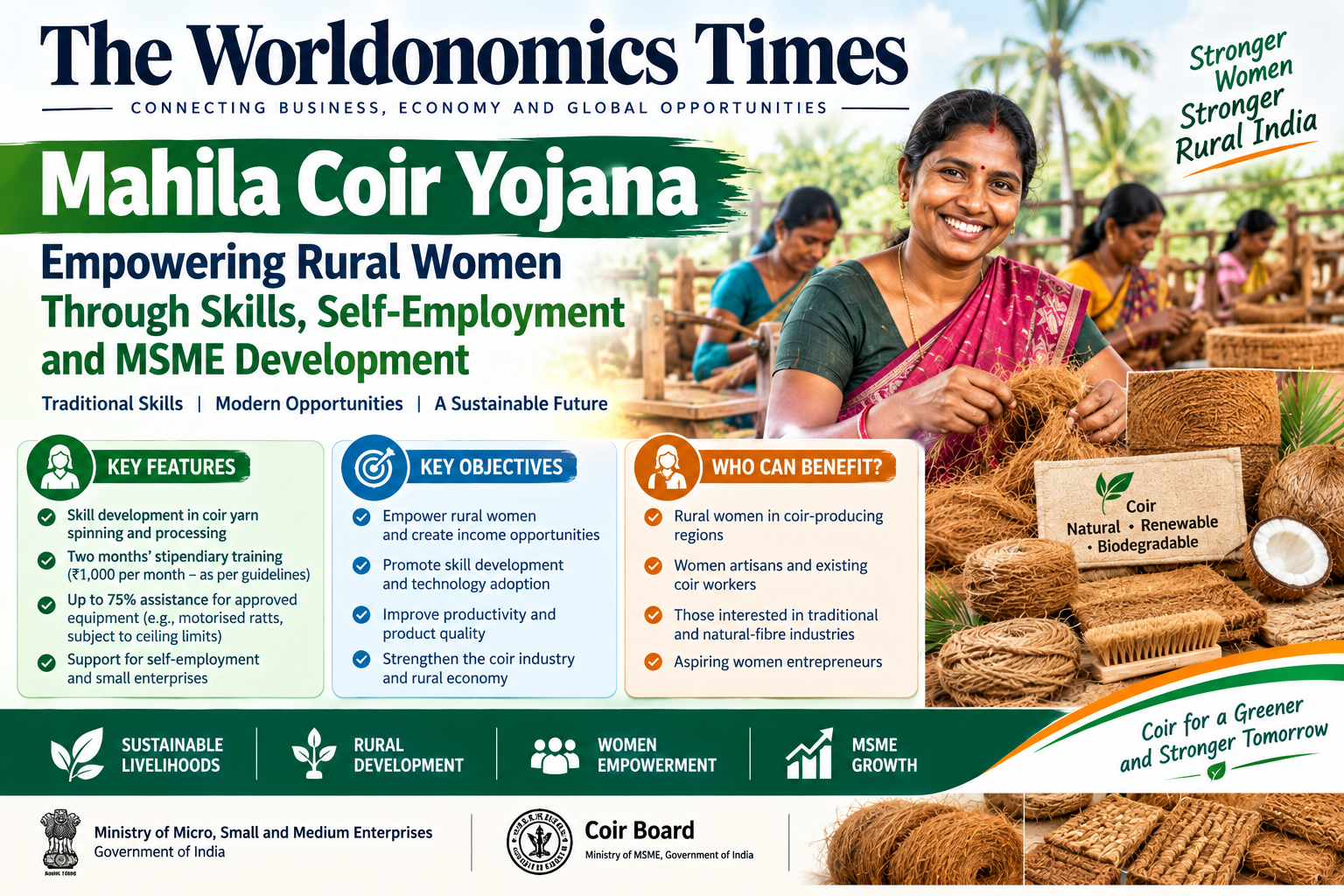
To address these challenges, the Ministry of Micro, Small and Medium Enterprises (MSME), through the Coir Board, implements the Mahila Coir Yojana (MCY) under the Coir Vikas Yojana. This women-oriented self-employment initiative aims to empower rural women artisans in coconut-producing regions through skill development, training and support for coir-processing equipment.
The scheme connects traditional craftsmanship with modern production methods, helping women participate more actively in India’s rural industrial economy.
1. Understanding Mahila Coir Yojana
Mahila Coir Yojana is a dedicated women-focused programme implemented by the Coir Board, a statutory body under the Ministry of MSME. The initiative has been operating since 1994 and focuses on creating self-employment opportunities for rural women artisans engaged in the coir sector.
Coir is a natural fibre extracted from coconut husks. India has a significant coir industry, particularly in states and regions where coconut cultivation and processing are important economic activities. Coir is used to manufacture products such as yarn, mats, ropes, brushes, mattresses, geotextiles and environmentally friendly household products.
The scheme seeks to help women acquire the skills required to convert coconut fibre into value-added products and develop opportunities for independent income generation.
2. Key Objectives of the Scheme
Mahila Coir Yojana has several important objectives:
- Women empowerment: Encourage rural women to become economically independent through skill-based employment.
- Skill development: Provide technical training in coir yarn spinning and related processing activities.
- Self-employment: Help trained women establish livelihood activities and small coir-based enterprises.
- Technology adoption: Introduce improved spinning equipment and production techniques.
- Productivity improvement: Improve the quality, efficiency and consistency of coir yarn and other products.
- Rural development: Generate employment opportunities in coconut-producing and coir-processing regions.
These objectives support inclusive growth while strengthening India’s traditional coir industry.
3. Training and Financial Assistance
Skill development is a central component of Mahila Coir Yojana. Women artisans receive specialised training in coir yarn spinning through Coir Board training centres and other approved training arrangements.
The programme generally provides two months of stipendiary training. According to the Ministry’s published scheme information, the training stipend is ₹1,000 per month, subject to applicable guidelines.
After successful training, eligible women artisans may receive support for purchasing motorised ratts and other approved coir-processing equipment. Published government information describes assistance of up to 75% of the equipment cost, subject to prescribed ceilings and scheme conditions. The historical published ceiling for motorised ratts is ₹7,500; applicants should confirm the currently applicable equipment categories, subsidy limits and availability with the Coir Board before making a purchase.
This combination of training and equipment assistance helps reduce the initial barriers faced by rural women who wish to enter the coir industry.
4. Who Can Benefit?
The scheme is primarily intended for rural women artisans living in regions where coir fibre is produced and processed.
Women interested in coir yarn spinning and related activities can approach the Coir Board’s training centres and regional offices to understand the available programmes.
The scheme is particularly relevant to:
- Rural women seeking self-employment.
- Women artisans from coconut-producing areas.
- Women interested in traditional and natural-fibre industries.
- Existing coir workers who want to improve their technical skills.
- Women who wish to develop small-scale coir-based livelihood activities.
Training selection, equipment assistance and other benefits are subject to the applicable Coir Board guidelines and eligibility requirements.
5. How Mahila Coir Yojana Supports Entrepreneurship
The benefits of the scheme extend beyond technical training. By helping women acquire production skills and access improved equipment, it creates a foundation for small-scale entrepreneurship.
Trained artisans can explore activities such as coir yarn production and other eligible coir-processing work. With appropriate business planning, they may also explore opportunities to establish production groups, participate in cooperative activities or develop small enterprises.
The Ministry’s wider MSME ecosystem provides additional opportunities through initiatives such as the Prime Minister’s Employment Generation Programme (PMEGP), which eligible trained women may explore for setting up new micro-enterprises, subject to its separate eligibility and approval conditions.
This creates a potential pathway from training to production, enterprise development and market participation.
6. Contribution to Sustainable and Green Business
Coir is a natural, renewable and biodegradable material. Its use in products such as mats, ropes, brushes, garden materials and geotextiles offers opportunities in markets increasingly interested in sustainable alternatives.
Better utilisation of coconut husk also helps generate economic value from agricultural resources that might otherwise be underutilised.
By encouraging rural production, value addition and improved processing techniques, Mahila Coir Yojana supports both women’s livelihoods and the development of environmentally responsible industries.
7. How to Apply and Seek Guidance
Interested women should contact the nearest Coir Board regional office, sub-regional office or authorised training centre.
The general process involves:
- Contacting the Coir Board to identify available training programmes.
- Checking the eligibility conditions and application schedule.
- Submitting the prescribed application and supporting documents.
- Completing the approved training programme.
- Exploring equipment assistance and further enterprise support under applicable guidelines.
Applicants should verify current training schedules, stipend provisions and equipment subsidy conditions directly with the Coir Board.
8. Challenges and the Way Forward
Despite its potential, women in rural coir-producing regions may face challenges involving access to markets, transport, working capital, technology and business awareness. Training alone cannot guarantee a sustainable enterprise unless artisans can connect with buyers and receive fair prices for their products.
Stronger market linkages, participation in exhibitions, digital marketing, product diversification and cooperative business models can improve the long-term impact of the scheme.
Greater awareness of complementary MSME programmes and access to suitable financial services can also help trained women move from individual livelihood activities towards sustainable business ownership.
Conclusion: Empowering Women, Strengthening Rural India
Mahila Coir Yojana represents an important effort to combine traditional skills with modern entrepreneurship. By providing rural women with technical training, stipendiary support and assistance towards approved equipment, the programme creates opportunities for self-employment and economic independence.
Its impact goes beyond the production of coir yarn. It encourages women to participate in local industries, strengthens rural livelihoods, promotes natural-fibre products and supports India’s broader MSME development goals.
With effective implementation, better market access and continued skill development, Mahila Coir Yojana can contribute to a stronger, more inclusive and sustainable rural economy.