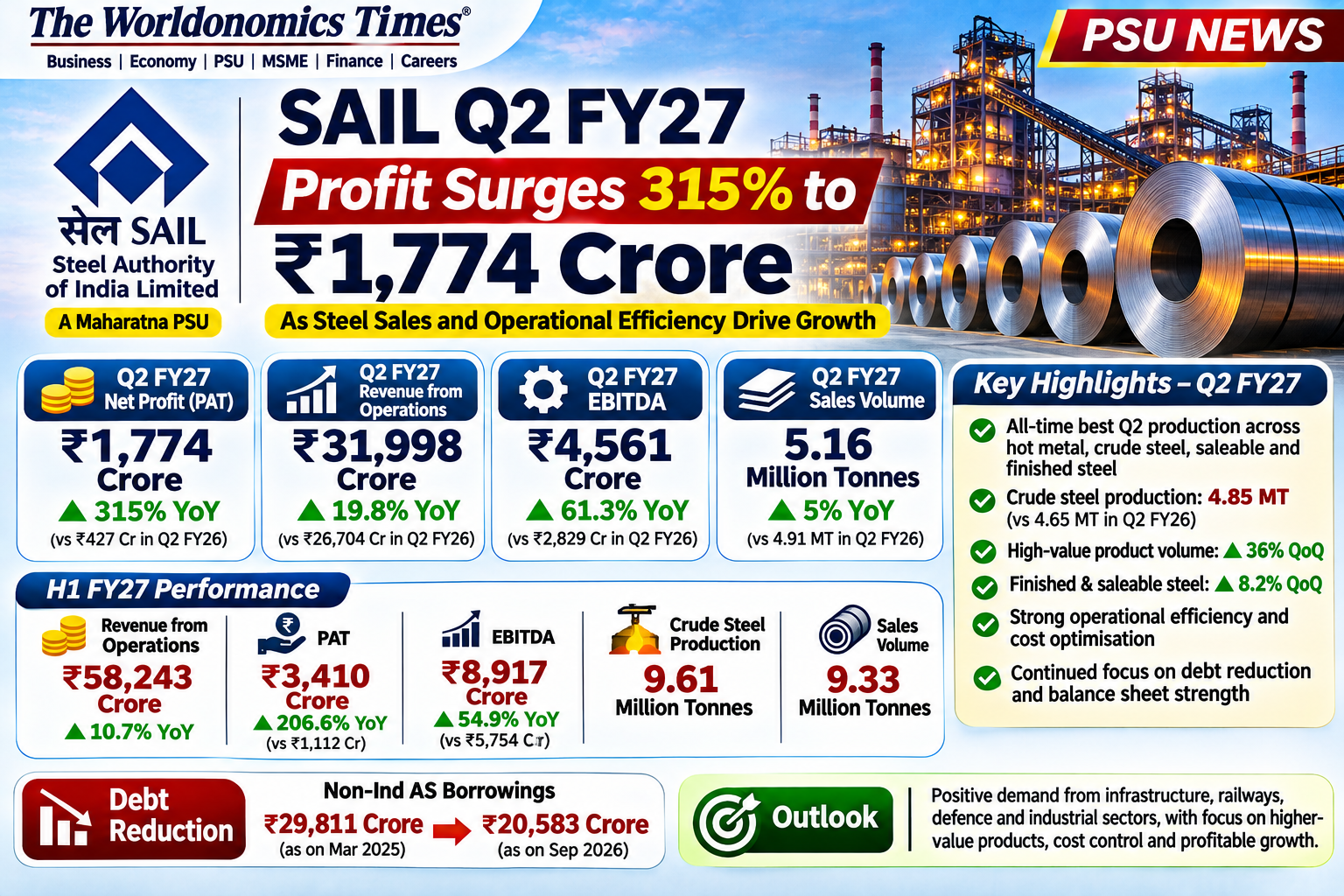
Steel Authority of India Limited (SAIL), one of India’s leading public sector steel producers, has delivered a sharp improvement in profitability during the second quarter of FY2026-27, with standalone Profit After Tax (PAT) rising approximately 315% year-on-year to ₹1,774 crore.
The performance reflects a combination of higher sales volumes, improved operational efficiency, cost optimisation, stronger product mix and disciplined financial management. The Maharatna PSU has also continued its efforts to reduce borrowings, strengthening its balance sheet at a time when the global steel industry remains exposed to input-cost and demand volatility.
Q2 Profit Jumps from ₹427 Crore to ₹1,774 Crore
SAIL’s standalone PAT increased from ₹427 crore in Q2 FY26 to ₹1,774 crore in Q2 FY27, representing growth of around 315%.
The sharp improvement in profitability was accompanied by significant growth in revenue. Revenue from operations increased to ₹31,998 crore in Q2 FY27 compared with ₹26,704 crore in the corresponding quarter of the previous year.
EBITDA also strengthened substantially, reaching ₹4,561 crore during the quarter compared with ₹2,829 crore in Q2 FY26.
Profit before tax stood at ₹2,356 crore, compared with ₹553 crore in the year-ago quarter.
Sales Volume Rises 5% During the Quarter
One of the major contributors to SAIL’s performance was the increase in steel sales.
The company reported Q2 sales volume of 5.16 million tonnes, compared with 4.91 million tonnes in Q2 FY26, representing approximately 5% growth.
Compared with Q1 FY27, sales volume increased substantially from 4.16 million tonnes. This indicates a strong sequential improvement in the company’s ability to convert production into sales.
SAIL has been increasing its outreach to retail and other consumers while also focusing on direct dispatches through rail and road networks. These measures are aimed at improving inventory movement and reducing turnaround time.
The company also reported an 8.2% quarter-on-quarter increase in finished and saleable steel during Q2, supporting the overall improvement in operating performance.
Record Q2 Production Across Key Categories
SAIL’s operational performance was another important feature of the quarter.
According to the company, Q2 FY27 delivered all-time best Q2 production across hot metal, crude steel, saleable steel and finished steel.
Crude steel production increased to 4.85 million tonnes, compared with 4.65 million tonnes in Q2 FY26.
The company attributed the improvement to better operational discipline, production-sales synchronisation and improved fuel-rate performance.
The focus on production efficiency is particularly important for an integrated steel producer because even relatively small improvements in production costs, fuel consumption and equipment utilisation can have a meaningful impact on margins.
High-Value Steel Products Gain Importance
SAIL is also focusing increasingly on higher-value steel products.
During Q2 FY27, the volume of high-value products increased 36% compared with Q1 FY27. The company’s strategy is to increase its presence in premium steel segments where demand is relatively resilient and margins can be stronger.
This product-mix strategy is important as the Indian steel market evolves beyond simple volume expansion. Infrastructure, defence, railways, automobiles, engineering and other industrial sectors increasingly require specialised grades and value-added steel products.
For SAIL, increasing the contribution of such products can potentially improve realisations while reducing dependence on commodity-grade steel.
H1 FY27 Profit More Than Triples
SAIL’s strong Q2 performance significantly improved its first-half financial numbers.
For H1 FY27, the company reported:
| Financial Indicator | H1 FY26 | H1 FY27 |
|---|---|---|
| Revenue from Operations | ₹52,625 Cr | ₹58,243 Cr |
| EBITDA | ₹5,754 Cr | ₹8,917 Cr |
| PBT | ₹1,443 Cr | ₹4,515 Cr |
| PAT | ₹1,112 Cr | ₹3,410 Cr |
| Crude Steel Production | 9.50 MT | 9.61 MT |
| Sales Volume | 9.46 MT | 9.33 MT |
H1 PAT therefore increased from ₹1,112 crore to ₹3,410 crore, while EBITDA rose to ₹8,917 crore from ₹5,754 crore.
The improvement demonstrates that SAIL’s profitability recovery is not restricted to a single month or isolated operational factor.
Debt Reduction Strengthens Balance Sheet
Another important development is SAIL’s continued focus on reducing borrowings.
The company’s non-Ind AS borrowings stood at approximately ₹20,583 crore as of September 2026. This represents a significant reduction from ₹29,811 crore in March 2025.
Lower debt can help reduce financial pressure and provide greater flexibility for future capital expenditure. It also strengthens the company’s ability to invest in modernisation and capacity expansion while maintaining financial discipline.
India’s Steel Demand Provides a Strategic Opportunity
SAIL’s performance comes at a time when India’s infrastructure and construction activity continues to create structural demand for steel.
Government infrastructure spending, railway expansion, highways, urban development, defence manufacturing, renewable-energy infrastructure and industrial investment are all important demand drivers for domestic steel producers.
For a large integrated PSU such as SAIL, this environment provides an opportunity to increase production, improve product mix and capture higher-value domestic demand.
At the same time, the company remains exposed to fluctuations in coking coal prices, international steel prices, freight costs and global demand conditions.
Focus on Cost Control and Operational Excellence
SAIL management has highlighted the importance of improving techno-economic parameters, rationalising costs, maintaining inventory discipline and increasing the share of high-end products.
This approach indicates that the company’s growth strategy is not based only on increasing production.
Instead, the emphasis is increasingly on profitable growth—producing efficiently, selling the right product, controlling costs and strengthening the balance sheet.
The company’s Q2 performance demonstrates how operational improvements can translate into significant financial gains.
Outlook for FY27
SAIL enters the second half of FY27 with stronger profitability, improved operating momentum and a healthier balance sheet.
The key areas to watch will be steel demand, realisations, coking-coal prices, production efficiency, high-value product sales and debt reduction.
The company’s ability to maintain the Q2 momentum will be important for determining whether the strong first-half performance can translate into another year of substantial earnings improvement.
For India’s public sector, SAIL’s performance is significant beyond its financial results. The company remains an important part of India’s industrial ecosystem and contributes to infrastructure development, employment, domestic steel production and strategic industrial capacity.
SAIL’s Q2 FY27 results therefore represent more than a turnaround in quarterly profit—they highlight the potential of operational efficiency, product-mix improvement and financial discipline to strengthen a major Indian PSU.
Key Highlights at a Glance
- Q2 FY27 PAT: ₹1,774 crore
- PAT growth: 315% YoY
- Q2 revenue: ₹31,998 crore
- Q2 EBITDA: ₹4,561 crore
- Q2 sales volume: 5.16 million tonnes
- Q2 crude steel production: 4.85 million tonnes
- H1 FY27 PAT: ₹3,410 crore
- H1 FY27 EBITDA: ₹8,917 crore
- H1 revenue from operations: ₹58,243 crore
- Borrowings: ₹20,583 crore as of September 2026
- High-value product volume: +36% QoQ in Q2 FY27
- Q2 sales volume growth: 5% YoY