The Worldonomics Times | Tax & Regulatory Affairs
India’s Goods and Services Tax (GST) dispute-resolution framework could undergo significant changes following a series of recommendations by the GST Council to standardise departmental proceedings and reduce unnecessary litigation.
The recommendations, announced after the 57th GST Council meeting on October 8, 2026, focus on improving the quality of show-cause notices, ensuring consistency in adjudication orders, reducing disputes involving small tax amounts and encouraging voluntary compliance.
For businesses, tax professionals and industry associations, the proposed reforms could bring greater predictability to GST proceedings. They also seek to address longstanding concerns about inconsistent interpretations, procedural irregularities and avoidable litigation between taxpayers and tax authorities.
However, the recommendations must be distinguished from changes that have formally become law. The proposed amendments and administrative instructions will require their respective implementing notifications, circulars or legislative amendments.
1. Standardised guidelines for GST notices and adjudication
One of the most important recommendations concerns the issuance of comprehensive guidelines for GST officers.
The Council has recommended a circular covering the procedures for issuing demand notices, passing adjudication orders and issuing appellate orders.
The proposed guidelines are intended to improve the quality and consistency of departmental decisions across jurisdictions.
The key areas identified include:
- Quality of notices: Demand notices should clearly explain the allegations, relevant facts and legal provisions involved.
- Timely proceedings: Notices and orders should be issued within the prescribed statutory timelines.
- Proper classification of offences: Allegations involving fraud, wilful misstatement or suppression of facts should be invoked only when supported by the merits of the individual case.
- Reasoned adjudication: Orders should properly address the taxpayer’s submissions and supporting evidence.
- Natural justice: Taxpayers should receive a fair opportunity to present their case, including personal hearings wherever applicable.
These measures could help reduce disputes arising from procedural shortcomings rather than genuine differences over tax liability.
A properly reasoned show-cause notice also allows a taxpayer to understand the department’s position and prepare an effective response.
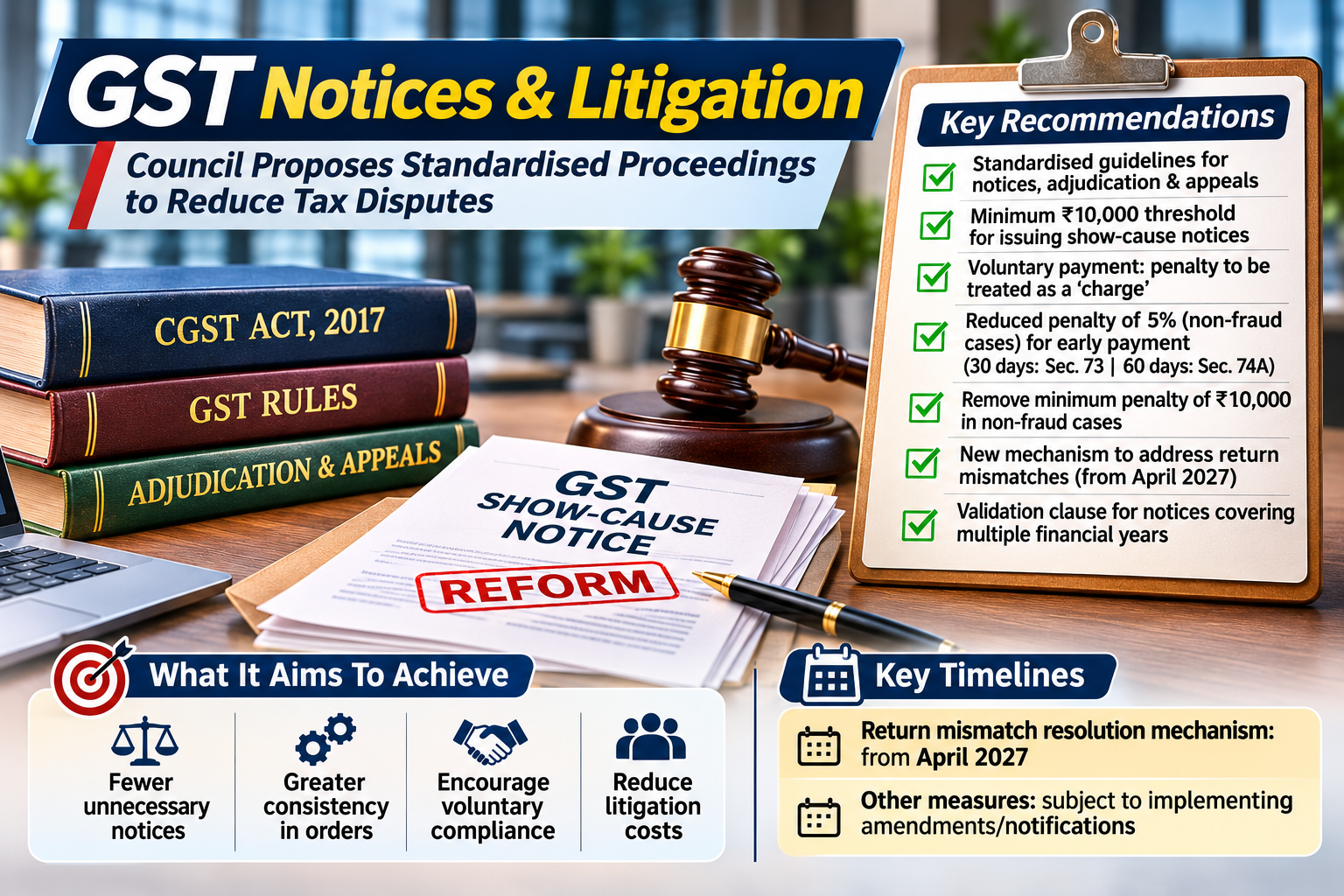
2. Minimum ₹10,000 threshold for issuing show-cause notices
Another significant proposal is the introduction of a minimum monetary threshold of ₹10,000 for issuing GST show-cause notices.
Under the recommendation, no show-cause notice would be issued where the tax amount involved is less than ₹10,000. The threshold is proposed to cover the combined amount of CGST, SGST, IGST and compensation cess.
The Council has also recommended transitional treatment for pending notices and appeals involving amounts below ₹10,000. Such matters would be decided as though the minimum threshold had been applicable when the notice was originally issued.
If implemented, this measure could reduce departmental resources spent on relatively small disputes and allow greater attention to cases involving substantial tax demands.
For smaller businesses, it could also reduce the cost and administrative effort associated with responding to low-value proceedings.
Importantly, the proposed threshold concerns the issuance of show-cause notices. It should not be interpreted as a general exemption from paying GST or as cancellation of every tax liability below ₹10,000.
3. Voluntary payment and revised treatment of penalties
The Council has also recommended changes intended to encourage voluntary payment and early settlement of tax liabilities.
Under the proposal, where the taxpayer voluntarily pays the full tax amount along with applicable interest and penalty within the prescribed period, the penalty amount would be treated as a ‘charge’.
The objective is to encourage taxpayers to resolve their liabilities without prolonged adjudication and litigation.
Another proposed measure concerns reduced penalties in non-fraud cases.
The Council has recommended a reduced penalty of 5% where the taxpayer pays the applicable tax and interest within:
- 30 days of the adjudication order under Section 73.
- 60 days of the adjudication order under Section 74A.
The Council has additionally recommended removing the minimum penalty of ₹10,000 in non-fraud cases.
These changes could provide an incentive for businesses to settle genuine tax disputes promptly instead of pursuing lengthy proceedings.
However, the proposed relief is linked to specific statutory provisions and conditions. It should not be assumed to apply automatically to fraud-related cases or every category of GST demand.
4. Reducing litigation caused by GST return mismatches
A major source of GST disputes involves differences between information reported in various returns.
For example, a mismatch between outward supplies reported in GSTR-1 and tax liability declared in GSTR-3B may generate system-based intimations or departmental queries.
Similarly, differences between ITC reported in GSTR-3B and credit reflected in GSTR-2B can create reconciliation difficulties.
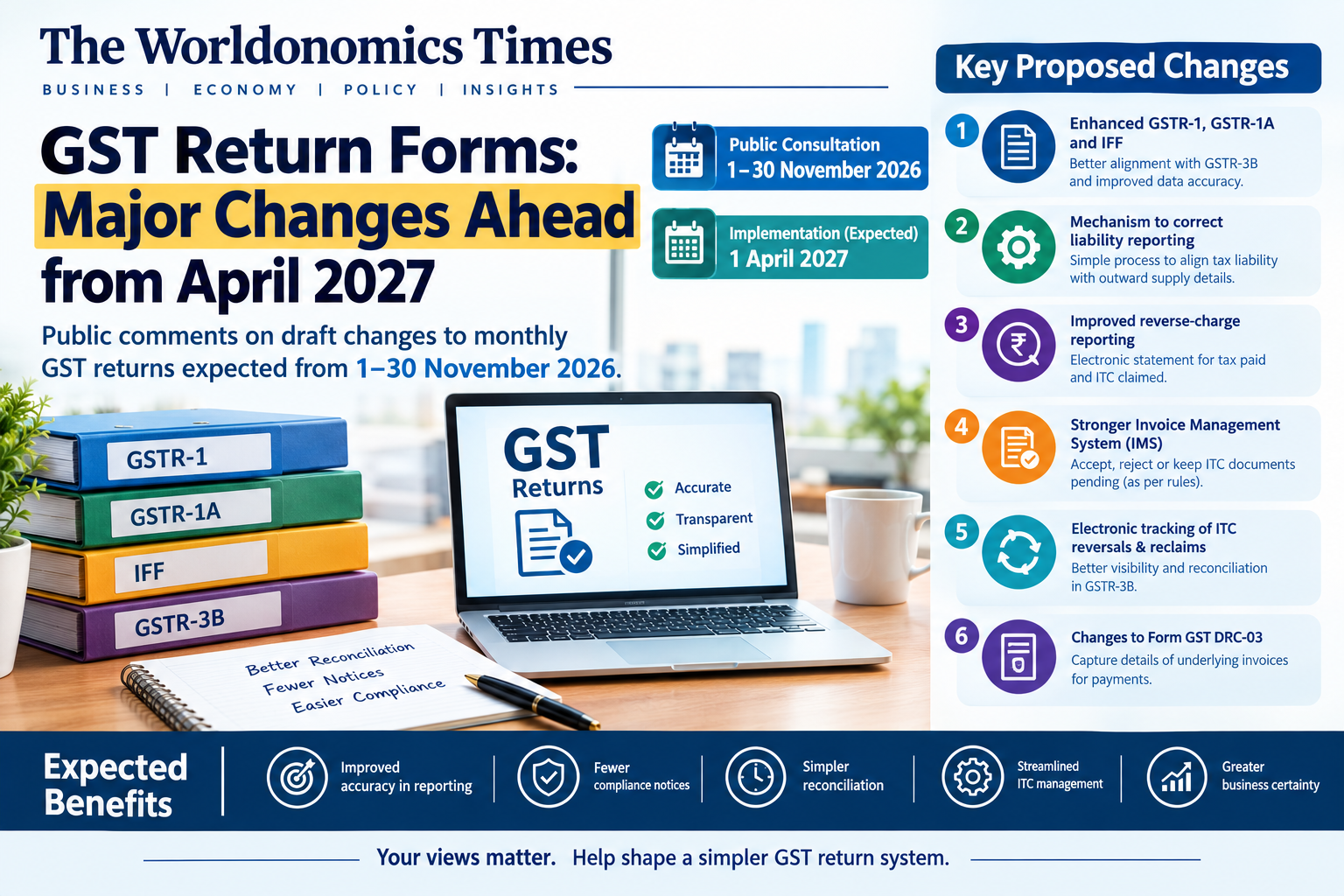
To address these issues, the Council has recommended an alternative mechanism for correcting tax liabilities and ITC reporting.
The proposed changes include improvements to GSTR-1, GSTR-1A and the Invoice Furnishing Facility, better reconciliation with GSTR-3B, and additional electronic statements for reporting reverse-charge tax payments and ITC reversals or reclaims.
The proposed mechanism is intended to allow appropriate corrections before differences escalate into demand notices.
The Council has recommended bringing this mechanism into force from the April 2027 return period, subject to stakeholder consultation and the necessary implementation measures.
This could represent an important shift towards resolving data discrepancies at the return-filing stage rather than through prolonged departmental proceedings.
5. Addressing notices covering multiple financial years
The Council has also recommended introducing a validation clause in the CGST Act to address notices that have been held invalid by courts because they covered multiple financial years.
The proposal seeks to provide statutory validation for notices affected by this particular procedural issue.
This is an important area because litigation over the validity of notices can consume considerable time and resources for both taxpayers and tax authorities.
However, the precise scope and legal consequences of the proposed validation clause will depend on the final legislative wording, including its treatment of existing proceedings and judicial decisions.
6. What businesses should do
Until the relevant changes are implemented, businesses should continue complying with the existing GST framework.
They should maintain proper reconciliations between GSTR-1, GSTR-3B and GSTR-2B, preserve supporting invoices and respond to departmental notices within the prescribed deadlines.
Taxpayers receiving show-cause notices should examine the legal grounds, tax calculations, supporting documents and procedural requirements before submitting a response.
Professional tax advice may be particularly useful where a dispute involves allegations of fraud, suppression or wrongful ITC claims.
Conclusion: Moving towards predictable GST dispute resolution
The GST Council’s recommendations represent an effort to make tax administration more transparent, consistent and proportionate.
Standardised notices, better-reasoned adjudication orders, a minimum threshold for proceedings and improved return reconciliation could reduce avoidable disputes and encourage voluntary compliance.
The success of these measures will ultimately depend on clear statutory amendments, practical departmental guidelines and consistent implementation across jurisdictions.
The bottom line: The proposed GST litigation reforms aim to shift the focus from procedural disputes towards efficient tax administration and substantive compliance. For businesses, the expected benefit is greater clarity, fewer unnecessary notices and a more predictable dispute-resolution process.