By The Worldonomics Times | Global Economy
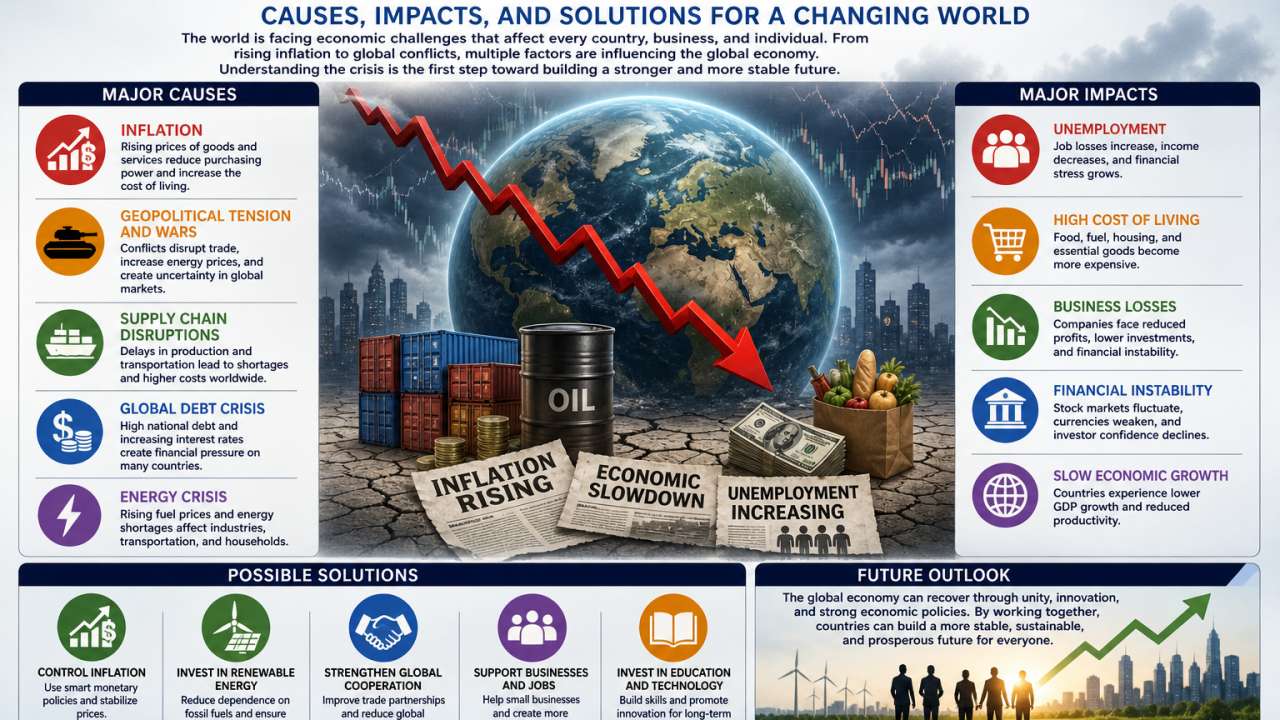
Global debt has become one of the most significant challenges facing the world economy. Governments and businesses are increasingly relying on borrowing to finance public expenditure, infrastructure development, technological investment and business expansion. While debt can support economic growth when used productively, rising borrowing costs and growing repayment obligations are creating concerns about financial stability and long-term economic sustainability.
As global markets navigate geopolitical tensions, inflationary pressures and uncertain economic conditions, the growing volume of public and corporate debt is attracting greater attention from policymakers, investors and financial institutions. The central challenge is no longer simply how much countries and companies borrow, but whether they can manage their obligations without weakening future growth.
Global Debt Reaches Record Levels
The scale of global borrowing has increased substantially over recent years. According to the Institute of International Finance (IIF), global debt reached approximately $348 trillion at the end of 2025. The increase reflected higher government borrowing as well as continued financing requirements across businesses and households.
The IIF subsequently reported that global debt surpassed $365 trillion in the first half of 2026, highlighting the continued expansion of borrowing worldwide. Government spending, infrastructure requirements, defence expenditure and investment in emerging technologies are among the factors contributing to this trend.
The International Monetary Fund (IMF) has also raised concerns about public debt. Its April 2026 Fiscal Monitor estimated that global gross government debt approached 94% of global GDP in 2025 and could reach 100% by 2029 if current trends continue.
These figures demonstrate the growing importance of debt management in determining the direction of the global economy.
Rising Public Debt Creates Pressure on Governments
Governments borrow to finance infrastructure, healthcare, education, social welfare programmes and economic development. During periods of recession or unexpected crises, borrowing can also help protect businesses and households from severe financial disruption.
However, persistent budget deficits can gradually increase national debt and reduce the flexibility available to governments. As outstanding obligations grow, a larger share of public revenue may be required to pay interest rather than support essential services or productive investment.
Higher borrowing costs make this challenge more difficult. Governments refinancing older debt at elevated interest rates may face substantially larger repayment expenses. This can create difficult decisions involving taxation, public spending and future borrowing.
Countries with limited fiscal resources are particularly vulnerable. Developing economies may face greater pressure when international interest rates rise, their currencies weaken or foreign investors become less willing to purchase government bonds.
Corporate Borrowing Adds to Financial Risks
Public debt is only one part of the broader challenge. Corporate borrowing has also increased as businesses seek capital for expansion, acquisitions, infrastructure and technological development.
According to the OECD’s Global Debt Report 2026, corporate borrowing from financial markets reached approximately $13.7 trillion in 2025, while outstanding corporate debt through bonds and syndicated loans stood at around $59.5 trillion.
Borrowing can help companies increase production, invest in research and development and strengthen their competitive position. However, businesses carrying excessive debt may become vulnerable when sales decline, operating costs increase or interest rates rise.
Companies with substantial floating-rate debt or loans approaching maturity may face higher financing expenses when refinancing. This can reduce profitability, restrict future investment and increase the possibility of financial distress.
The expansion of artificial intelligence and digital infrastructure is also creating new financing requirements. Large technology companies are investing heavily in data centres, computing capacity and energy infrastructure. Although these investments may generate long-term economic benefits, they also introduce questions about future returns and the sustainability of debt-funded expansion.
Higher Interest Rates Increase Refinancing Risks
One of the most important concerns surrounding global debt is the cost of refinancing. When interest rates rise, governments and businesses must often pay more to replace maturing loans and bonds.
The OECD estimates that governments and corporations will borrow approximately $29 trillion from markets in 2026. A significant portion of this borrowing will be used to refinance existing obligations rather than finance entirely new projects.
Borrowers have increasingly shifted towards shorter-term debt to manage immediate financing costs. However, shorter maturities mean that loans must be refinanced more frequently, exposing borrowers to changing market conditions.
If investor confidence weakens or borrowing costs increase suddenly, refinancing can become more expensive or difficult. This risk is particularly significant for emerging markets and lower-rated companies that have fewer financing alternatives.
Potential Impact on Financial Markets and Economic Growth
Rising debt can influence financial markets through several channels. Concerns about government finances may push bond yields higher, increase currency volatility and encourage investors to move capital towards assets perceived as safer.
For businesses, expensive credit can discourage investment and expansion. Companies may delay hiring, reduce capital expenditure or postpone new projects to protect their balance sheets.
Higher government interest payments can also limit spending on infrastructure, education and healthcare. Over time, this may weaken productivity and reduce the ability of economies to respond effectively to future crises.
Financial institutions are not completely insulated from these developments. If highly indebted borrowers struggle to meet repayment obligations, banks and other lenders may experience rising loan losses. Stress in private credit markets and other less transparent areas of finance could create additional vulnerabilities.
The Worldonomics View
Global debt should not automatically be viewed as a threat. Borrowing remains an essential instrument for economic development, business investment and financial stability. The real concern emerges when debt grows faster than income, productivity and the capacity to repay it.
Governments must focus on responsible fiscal management, transparent budgets and productive public expenditure. Businesses should maintain sustainable debt levels and ensure that borrowing supports investments capable of generating long-term returns.
International financial institutions and regulators also have an important role in monitoring refinancing risks, improving transparency and strengthening financial-sector resilience.
The priority should not be to eliminate borrowing, but to ensure that debt supports economic progress rather than becoming a permanent constraint on growth.
Conclusion
Increasing public and corporate debt is creating significant challenges for the global economy. Higher interest expenses, refinancing requirements and uncertainty surrounding future growth are putting pressure on governments, businesses and financial markets.
Although borrowing can support investment and development, its long-term benefits depend on responsible management and sustainable repayment capacity. Countries and companies that maintain financial discipline and direct capital towards productive activities will be better positioned to manage economic uncertainty.
As global debt continues to rise, the ability to balance borrowing with financial responsibility will become increasingly important for maintaining economic stability and supporting sustainable growth.