The Goods and Services Tax Network (GSTN) has announced an important technological change concerning the numbering formats of E-Way Bills and Consolidated E-Way Bills, which is proposed to come into effect from 1 January 2027. The revision has been necessitated by the substantial increase in the volume of E-Way Bills generated under the Goods and Services Tax (GST) framework and the anticipated exhaustion of the existing numbering capacity.
Through its advisory dated 4 November 2026, GSTN has proposed increasing the length of both identification numbers to accommodate the growing volume of transactions and ensure the uninterrupted functioning of the E-Way Bill system.
1. What Is the Proposed Change?
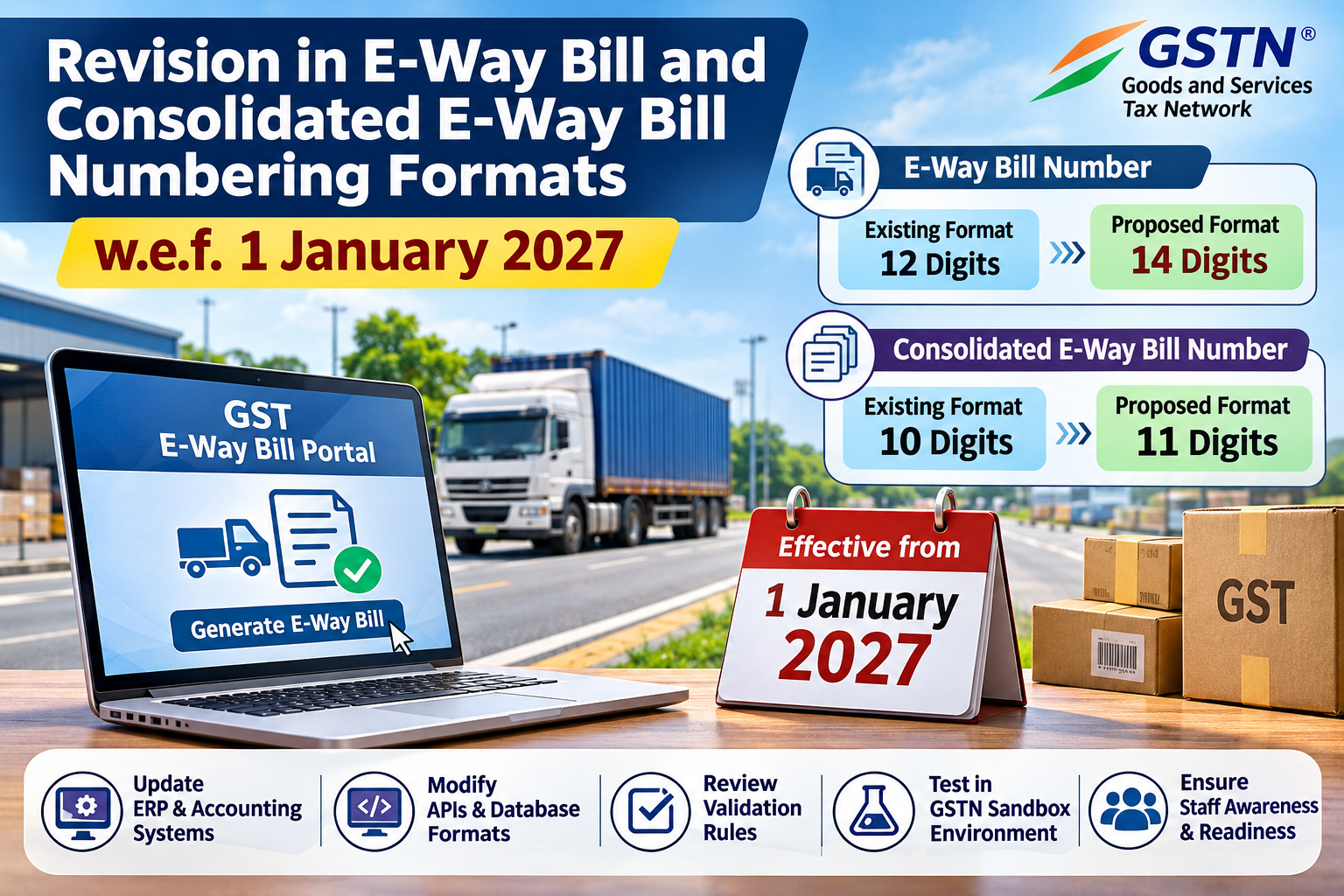
Under the existing system, an E-Way Bill number consists of 12 digits, whereas a Consolidated E-Way Bill number consists of 10 digits. Considering the increasing volume of E-Way Bills generated across the country, GSTN has proposed expanding the numbering capacity.
The proposed changes are summarised below:
| Particulars | Existing Format | Proposed Format |
|---|---|---|
| E-Way Bill Number | 12 Digits | 14 Digits |
| Consolidated E-Way Bill Number | 10 Digits | 11 Digits |
Accordingly, from 1 January 2027, the E-Way Bill number will increase by two digits, while the Consolidated E-Way Bill number will increase by one digit.
This change is primarily technological in nature and is intended to provide additional numbering capacity for the GST ecosystem.
2. Why Is This Change Necessary?
The E-Way Bill mechanism plays a significant role in monitoring the movement of goods under GST. Since its introduction, the system has witnessed substantial growth in the number of E-Way Bills generated by businesses, manufacturers, wholesalers, retailers and transporters.
With the expansion of domestic trade, e-commerce activities, logistics operations and inter-State transportation, the number of E-Way Bills generated through the GST portal has increased considerably.
GSTN has indicated that the existing numbering capacity is expected to be exhausted in view of the substantial volume of E-Way Bills being generated.
Therefore, increasing the number of digits will expand the available identification capacity and support the continued growth of the GST infrastructure.
3. Who Will Be Affected by This Revision?
Although the revision relates only to numbering formats, its impact will extend to several stakeholders associated with the GST and logistics ecosystem.
The following stakeholders should take note:
A. Taxpayers and Registered Businesses
Businesses generating E-Way Bills directly through the GST portal or through integrated accounting software should ensure that their systems can capture and process 14-digit E-Way Bill numbers and 11-digit Consolidated E-Way Bill numbers.
B. Transporters and Logistics Companies
Transporters regularly use E-Way Bill numbers for tracking consignments, preparing transportation documents and coordinating vehicle movements. Their operational systems and internal records must be compatible with the revised formats.
C. ERP and Accounting Software Providers
Software developers must modify their applications, database structures, input fields and validation mechanisms to accommodate the revised number lengths.
D. GST Suvidha Providers (GSPs) and API Integrators
GSPs and API service providers will need to review their integration systems to ensure that the revised numbers can be generated, transmitted, received and stored without technical errors.
4. Important Technical Preparations Required
GSTN has specifically advised all stakeholders to make the necessary modifications to their applications, APIs, database schemas and validation rules.
Businesses should consider the following preparatory measures:
- Database Modifications: Review database fields currently designed to store 12-digit E-Way Bill numbers and 10-digit Consolidated E-Way Bill numbers. Ensure that sufficient capacity is available for the revised formats.
- Software Upgradation: Coordinate with ERP, billing and accounting software providers to implement the necessary changes before the effective date.
- API Integration: Businesses using automated E-Way Bill generation facilities should ensure that their APIs can accept and process the revised number lengths.
- Validation Rules: Existing software validation rules, which may restrict E-Way Bill numbers to 12 digits or Consolidated E-Way Bill numbers to 10 digits, should be updated.
- Testing and Verification: Conduct appropriate testing to ensure that the revised numbers are correctly generated, stored, displayed, retrieved and communicated across integrated systems.
- Staff Awareness: Inform accounts, dispatch, logistics and compliance teams about the upcoming changes to minimise operational confusion.
5. Sandbox Testing and Implementation Readiness
One of the important aspects of the GSTN advisory is the proposed release of these changes in the Sandbox environment shortly.
The Sandbox environment will provide an opportunity for software developers, GSPs, ERP providers and API integrators to test their systems before the actual implementation date.
Stakeholders should utilise this testing facility to identify potential compatibility issues and resolve them well in advance.
Further technical details regarding the revised numbering formats will be published on the E-Way Bill Portal.
Businesses should not wait until the last week of December 2026 to initiate the required modifications. Early preparation will help avoid system failures, transaction delays and unnecessary compliance difficulties.
6. Will There Be Any Change in GST Compliance Requirements?
It is important to understand that the announced revision concerns the numbering formats of E-Way Bills and Consolidated E-Way Bills.
The advisory does not, by itself, announce any change in the fundamental E-Way Bill generation requirements, applicable consignment value thresholds, validity provisions or documentation requirements under the GST framework.
The statutory provisions governing E-Way Bills, including Rule 138 of the CGST Rules, 2017, will continue to govern the generation and movement of goods, subject to applicable amendments and notifications.
Further, the advisory does not expressly clarify the treatment of E-Way Bills generated before 1 January 2027. Stakeholders should therefore refer to subsequent technical instructions issued by GSTN for any transitional requirements.
7. Conclusion: Prepare Today for a Seamless GST Transition
The proposed revision in E-Way Bill and Consolidated E-Way Bill numbering formats represents another step towards strengthening India’s digital GST infrastructure.
Increasing the E-Way Bill number from 12 to 14 digits and the Consolidated E-Way Bill number from 10 to 11 digits will provide additional numbering capacity to support the growing volume of commercial and transportation activities.
While the change may appear minor from a taxpayer’s perspective, it carries significant implications for businesses relying on automated accounting, ERP, logistics and GST integration systems.
Accordingly, taxpayers, transporters, GSPs, software developers and API integrators should review their existing systems, coordinate with technology providers and complete the necessary modifications well before 1 January 2027.