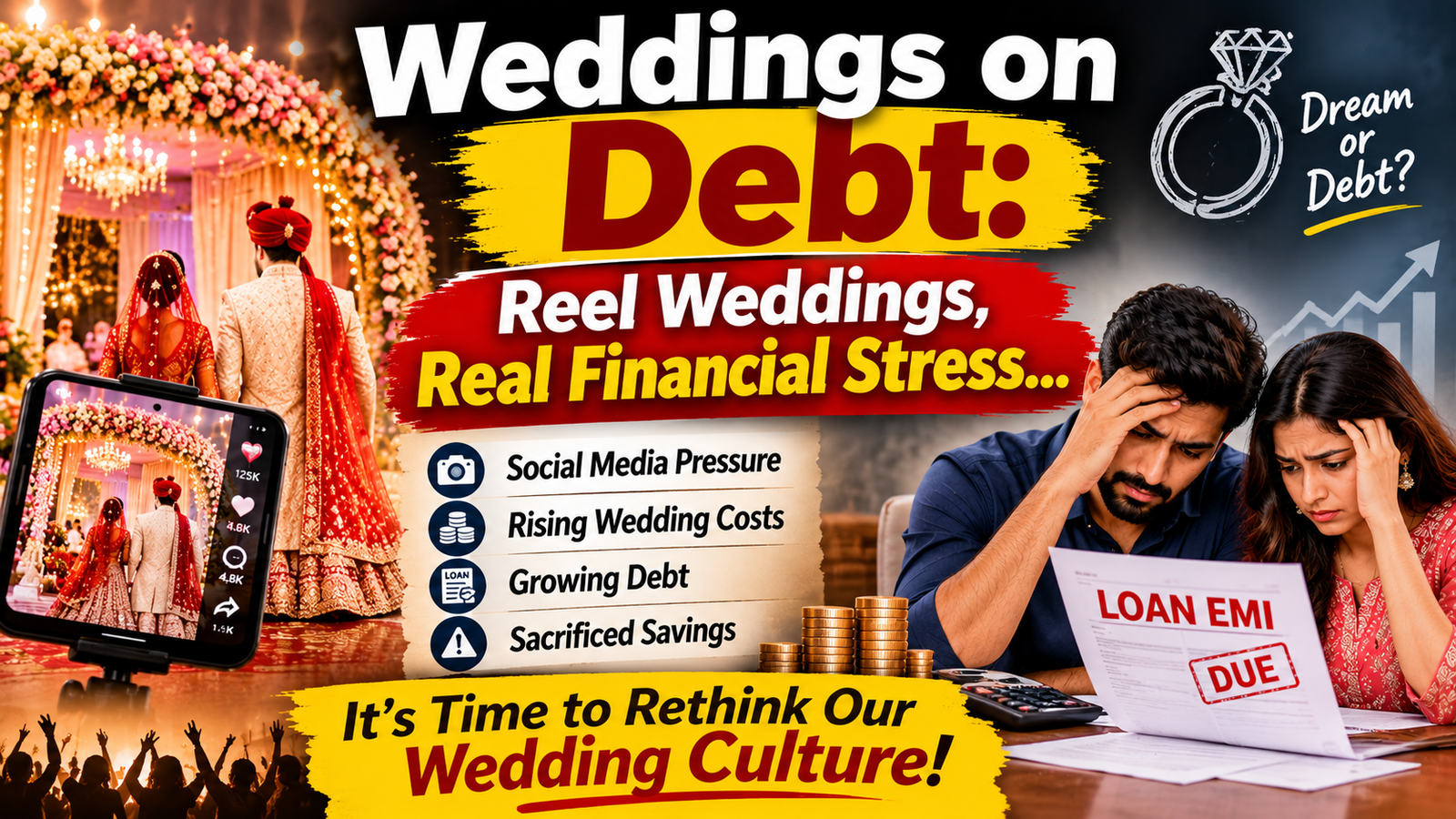
How social-media pressure, lavish celebrations and copy-paste wedding trends are turning a day of joy into years of financial commitments.
A wedding lasts a few days. The photographs may remain online for years, but the loan repayments can last even longer.
Across India, weddings are increasingly influenced by destination venues, designer outfits, elaborate decorations, cinematic pre-wedding shoots and social-media trends. For some families, the desire to create a memorable celebration is gradually becoming a financial competition—one in which spending is measured against what relatives, friends, celebrities and influencers have displayed online.
The problem is not spending money on a wedding. It is spending beyond one’s financial capacity to maintain an image of prosperity.
From a finance perspective, this raises an important question: when a celebration is funded by borrowing, depleted savings or the sale of family assets, what is its real economic cost?
1. The numbers behind India’s wedding economy
India’s wedding industry generates significant economic activity across hospitality, catering, jewellery, clothing, photography, travel and event management. But the growth of wedding spending also creates a personal-finance challenge when budgets rise faster than household savings.
A 2025 report by wedding-planning platform WedMeGood, covered by Outlook Money, estimated the average wedding budget among its surveyed couples at ₹39.5 lakh, up 8% year on year. The reported average for destination weddings was ₹58 lakh. Around 79% of respondents relied on savings, while approximately 15% reported taking loans. These are survey findings, not a census of all Indian weddings, and should not be treated as representative of every household.
A separate 2026 survey by Mint, YouGov India and the Centre for Policy Research, covering 10,022 adults across 207 towns and cities, found a median expected wedding budget of ₹5 lakh. Nearly one in six respondents placed their budget at ₹20 lakh or more, while around seven in ten favored limited borrowing or no wedding loans.
The different figures reflect differences in samples, survey methods and the people being measured. They should not be directly compared as if they describe the same population. Together, however, they reveal an important tension: lavish wedding aspirations coexist with widespread concern about affordability and debt.
2. The “reel wedding” effect: when social media changes spending decisions
Social media has transformed weddings from private family celebrations into highly visible public performances. A ceremony is now often planned with photographs, cinematic videos, elaborate entrances, coordinated outfits and visually striking decorations in mind.
The financial problem begins when inspiration becomes imitation.
A celebrity may spend crores on a wedding without materially affecting their financial security. A household with a modest income may attempt to recreate the same aesthetic by borrowing, exhausting savings or diverting money from essential goals.
This creates a form of social comparison spending: the family does not spend according to what it can comfortably afford, but according to what it fears others might think.
The result is a distorted financial decision. A wedding may look wealthy without leaving the family financially secure.
3. The real cost of borrowing for a wedding
Consider a hypothetical family borrowing ₹5 lakh through a personal loan to fund wedding expenses.
ILLUSTRATIVE LOAN CALCULATION
Loan amount
₹5,00,000
Assumed annual interest
15%
Repayment period
36 months
Approximate monthly EMI
₹17,333
Total interest paid
₹1.24 lakh
Total repayment
₹6.24 lakh
Illustration assumes a fixed monthly repayment schedule, with no processing fees, insurance charges or other loan costs. Actual lender rates and terms vary.
The family does not simply spend ₹5 lakh. It commits future income to repay that amount plus interest.
That ₹17,333 monthly EMI could otherwise contribute to rent, an emergency fund, professional education, retirement investments or a future home down payment.
The opportunity cost is important. Money spent on a wedding cannot simultaneously fund another financial goal. Money borrowed for it also carries a financing cost.
4. The hidden cost: sacrificing savings and financial security
Debt is not the only risk. Some families finance weddings by liquidating investments, withdrawing long-term savings or selling assets.
Suppose a family has ₹10 lakh in savings and spends ₹7 lakh on a celebration. It may still avoid borrowing, but its financial resilience can weaken significantly.
An unexpected medical expense, job loss or business slowdown could then force the family to borrow at short notice.
The financial impact extends beyond the wedding itself:
- Emergency savings shrink: the household has less protection against unexpected expenses.
- Investment goals are delayed: money that could compound over time is consumed by a one-time event.
- Financial independence is postponed: young couples may have to delay buying a home or pursuing further education.
- Family tensions can increase: repayment obligations may become a source of stress between couples and relatives.
The important distinction is between having enough money to pay for a wedding and being able to afford it without compromising future needs.
5. Why this is also a household-debt issue
The Reserve Bank of India’s Financial Stability Report, discussed in reporting by Business Standard in June 2026, placed household-sector debt at 45.5% of GDP in September 2025, with non-housing retail loans accounting for a growing share of borrowing. The report also noted that borrower credit profiles had improved, so rising debt does not automatically mean every household is under financial distress.
Wedding loans represent only one possible use of personal credit; they should not be mistaken for a major driver of national household debt without stronger evidence.
Nevertheless, the broader financial principle matters: easy access to credit can make a purchase appear affordable even when its long-term cost is difficult to sustain.
A loan approval confirms that a lender is willing to lend under its assessment criteria. It does not establish that the expense is the best use of a family’s money.
When borrowing finances an asset or a productive investment, it may generate future economic benefits. A wedding can provide emotional and social value, but it generally does not produce a financial return that repays the loan.
That does not make wedding spending inherently wrong. It means the decision must be judged by affordability, not by the availability of credit.
6. The economics of copy-paste weddings
Copying wedding trends can create a cycle of escalating expectations.
One family chooses an elaborate venue. Another feels pressure to match it. A third adds a destination event, luxury photography or multiple ceremonies to avoid appearing less generous.
Each family may believe its spending is a personal decision, but collectively these choices can reinforce increasingly expensive social norms.
The effects are uneven. Wealthier households may absorb the cost comfortably, while middle- and lower-income families can face a heavier burden relative to their incomes.
There is also a difference between productive spending and status-driven spending. Wedding expenditure supports businesses and workers, including caterers, decorators, photographers and hospitality providers. This creates genuine economic activity. Yet the value of that activity does not automatically justify every household expense, particularly when it is financed through unsustainable debt.
A wedding industry can prosper while individual families experience financial pressure. Both realities can exist at the same time.
7. How families can celebrate without compromising their finances
A financially responsible wedding does not need to be joyless or excessively frugal. It needs a budget that reflects the family’s actual circumstances.
A practical financial framework:
- Set the budget before choosing the venue. Start with available funds, not a list of aspirational expenses.
- Protect emergency savings. Do not spend the money needed to manage job loss, illness or urgent household costs.
- Separate needs from status expenses. Prioritise the ceremony, food, essential travel and meaningful traditions before optional upgrades.
- Agree on financial boundaries as a couple. Discuss debt, family contributions and post-wedding goals openly.
- Calculate the full cost of borrowing. Consider interest, fees, monthly repayments and the effect on other financial commitments.
- Resist comparison-driven spending. A trend seen online is not a financial benchmark for another household.
A useful rule is simple: if the wedding requires high-cost borrowing or puts essential savings at risk, the budget deserves to be reconsidered.
Conclusion: A celebration should not become a financial burden
India’s wedding traditions are rooted in family, community and the celebration of a new beginning. There is nothing inherently wrong with spending on an important life event, and the wedding industry provides livelihoods to many people.
The concern arises when the desire to create a perfect public image takes priority over private financial stability.
A wedding video may capture the decorations, outfits and celebrations. It will not show the EMI deducted from next month’s salary, the investment that was never made or the emergency fund that no longer exists.
Financial maturity means recognising that a celebration’s value is not determined by its price tag, its resemblance to a celebrity wedding or the number of views it receives.
The best wedding is not the one that looks the richest on social media. It is the one a couple can remember happily without spending the next several years paying for the performance.