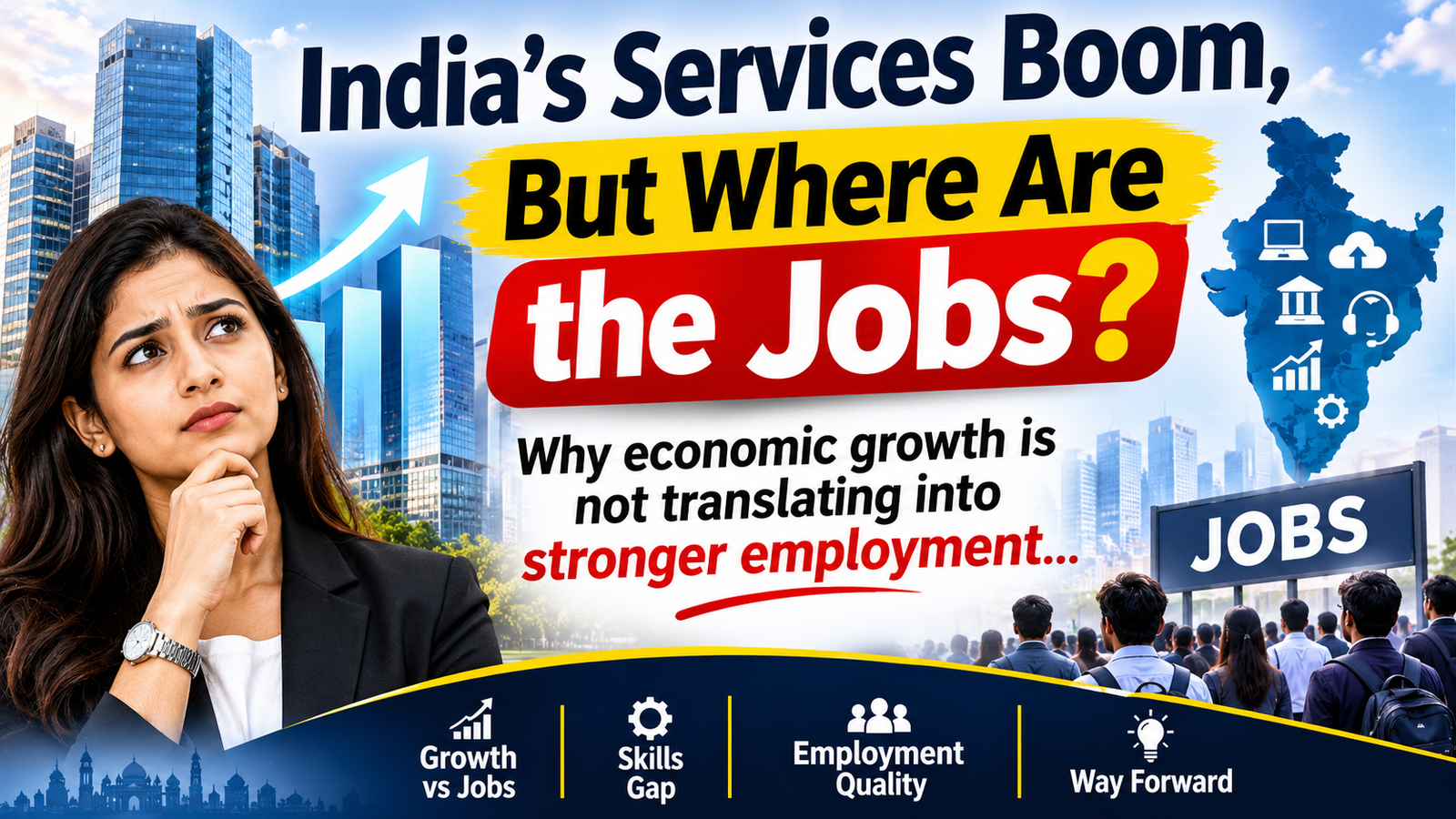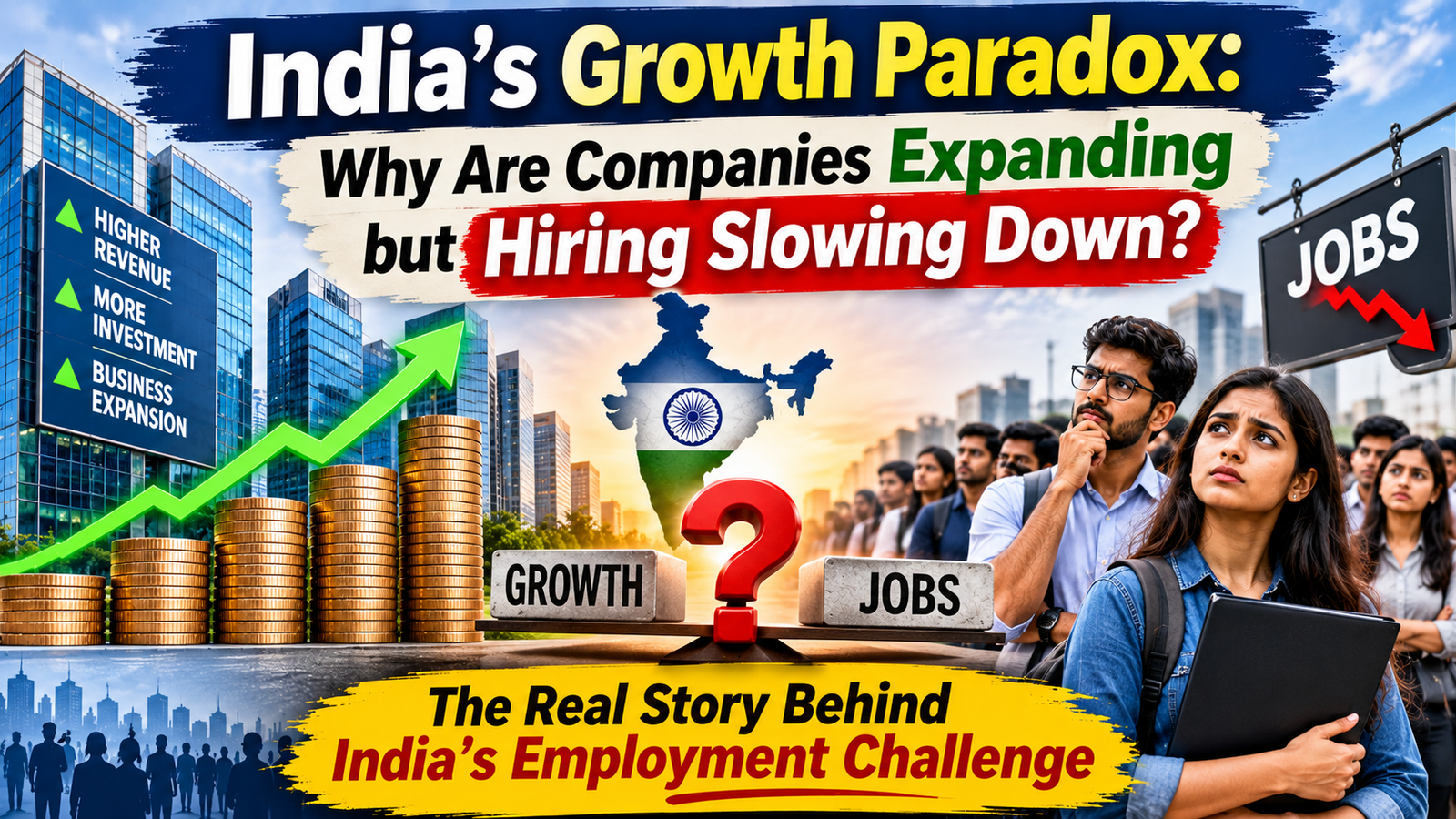
India’s economy is expanding, business activity is strengthening and companies are investing in technology and capacity. Yet corporate employment growth is losing momentum. The contradiction raises a critical question: if businesses are growing, why aren’t they creating jobs at the same pace?
The central finding: India’s problem is not simply a lack of economic growth. It is the changing relationship between growth, productivity and employment. Businesses can now increase output through technology, automation, outsourcing and better utilisation of existing employees. At the same time, skill mismatches, cautious corporate spending and uneven sectoral growth are making recruitment more selective.
The result is an economy in which business expansion and employment creation do not always move together.
1. The numbers behind the paradox
Two recent indicators illustrate the gap particularly clearly.
- Organised corporate employment: A Jefferies analysis of around 2,200 listed Indian companies, employing approximately 10.4 million people, found that employment growth slowed to 1.8% in FY26, from 2.7% in FY25. Only 54% of the companies expanded their workforces. The Financial Express+1
- Services-sector activity: The HSBC India Services PMI increased from 55.2 in September to 55.8 in October 2026, its highest reading in four months. However, services-sector hiring growth slowed to a four-month low.
The growth-versus-hiring gap
55.8
Services PMIOctober 2026; above 50 indicates expansion
1.8%
Corporate employment growthFY26; down from 2.7% in FY25
These figures measure different things and periods: the PMI is a monthly survey of business activity, while the employment figure is an annual analysis of listed companies. They illustrate the contrast, not a direct statistical comparison.
This distinction matters. A company can receive more orders, increase sales and improve production without immediately recruiting more employees.
However, slower hiring does not automatically mean widespread job losses. It may simply mean that companies are adding fewer employees than before.
2. The first major reason: productivity is replacing headcount growth
For decades, business expansion was closely associated with workforce expansion. A company opening a new branch, factory or office generally needed additional employees.
That relationship is changing.
Companies increasingly use technology and process improvements to increase output without proportionately increasing headcount. This is known as productivity-led growth.
Consider a simplified example:
| Business activity | Traditional approach | Technology-enabled approach |
|---|---|---|
| Accounting | Manual entries and reconciliations | Automated accounting systems |
| Customer support | Large call-centre teams | Chatbots and AI-assisted service |
| Banking | Branch-based processing | Digital banking platforms |
| Manufacturing | Labour-intensive processes | Automation and robotics |
| Reporting | Manual spreadsheet preparation | Integrated dashboards |
A business that previously required 100 employees to handle a particular volume of work may now handle more work with a smaller additional workforce.
This does not mean every automated task eliminates a job. Technology can also create new roles, increase demand and allow businesses to expand into new markets. But the transition can reduce recruitment for certain routine activities.
The economic implication: output can grow faster than employment when productivity rises.
This is one of the most important explanations behind the growth paradox.
3. Artificial intelligence: a changing recruitment equation
Artificial intelligence is becoming a workforce-planning issue rather than simply a technology investment.
Businesses are experimenting with AI in:
- Customer service and communication.
- Software development and testing.
- Financial analysis and reporting.
- Document processing and compliance.
- Market research and data management.
- Recruitment administration and back-office operations.
The immediate impact is not necessarily mass unemployment. A more visible change is the redesign of jobs.
For example, a finance department may use automated tools to process invoices, identify reconciliation differences and prepare preliminary reports. Employees may then spend more time reviewing exceptions, interpreting results and advising management.
This changes the skills employers value.
Routine execution becomes easier to automate, while judgement, controls, analytical ability and business understanding become more important.
The entry-level workforce may face a particular challenge. Junior positions have traditionally provided opportunities to learn through repetitive tasks. If those tasks become automated, companies must rethink how they train and develop fresh graduates.
AI can create employment in new areas, but there is no guarantee that new jobs will emerge in the same locations, at the same speed or for the same workers whose existing tasks are affected.
4. The IT sector: why technology growth is not translating into equivalent hiring
India’s IT industry is a useful example of this changing employment model.
The sector continues to benefit from cloud computing, cybersecurity, digital transformation, data analytics and AI-related services. Yet technology companies are becoming more cautious about adding employees.
According to the Jefferies analysis, employment growth among listed IT companies was only 0.8% in FY26.
Several factors explain this development.
First, clients are demanding greater efficiency. Businesses purchasing IT services increasingly expect faster delivery, lower costs and measurable productivity improvements.
Second, automation is changing project requirements. Software development, testing, documentation and support functions are increasingly supported by AI-based tools.
Third, companies are prioritising existing workforce utilisation. Rather than immediately recruiting new employees, businesses may retrain existing staff, move employees between projects or improve productivity.
Fourth, global uncertainty affects technology spending. Indian IT companies depend heavily on international clients. When overseas businesses postpone discretionary technology spending, recruitment plans in India can also be affected.
This does not mean India’s IT industry has stopped growing. It means revenue opportunities and workforce requirements are evolving differently.
5. Companies are expanding, but investment does not always create immediate jobs
Another important distinction is between capital-intensive and labour-intensive investment.
A company may invest heavily in:
- Automated manufacturing equipment.
- Data centres and cloud infrastructure.
- Advanced machinery.
- Digital platforms.
- Warehousing and logistics technology.
Such investment can increase productive capacity, but the number of employees required to operate that capacity may be relatively limited.
For example, a modern automated factory may require substantial investment in machinery, software and infrastructure while employing fewer production workers per unit of output than a traditional factory.
This is particularly relevant to India’s manufacturing ambitions.
The Economic Survey 2025–26 discusses the shift towards medium- and high-technology manufacturing and stronger integration into global value chains. These changes can improve competitiveness, but they also make workforce requirements more specialized.
The policy challenge is therefore not simply attracting investment. It is attracting investment that also generates sufficient employment across different skill levels.
6. The skills gap: vacancies and unemployed candidates can exist together
One of the most misunderstood aspects of India’s employment challenge is the difference between having a qualification and being ready for a particular job.
A company may need employees with practical experience in financial software, data analysis, automation, compliance or specialised engineering. However, applicants may have mostly theoretical knowledge.
This creates a skills mismatch.
Consider the finance and accounts industry:
| Traditional requirement | Increasingly valuable capability |
|---|---|
| Bookkeeping | Accounting systems and process automation |
| Preparing reports | Financial analysis and interpretation |
| Basic Excel | Advanced Excel and data handling |
| Tax compliance | Digital tax systems and regulatory knowledge |
| Manual reconciliation | ERP-based reconciliation and controls |
| Routine accounting | Business partnering and decision support |
The same pattern exists in manufacturing, logistics, marketing and customer service.
A qualification provides the foundation, but employers increasingly expect candidates to demonstrate how they can apply that knowledge.
The Economic Survey 2025–26 identifies skill development and employment quality as important priorities in India’s labour-market transition. India Budget+1
However, there is an important qualification: the skills gap should not become an excuse for employers to avoid training. Entry-level recruitment must provide opportunities for candidates to acquire practical experience.
7. The fresher employment paradox: companies want talent, but fewer want to train it
The entry-level job market reveals another dimension of the problem.
According to TeamLease EdTech’s Career Outlook Report for the second half of 2026, 75% of surveyed employers intended to hire freshers. However, hiring intentions varied significantly across industries.
The survey of 1,097 employers found:
| Industry | Fresher hiring intent, July–December 2026 |
|---|---|
| Retail | 93% |
| E-commerce and technology start-ups | 93% |
| Manufacturing | 89% |
| FMCG | 86% |
| Travel and hospitality | 81% |
| IT | 76% |
| Consulting | 19% |
| Educational services | 21% |
These are employer intentions, not the percentage of fresh graduates who actually secured jobs.
The findings reveal something important: entry-level recruitment is not declining uniformly. It is shifting between industries.
Manufacturing, retail and e-commerce are reporting stronger fresher hiring intentions, while several traditional white-collar recruitment categories are becoming more selective.
This suggests that the employment challenge is partly about where jobs are being created and whether candidates possess the skills required for those positions.
8. A sector-wise picture: not every industry is experiencing the same slowdown
The corporate employment analysis also reveals significant differences between industries.
| Sector | FY26 employment trend |
|---|---|
| IT | 0.8% growth |
| Financial services | 1.7% growth |
| Healthcare | Added approximately 37,000 jobs |
| Consumer discretionary | Added approximately 34,400 jobs |
These figures are from the Jefferies analysis of listed companies. They should not be interpreted as complete employment totals for the entire Indian economy.
The contrast is important.
Healthcare can require additional professionals as demand for medical services expands. Consumer-facing industries may recruit to support retail operations, distribution and customer demand.
Meanwhile, IT and financial services can increase output through technology, digital platforms and improved workforce productivity.
The lesson is that India’s employment market is becoming increasingly sector-specific. A slowdown in one industry does not necessarily mean that every industry is reducing recruitment.
9. The role of MSMEs: India’s missing employment multiplier
India’s large companies attract considerable attention because their investments and financial results are widely reported. However, smaller businesses are equally important to employment generation.
Micro, small and medium enterprises contribute to manufacturing, trading, services, logistics, repair work, food processing and local supply chains.
Unlike highly automated businesses, many MSMEs operate through labour-intensive processes and can create employment across smaller cities and towns.
But their ability to expand is affected by several constraints:
- Limited access to affordable and timely credit.
- Delayed payments from larger buyers.
- High compliance and operating costs.
- Limited access to modern technology.
- Difficulty attracting skilled employees.
- Inadequate infrastructure and market access.
The Economic Survey 2025–26 highlights the importance of firm growth, productivity and employment quality.
This creates a critical policy question: can India help smaller enterprises become larger, more productive and more employment-intensive businesses?
A country cannot depend only on a limited number of large corporations to absorb its expanding workforce.
10. Is India’s unemployment situation actually worsening?
A careful analysis must distinguish between corporate recruitment and the wider labour market.
The official Periodic Labour Force Survey provides a broader picture than listed-company employment figures.
According to the Ministry of Statistics and Programme Implementation’s PLFS Annual Report 2025:
- The unemployment rate among people aged 15 and above, using usual status, declined to 5.2% in 2025 from 5.6% in 2024.
- The unemployment rate among educated persons (secondary education and above) declined to 6.5% from 7.0%.
- The share of regular wage and salaried workers increased to 23.6% from 22.4%.
These indicators complicate the idea that India’s entire labour market is deteriorating.
At the same time, a lower unemployment rate does not necessarily mean that everyone has access to a suitable, stable or adequately paid job.
A person may be employed in informal work, self-employment or low-productivity activities while still seeking better employment.
Similarly, the unemployment rate does not capture all aspects of underemployment, job quality or the difficulty fresh graduates face in securing their first professional position.
Therefore, the real question is not only how many people are employed, but what kind of employment they have.
11. The hidden issue: India’s employment growth must be measured beyond corporate headcount
There are at least four different dimensions of employment that need to be examined together.
1. Quantity of jobs: How many new employment opportunities are being created?
2. Quality of jobs: Are these regular, secure and adequately paid positions?
3. Productivity: Does employment generate sufficient economic value and income?
4. Accessibility: Can young graduates, women, rural workers and people in smaller cities access these opportunities?
A business can increase productivity while employing fewer additional workers. A growing gig economy can create work opportunities without necessarily providing the income security of regular salaried employment.
The Economic Survey 2025–26 notes that India’s gig workforce expanded by 55% between FY21 and FY25. It also identifies challenges involving income volatility, social security and worker protection.
This demonstrates why employment growth should not be evaluated only through corporate payroll numbers.
12. What India needs to do: turning economic expansion into employment expansion
The solution is not to discourage automation or prevent companies from becoming more productive. Doing so could weaken India’s competitiveness.
Instead, India needs a development strategy that connects investment, technology and employment.
A. Encourage labour-intensive manufacturing
Textiles, apparel, footwear, food processing, furniture, tourism-related manufacturing and other labour-intensive industries can create opportunities for workers with different educational backgrounds.
B. Strengthen MSMEs
Affordable credit, faster payments, digital infrastructure, technology adoption and better market access can help smaller businesses expand their workforce.
C. Reform the transition from education to employment
Industry-linked training, apprenticeships, internships and practical projects can reduce the gap between academic qualifications and workplace requirements.
D. Make AI adoption workforce-inclusive
Companies should combine automation with reskilling and internal mobility. Employees whose routine tasks are automated should have pathways into higher-value responsibilities.
E. Expand employment beyond major metropolitan cities
Industrial clusters, logistics hubs, healthcare facilities and service-sector investment in Tier 2 and Tier 3 cities can make employment opportunities more geographically accessible.
F. Improve job quality
India must pay attention to stable incomes, social protection, workplace safety and career progression—not merely the number of people classified as employed.
13. The bigger economic question: Can India become a high-growth, high-employment economy?
India’s long-term economic ambition requires more than high GDP growth.
The country needs to improve productivity while creating sufficient employment for its large and evolving workforce.
This is a difficult balance.
If businesses grow through automation alone, productivity may improve without generating enough new jobs. If employment expands only through low-productivity activities, incomes and living standards may not rise sufficiently.
The objective should be to build an economy where technology creates new industries, manufacturing absorbs more workers, services generate higher-value employment and MSMEs provide opportunities across regions.
The next phase of India’s development will depend on how successfully it connects these objectives.
Conclusion: Corporate Growth Is Not Enough
India’s growth paradox is not evidence that economic expansion has become meaningless. It reveals that the benefits of growth do not automatically translate into employment.
Companies are becoming more productive, technology is changing job requirements, and recruitment is shifting across sectors. At the same time, skill mismatches, cautious hiring and uneven business expansion are making opportunities more difficult to access for certain groups of job seekers.
The challenge is particularly significant for young graduates entering the workforce, because the first professional opportunity often determines the direction of an entire career.
India must therefore move beyond measuring economic success only through investment, corporate revenue and GDP growth.
A successful economy must create value for businesses and opportunities for people.
The real test of India’s growth story will be whether its expanding companies can also build an expanding workforce.