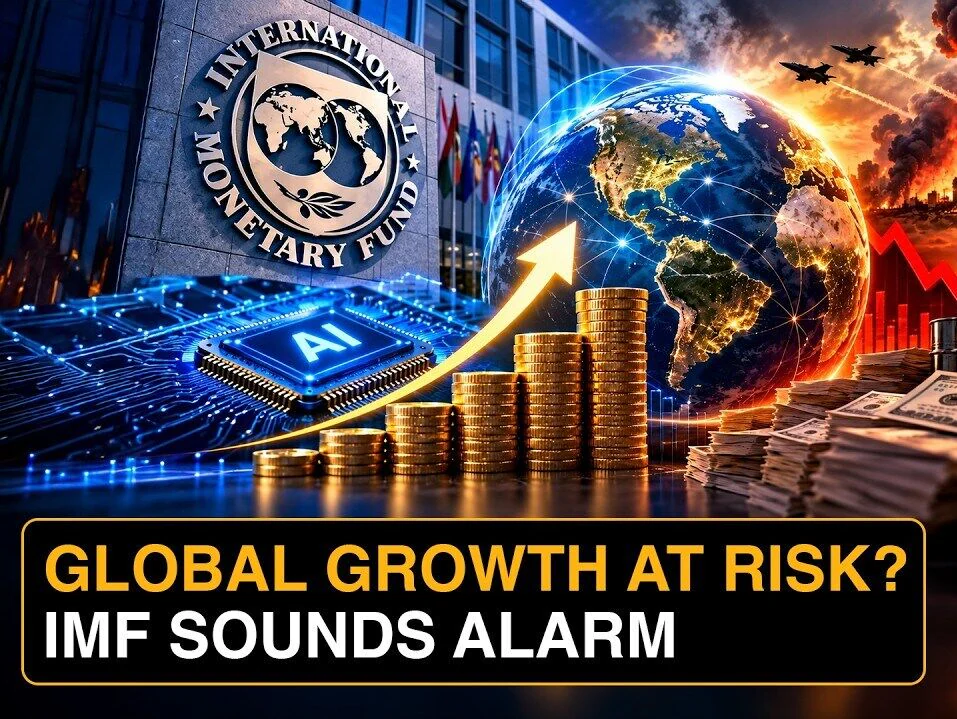
The International Monetary Fund expects the global economy to expand at a moderate pace in 2026 before gaining momentum in 2027. However, geopolitical tensions, elevated energy prices, inflationary pressures and financial uncertainty continue to threaten the recovery, creating an increasingly complex environment for governments, businesses and investors.
The global economy is demonstrating resilience despite facing repeated economic and geopolitical shocks. However, the pace of expansion remains moderate, and the recovery is becoming increasingly uneven across countries and regions.
According to the International Monetary Fund’s (IMF) October 2026 World Economic Outlook, global economic growth is projected to slow from 3.5% in 2025 to 3.1% in 2026 before improving to 3.4% in 2027. The forecast suggests that international economic activity will gradually strengthen, although significant risks remain.
The IMF’s assessment highlights two competing forces shaping the global economy. On one side, higher energy and commodity prices resulting from geopolitical conflict are increasing production costs and restricting economic activity. On the other, strong investment in artificial intelligence and technology infrastructure is supporting demand, trade and investment in several economies.
This combination means that the global economy is not simply slowing down or accelerating uniformly. Instead, growth is shifting between countries depending on their exposure to energy disruptions, international trade and technological investment.
Global Growth Remains Resilient but Uneven
The projected 3.1% growth rate in 2026 reflects the ability of businesses, financial institutions and governments to adapt to challenging international conditions.
However, economic performance differs significantly across advanced and developing economies. Countries with strong domestic demand, established financial systems and advanced technology industries may maintain relatively stable growth. In contrast, economies heavily dependent on imported energy and commodities face greater pressure.
The IMF identifies energy-importing economies outside the global technology value chain as particularly vulnerable. These countries may experience higher import costs without receiving the same benefits from expanding technology investment.
The outlook therefore highlights the importance of economic diversification, productivity improvements and stronger domestic investment in maintaining sustainable growth.
Inflation and Energy Prices Remain Major Risks
Inflation continues to be a central concern for policymakers. Although price pressures have moderated in some regions, rising energy and commodity costs are creating fresh challenges.
The IMF projects global headline inflation to increase to 4.7% in 2026 before easing to 4.1% in 2027. Higher oil, gas and food prices could place additional pressure on household purchasing power and business operating expenses.
Energy-market disruptions are particularly significant because they affect multiple sectors simultaneously. Transportation, manufacturing, agriculture and logistics all depend on reliable and affordable energy supplies.
For energy-importing countries, higher prices can increase import bills, weaken currencies and create pressure on government budgets. Businesses may respond by raising product prices, reducing operating expenses or postponing expansion plans.
Central banks consequently face difficult decisions. Maintaining higher interest rates may help control inflation, but it can also increase borrowing costs and slow investment. Policymakers must balance price stability with the need to support economic activity.
Geopolitical Tensions and Trade Uncertainty
Geopolitical developments remain among the most important downside risks to the global growth forecast.
Conflicts, trade restrictions, sanctions and strategic competition between major economies can disrupt international supply chains and weaken investor confidence. Prolonged instability in energy-producing regions can also increase commodity prices and create uncertainty in global financial markets.
The IMF’s October outlook identifies further escalation of conflicts, renewed trade tensions and fiscal vulnerabilities as important risks to economic stability.
International businesses are increasingly considering geopolitical exposure when making decisions about production, transportation and investment. Diversifying suppliers and establishing alternative supply routes can improve resilience, but these adjustments may increase costs.
A stable international trading environment will therefore be important for maintaining business confidence and supporting global economic expansion.
Artificial Intelligence Offers an Opportunity for Growth
While geopolitical and energy-related challenges are creating economic pressure, technological investment is providing an important source of momentum.
Artificial intelligence, automation, cloud computing and advanced digital infrastructure are attracting significant investment across major economies. These technologies have the potential to improve productivity, reduce operational costs and create new business opportunities.
The IMF identifies stronger AI-related investment and productivity improvements as possible upside factors for the global economy.
However, the benefits may not be distributed equally. Economies with advanced digital infrastructure, skilled workforces and strong research capabilities are better positioned to benefit from technological expansion.
Developing countries will need to improve digital connectivity, invest in education and encourage technology adoption to participate more fully in this transformation.
Emerging Economies Need Stronger Economic Resilience
Emerging markets face a particularly complicated economic environment. Higher energy prices, currency fluctuations and international borrowing costs can increase financial pressure on countries with significant external debt.
At the same time, expanding domestic consumption, infrastructure investment and digital services offer opportunities for long-term development.
Countries such as India can strengthen their economic position through infrastructure development, manufacturing expansion, energy diversification and investment in human capital. Maintaining stable public finances and attracting productive investment will also be important.
For developing economies more broadly, improving domestic production capabilities and reducing excessive dependence on imported essential commodities can help limit exposure to external shocks.
The Worldonomics Times View
The Worldonomics Times believes that the IMF’s growth projections reflect a global economy that remains resilient but faces increasingly complex structural challenges.
The improvement from 3.1% growth in 2026 to 3.4% in 2027 is encouraging, but it should not be interpreted as a guarantee of economic stability. Inflation, energy-market disruptions, geopolitical uncertainty and financial vulnerabilities could still affect the recovery.
Governments must prioritise economic resilience through responsible fiscal management, stable monetary policies, diversified energy supplies and investment in productive infrastructure. International cooperation will also be essential to maintain predictable trade relationships and prevent regional conflicts from creating wider economic disruptions.
Businesses should focus on operational efficiency, supply-chain diversification and technological innovation. Developing economies, meanwhile, must strengthen domestic capabilities and ensure that the benefits of global investment reach a wider section of their populations.
Ultimately, sustainable global growth will depend not only on economic forecasts but also on the ability of countries to respond effectively to uncertainty. The transition towards stronger growth in 2027 will require sound policymaking, responsible investment and cooperation across international markets.