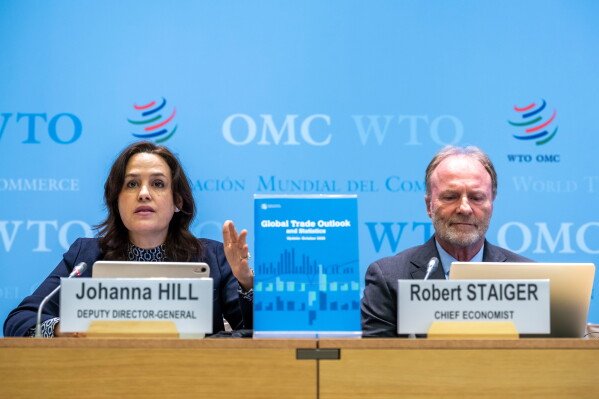
The World Trade Organization has raised its forecast for global merchandise trade growth to 3.9% in 2026, up from 1.9% previously. Strong demand for artificial intelligence-related products, semiconductors and data-centre equipment is helping international trade withstand geopolitical disruptions, although rising energy costs and weakness in services trade remain significant concerns.
Global trade has demonstrated unexpected resilience in 2026 despite the economic disruption caused by the ongoing Middle East conflict. While higher energy prices, shipping challenges and geopolitical uncertainty have affected international supply chains, strong demand for technology products has provided an important source of growth.
In its Global Trade Outlook and Statistics report released on October 8, 2026, the World Trade Organization (WTO) revised its forecast for global merchandise trade volume growth to 3.9% for 2026, compared with its earlier projection of 1.9% issued in March.
The organisation also expects merchandise trade to expand by 4.1% in 2027, provided geopolitical conditions improve and international supply chains remain functional.
The upward revision highlights an important development in the global economy: investment in artificial intelligence is becoming a major driver of international trade, helping offset some of the negative effects of geopolitical instability.
AI-Related Goods Become a Major Trade Driver
One of the strongest contributors to global merchandise trade growth has been the rapid expansion of artificial intelligence infrastructure.
Technology companies worldwide are investing heavily in advanced semiconductors, computer servers, networking equipment and data centres. These investments have increased demand for specialised products that are manufactured and traded across international markets.
According to the WTO, trade in AI-enabling goods increased by 67% year on year during the first half of 2026. These products accounted for approximately 47% of global merchandise trade growth by value during the same period.
The figures demonstrate how quickly AI-related investment is influencing international commerce.
Countries with established semiconductor industries and advanced technology manufacturing capabilities are benefiting from this demand. Major exporters of electronic components, computer hardware and industrial equipment are experiencing new opportunities as businesses expand their digital infrastructure.
However, the benefits are not evenly distributed. The WTO notes that trade in AI-enabling products remains geographically concentrated, with a relatively small number of economies accounting for a substantial share of global exports and imports.
Middle East Conflict Continues to Disrupt Supply Chains
Despite stronger merchandise trade, geopolitical tensions remain a major risk.
The Middle East is an important centre for international energy production and transportation. Disruptions to shipping routes, particularly around the Strait of Hormuz, have affected oil and liquefied natural gas supplies.
The WTO reported that Middle Eastern crude oil exports fell approximately 24% year on year during the first half of 2026, while liquefied natural gas exports declined by 47%.
However, increased shipments from alternative suppliers helped limit the decline in global exports. This adjustment demonstrates the ability of international supply chains to respond to sudden disruptions through alternative sourcing and transportation routes.
Fertiliser markets have also shown resilience. Importers have sought alternative suppliers to reduce the impact of disrupted shipments, helping prevent a more severe contraction in global availability.
Nevertheless, rerouting shipments and securing alternative supplies can increase transportation expenses, insurance premiums and delivery times.
Services Trade Faces a Different Challenge
While merchandise trade has exceeded expectations, the outlook for commercial services has weakened.
The WTO reduced its forecast for global commercial services trade growth in 2026 to 3.3%, compared with its earlier projection of 4.8%.
The Middle East conflict has affected international travel, tourism, shipping and transportation services. Higher aviation fuel costs and disruptions to established transport routes have increased operating expenses for airlines and logistics companies.
The organisation expects transport services to grow by just 0.9% and travel services by 0.2% in 2026.
This contrast between merchandise and services trade reveals an uneven recovery. Digital services, financial technology and computer-related exports continue to benefit from global digitalisation, while traditional transport and tourism businesses face greater difficulties.
The WTO expects commercial services trade growth to recover to 6.4% in 2027, assuming geopolitical conditions become more stable.
Asia Emerges as a Major Beneficiary
Regional trade performance is also expected to vary considerably.
Asia is projected to lead merchandise trade growth in 2026, with exports increasing by 9.9% and imports by 9.5%. The region’s position in semiconductor manufacturing, electronics production and technology supply chains provides a significant advantage.
Africa is also expected to record relatively strong growth, with merchandise imports projected to rise by 8.9% and exports by 5.6%.
By contrast, the Middle East is expected to experience a substantial contraction in merchandise trade, reflecting the direct impact of conflict and supply disruptions. Europe is also facing comparatively modest export growth.
For emerging economies, the expansion of AI-related trade offers opportunities to attract investment, develop manufacturing capabilities and strengthen participation in international supply chains.
However, countries without the necessary infrastructure, skilled workforce and technological capacity may struggle to benefit equally from this expansion.
Risks to the Global Trade Outlook
Despite the improved forecast, the WTO has warned that several risks could weaken trade growth.
A prolonged Middle East conflict could keep energy and fertiliser prices elevated, reducing household purchasing power and increasing production expenses. Higher shipping costs could also affect the competitiveness of exporters.
Another important risk is a slowdown in AI investment. Since technology-related goods have contributed significantly to merchandise trade growth, any reduction in spending on data centres, semiconductors and digital infrastructure could affect international trade volumes.
The organisation has also highlighted continuing differences in trade relationships between major economies, particularly between the United States and China. Changes in tariffs, export controls and supply-chain strategies could influence the future direction of global commerce.
The Worldonomics Times View
The WTO’s improved trade forecast demonstrates that international commerce remains more adaptable than many observers expected. Even amid geopolitical conflict, businesses and governments have found alternative suppliers, adjusted transportation routes and continued investing in strategic industries.
However, the strong performance of merchandise trade should not be interpreted as evidence that the global economy is free from risk. Much of the current momentum is concentrated in AI-related products, while traditional services, transportation and tourism remain under pressure.
The growing importance of artificial intelligence also raises questions about the distribution of economic opportunities. Countries that invest in digital infrastructure, semiconductor capabilities, education and technological innovation are likely to benefit more than economies that remain dependent on traditional exports.
Governments should therefore strengthen trade partnerships, diversify supply chains and support industries that can participate in emerging technology markets. Maintaining a predictable, rules-based international trading system will also be essential to preventing geopolitical disagreements from damaging global economic cooperation.
The Worldonomics Times believes that the resilience of global trade in 2026 is an encouraging sign, but its long-term strength will depend on more than the AI investment boom. Sustainable international commerce requires diversified economic opportunities, reliable supply chains and cooperation among trading nations.