By CA Sangam Kumar Aggarwal
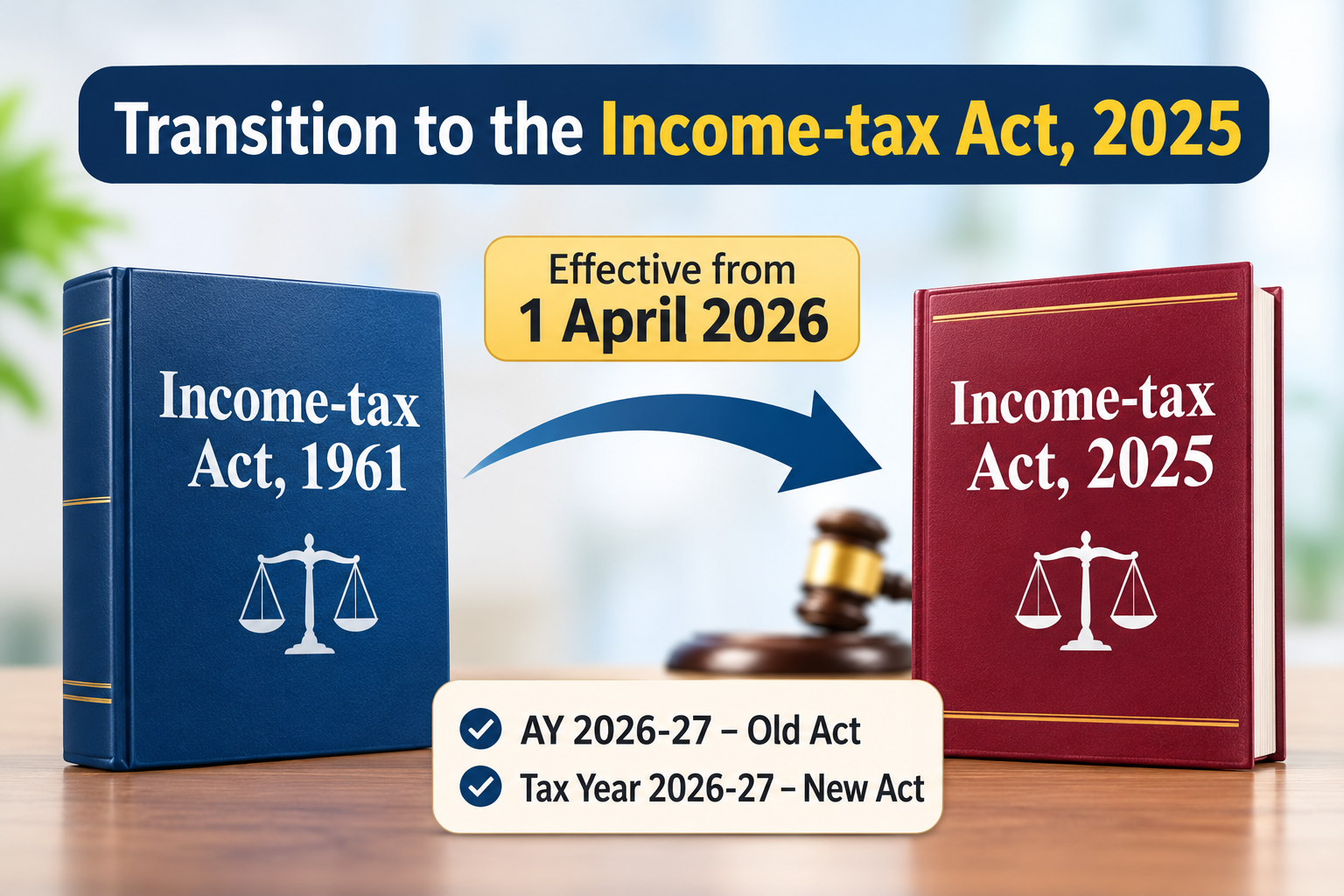
India’s direct tax administration has entered a new phase with the implementation of the Income-tax Act, 2025, with effect from 1 April 2026. One of the significant areas affected by this transition is Tax Deducted at Source (TDS) and Tax Collected at Source (TCS), which play an important role in ensuring timely tax collection, improving transparency and widening the tax base.
TDS and TCS are not merely procedural requirements; they are important instruments of tax administration. While TDS requires the payer to deduct tax before making specified payments, TCS requires the seller or specified person to collect tax from the buyer or another specified person on notified transactions. The new legislation seeks to simplify the framework, rationalise its presentation and make compliance more technology-driven.
1. Consolidation of TDS Provisions
Under the Income-tax Act, 1961, TDS provisions were spread across several sections, including Sections 192, 194C, 194H, 194-I, 194J, 194Q and others. The Income-tax Act, 2025 has consolidated these provisions into a simplified structure.
Section 392 primarily deals with TDS on salaries, while Section 393 covers TDS on other specified payments. Section 393 presents the applicable provisions in tabular form, identifying the nature of payment, monetary threshold, category of deductee and applicable rate.
An important point is that the restructuring does not, by itself, signify a fundamental change in tax policy. The Government has largely retained the existing TDS rates and monetary thresholds, while simplifying their presentation. Consequently, businesses must familiarise themselves with the new section references rather than assuming that the underlying withholding obligations have disappeared. Income Tax Department+1
2. TCS Provisions Under the New Act
Similarly, the provisions relating to Tax Collected at Source have been consolidated under Section 394 of the Income-tax Act, 2025. TCS continues to apply to specified transactions, including certain sales of goods, overseas remittances under the Liberalised Remittance Scheme (LRS), overseas tour packages and other notified transactions.
The responsibility of collecting tax at source remains with the prescribed seller or collector. Businesses engaged in such transactions must identify the applicable threshold, determine the correct rate and ensure timely deposit and reporting.
The revised statutory structure should encourage businesses to review their accounting systems, billing software and transaction-monitoring mechanisms to ensure that TCS is correctly identified and collected. Income Tax Department+1
3. Transition from the Old Act to the New Act: A Critical Compliance Issue
One of the most important aspects for deductors and collectors is determining which legislation applies to a particular transaction.
The governing principle is the date of the relevant triggering event. For ordinary TDS transactions, where tax is deductible at the earlier of credit or payment, the following distinction applies:
- Transactions where the earlier event occurred on or before 31 March 2026 will be governed by the Income-tax Act, 1961.
- Transactions where the earlier event occurs on or after 1 April 2026 will be governed by the Income-tax Act, 2025.
For example, if professional fees are credited in the books on 30 March 2026 but paid in April 2026, the provisions of the old Act will apply. However, professional fees credited on 5 April 2026 will attract the corresponding provisions of the new Act.
This distinction is equally important for TCS, where the applicable statutory trigger must be examined. Income Tax Department+2
4. Introduction of New Forms and Digital Compliance
The Income-tax Rules, 2026 have introduced revised forms and reporting procedures to align with the new legislation.
An important development is the introduction of Form No. 141, a consolidated challan-cum-statement replacing the earlier Forms 26QB, 26QC, 26QD and 26QE for specified transactions. These include TDS on property purchases, rent, certain contractor and professional payments by individuals/HUFs and virtual digital assets.
Further, Schedule E was introduced in Form 141 with effect from 1 October 2026 to facilitate reporting of specified immovable property transactions involving non-resident deductees.
Similarly, Form No. 138 has replaced Form 24Q for reporting TDS on salaries and specified senior-citizen income. Quarterly filing deadlines have been prescribed, with the fourth-quarter statement due by 31 May.
These changes demonstrate the Government’s intention to consolidate reporting mechanisms and improve digital tax administration. Income Tax Department+2
5. Timely Deposit, Returns and Consequences of Non-Compliance
Despite the restructuring, the fundamental compliance responsibilities remain significant. Deductors and collectors must ensure timely deduction or collection, deposit of tax, filing of prescribed statements and issuance of certificates.
Generally, TDS is required to be deposited by the seventh day of the following month, subject to prescribed exceptions. For non-government deductors, tax deducted in March is generally payable by 30 April. The corresponding challan-cum-statement cases have their own prescribed timelines.
Failure to comply may result in interest, fees, penalties and, in appropriate cases, prosecution. Further, Section 35(b) of the Income-tax Act, 2025 provides for disallowance of 30% of specified expenditure payable to residents where tax was deductible but not deducted or, after deduction, not deposited within the prescribed time.
Therefore, businesses must treat TDS and TCS compliance as an integral part of their monthly accounting and financial control systems. Income Tax Department+2
6. What Businesses and Tax Professionals Should Do
The transition calls for a proactive approach from companies, accountants, finance teams and tax professionals. Some essential steps include:
- Updating accounting software, ERP systems and payroll utilities with the new statutory references.
- Reviewing vendor masters, PAN details, residential status and applicable withholding rates.
- Mapping old TDS sections with the corresponding provisions and table serial numbers under the new Act.
- Reconciling TDS/TCS ledgers with challans, quarterly statements, AIS and Form 168, wherever applicable.
- Reviewing lower or nil deduction certificates and their validity.
- Ensuring that the applicable Act is correctly identified for transactions spanning March and April 2026.
Particular attention should also be given to transactions involving non-residents, contractors, professionals, property transfers and overseas remittances, where incorrect classification or reporting may create compliance complications.
Conclusion: Simplification Must Be Accompanied by Awareness
The Income-tax Act, 2025 represents an important step towards simplifying India’s direct tax framework. The consolidation of TDS and TCS provisions, introduction of revised forms and improved digital reporting mechanisms are expected to make compliance more structured and accessible.
However, simplification of legislation does not eliminate the responsibility of taxpayers and deductors to understand and implement the applicable provisions correctly. The success of the new framework will ultimately depend on awareness, timely compliance, technological readiness and effective professional guidance.
For businesses, the message is clear: the transition to the new tax regime is not merely a change in section numbers; it is an opportunity to strengthen tax governance and build a more disciplined compliance framework.