By CA Sangam Kumar Aggarwal
The Central Board of Direct Taxes (CBDT) has introduced an important regulatory framework governing the merger of registered charitable trusts and other non-profit organisations (NPOs) through the Income-tax (Eighth Amendment) Rules, 2026, notified vide Notification No. 139/2026 dated 30 October 2026.
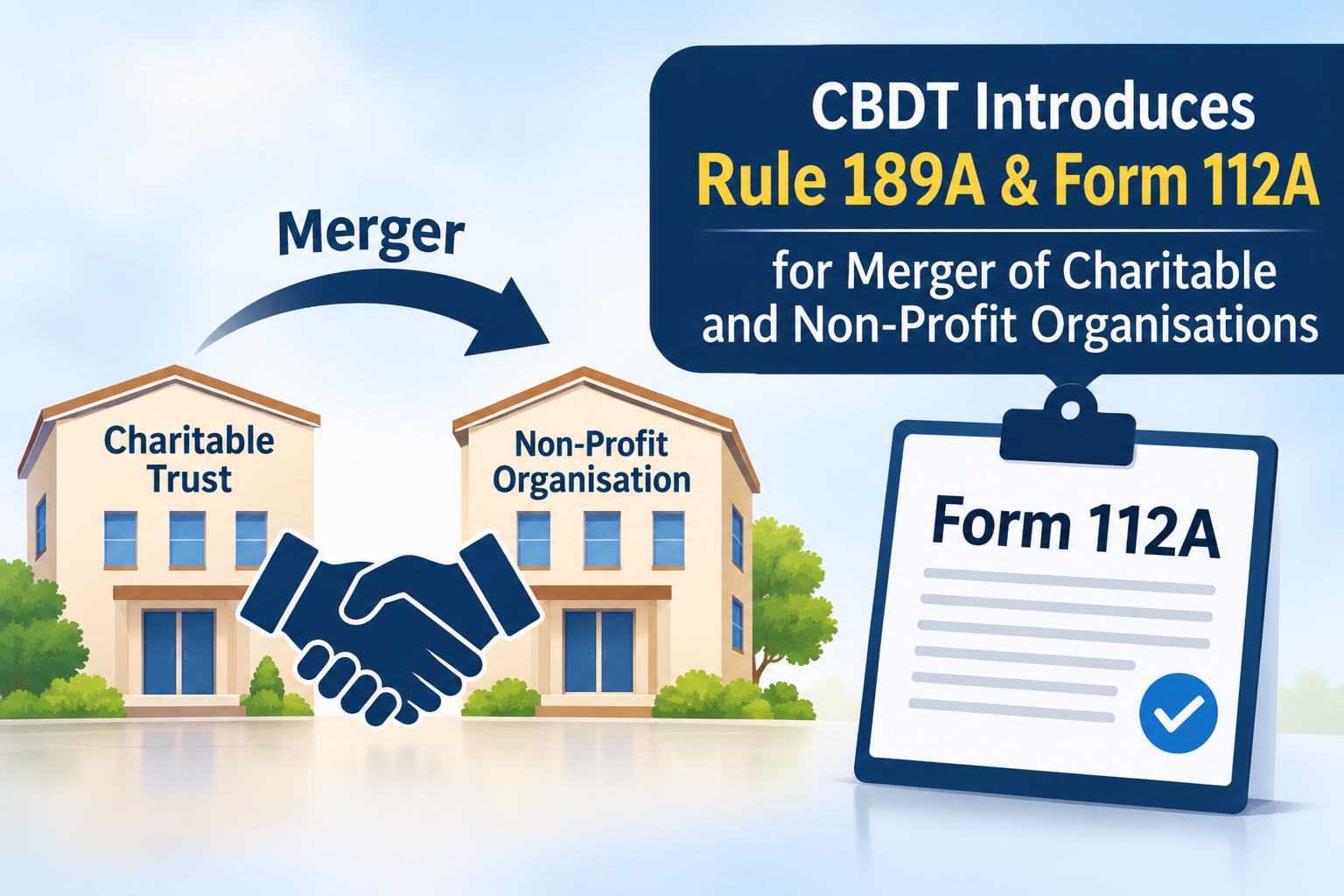
The amendment introduces Rule 189A and a new Form No. 112A under the Income-tax Rules, 2026. It prescribes specific conditions and compliance requirements for the merger of two registered non-profit organisations having the same or similar objects under the Income-tax Act, 2025.
This development is significant for charitable trusts, societies and other eligible non-profit organisations, as it provides a structured tax framework for consolidation while ensuring that charitable assets continue to be utilised for their intended purposes. Income Tax Department+2
1. Background and legislative framework
The newly introduced Rule 189A has been prescribed under Sections 352(4) and 354A of the Income-tax Act, 2025.
The objective is to ensure that a merger between registered non-profit organisations does not result in the diversion of charitable funds or assets for non-charitable purposes. It also establishes safeguards to ensure continuity of charitable activities and compliance with applicable tax obligations.
The amendment has come into force from the date of its publication in the Official Gazette, i.e., 30 October 2026. Gazette Tracker+1
2. Key conditions prescribed under Rule 189A
Rule 189A lays down several conditions that must be fulfilled for a merger to qualify under the prescribed framework:
A. Similar registration status: A regularly registered NPO cannot merge with a provisionally registered NPO, and vice versa. Both organisations must have the same category of registration under Section 332.
B. Outstanding tax demand: The merging organisation should not have any outstanding tax, interest, penalty, fine or other demand arising from an order, unless the demand is under appeal. Where an appeal is pending, the surviving organisation must discharge the liability if the appeal is ultimately decided against the merging organisation.
C. Continuity of charitable objectives: The objects of the surviving organisation cannot be amended for five years from the end of the financial year in which the merger takes place.
D. Transfer of assets and liabilities: All assets and liabilities of the merging organisation shall become the assets and liabilities of the surviving organisation from the effective date of merger.
E. No private benefit: The merger must not result in any direct or indirect benefit to related persons specified under Section 337(1) of the Act.
F. Continuation of tax obligations: The surviving organisation must undertake the tax-related obligations of the merging organisation, including application of income, utilisation of accumulated income, compliance with investment conditions and payment of additional income-tax wherever applicable. Gazette Tracker+1
3. Mandatory audit and transfer of tax liabilities
An important aspect of Rule 189A is that both the merging and surviving organisations are required to get their books of account audited by an accountant, as defined under Section 515(3)(b) of the Income-tax Act, 2025, as on the date of merger.
Further, the surviving organisation will assume responsibility for the tax history of the merging organisation. Any assessment, reassessment or other proceedings already initiated against the merging organisation shall be deemed to have been initiated against the surviving organisation.
Similarly, proceedings relating to the tax year in which the merger takes place (up to the date of merger), as well as earlier tax years, may be carried out against the surviving organisation. Gazette Tracker+1
4. Introduction of Form No. 112A – A new reporting requirement
To ensure proper reporting and documentation, CBDT has introduced Form No. 112A, titled Intimation for Merger of Registered Non-Profit Organisations.
The surviving organisation is required to furnish this form electronically before the jurisdictional Principal Commissioner or Commissioner of Income-tax.
The important filing requirements are:
- Due date: Within one month from the end of the month in which the merger becomes effective.
- Filing mode: Electronic filing.
- Verification: Digital Signature Certificate (DSC) or Electronic Verification Code (EVC).
- Responsibility: The surviving or merged non-profit organisation.
For example, if the merger takes effect on 15 December 2026, Form No. 112A must be furnished by 31 January 2027. Gazette Tracker+2
The form also requires supporting documentation, including:
- Trust deeds or constitutional documents of both organisations.
- Registration certificates of both organisations.
- Resolution passed by the trustees or governing bodies approving the merger.
- Audited books of accounts of both organisations as on the merger date and for the preceding financial year.
- A statement explaining the reasons for the merger.
5. Practical implications for charitable trusts and NPOs
The introduction of Rule 189A is an important step towards providing clarity and certainty in the tax treatment of mergers involving charitable organisations.
However, the surviving organisation must exercise due diligence before proceeding with a merger. It should examine the registration status, outstanding tax demands, accumulated income, utilisation of funds, investments and pending litigation of the merging organisation.
It is equally important to ensure that the merger does not result in any private benefit and that the charitable objectives remain unchanged for the prescribed five-year period.
Organisations should also remember that compliance with Rule 189A does not replace any separate approval or procedural requirements applicable under trust, society or company law.
6. Conclusion
The introduction of Rule 189A and Form No. 112A represents a significant development in the regulatory framework for charitable trusts and non-profit organisations under the Income-tax Act, 2025.
By prescribing clear eligibility conditions, audit requirements and post-merger reporting obligations, CBDT has provided a structured mechanism for the consolidation of organisations having similar charitable objectives.
While the framework may facilitate the consolidation of smaller charitable institutions and improve administrative efficiency, the surviving organisation must be prepared to assume the assets, liabilities and tax compliance responsibilities of the merging organisation.
For tax professionals, trustees and management of charitable institutions, understanding and complying with Rule 189A will be essential before undertaking any merger transaction.